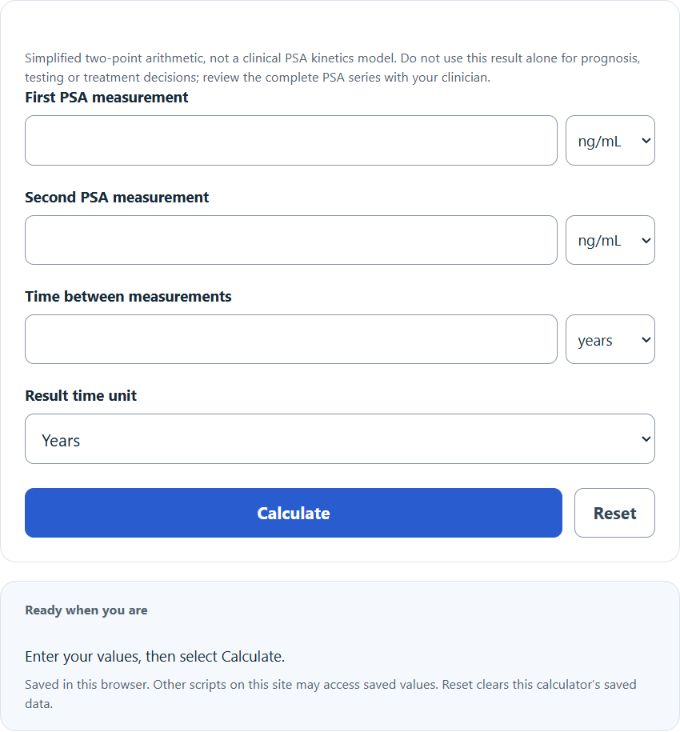
Estimate two-point PSA doubling time when PSA rises, or halving time when it falls, from two positive measurements and a positive time interval.
PSA Doubling Time Formula
For rising PSA, the following formula gives the simplified two-point doubling time:
Variables:
- DT is the PSA Doubling Time
- t is the time interval between the two PSA measurements
- P2 is the second PSA measurement
- P1 is the first PSA measurement
To calculate the PSA Doubling Time, multiply the time interval between the two PSA measurements by the natural logarithm of 2. Then divide the result by the natural logarithm of the ratio of the second PSA measurement to the first PSA measurement.
What is a PSA Doubling Time?
PSA doubling time describes exponential PSA growth over time. This calculator uses only two measurements, so it returns a simplified two-point estimate. Clinical or guideline-based PSA doubling time generally fits a line to the natural logarithm of at least three PSA measurements collected over time.
Do not assign a prognosis or make testing or treatment decisions from this two-point value alone. If the second PSA is lower than the first, the calculator reports a positive halving time; if the values are equal, doubling time is not finite. Review PSA kinetics with the treating clinician and the complete series of measurements.
How to Calculate PSA Doubling Time?
The following steps outline how to calculate the PSA Doubling Time.
- First, determine the initial PSA level (PSA1).
- Next, determine the final PSA level (PSA2).
- Next, calculate the ratio of the final to initial PSA levels (PSA2 / PSA1).
- Finally, calculate PSA Doubling Time using DT = t × ln(2) / ln(PSA2/PSA1), where t is the time interval between the two measurements (DT will be in the same time units as t).
- After inserting the variables and calculating the result, check your answer with the calculator above.
Example Problem:
Use the following variables as an example problem to test your knowledge.
Initial PSA level (PSA1) = 4.5 ng/mL
Final PSA level (PSA2) = 9.2 ng/mL
Time interval between the two PSA measurements = 6 months. The two-point doubling time is approximately 5.82 months. The calculator uses 12 months and 365.2425 days per average year.