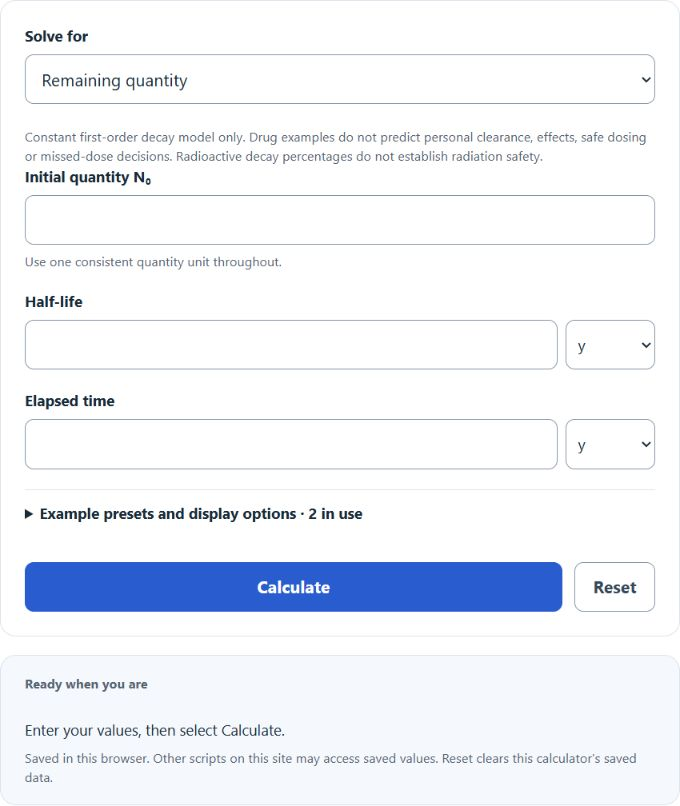
Calculate half-life, remaining quantity, initial amount, elapsed time, or the time to reach any target level for radioactive isotopes and drugs.
Half Life Formula
Every mode rearranges the constant first-order decay equation described in OpenStax’s half-life lesson. Presets use approximate IAEA/ENSDF reference data, with the conventional textbook carbon-14 example, and explicitly qualified parent-drug label examples. The remaining quantity after a given time is:
Solving that equation for the half-life gives:
Solving for the elapsed time gives:
Solving for the initial quantity gives:
The time needed to fall to a chosen percentage P of the starting amount is:
The decay constant and the mean lifetime come from the half-life directly:
- N = quantity remaining after time t (grams, atoms, mg, counts per minute, or percent)
- N0 = initial quantity, in the same unit as N
- t = elapsed time
- T = half-life, the time for the quantity to fall by half
- P = target percentage of the original amount still present
- lambda = instantaneous fractional decay-rate constant, in inverse time units
- tau = mean lifetime, the average survival time of one particle
- ln = natural logarithm
The five solve-for modes map onto those formulas. Remaining quantity uses the first equation and needs the starting amount, the half-life, and the elapsed time. Half-life uses the second equation and needs two measurements of the same sample plus the time between them. Elapsed time uses the third equation and is the mode used for radiometric dating, since it converts a measured ratio N/N0 into an age. Initial quantity uses the fourth equation and works backward from what is left today. Time to reach a target level uses the fifth equation and answers the practical question of how long until only 10 percent, 1 percent, or some specific amount is left. The quantity ratio controls elapsed-time and half-life inference, while remaining and initial quantity outputs also depend on the supplied absolute amount. Use the same unit for both quantities.
Decay Progress and Model Threshold Times
The first table shows mathematical fractions after selected half-lives. Positive exponential decay approaches zero without reaching it. A measurement threshold depends on the starting amount and measurement method; safety or clinical decisions require separate evidence.
| Half-lives elapsed | Fraction left | Percent left | Percent decayed | Common interpretation |
|---|---|---|---|---|
| 1 | 1/2 | 50% | 50% | 50% remains in this mathematical model |
| 2 | 1/4 | 25% | 75% | 25% remains in this mathematical model |
| 3 | 1/8 | 12.5% | 87.5% | 12.5% remains; effects are not inferred |
| 4 | 1/16 | 6.25% | 93.75% | 6.25% remains; repeated doses are not modeled |
| 5 | 1/32 | 3.125% | 96.875% | 3.125% remains; not a clearance decision |
| 6.643856… | 1/100 | 1% | 99% | A chosen mathematical fraction, not a safety threshold |
| 7 | 1/128 | 0.78% | 99.22% | Detectability depends on the method and starting amount |
| 9.965784… | 1/1000 | 0.1% | 99.9% | Nonzero amount remains in the model |
| 20 | 1/1,048,576 | 0.000095% | >99.9999% | Measurement limits are instrument and sample dependent |
The second table pairs approximate illustrative half-lives with model times to 1% remaining (about 6.643856 half-lives). These are not clearance or safety times. Dating applications also depend on the initial ratio, sample history, uncertainty and calibration; the model time alone is not a calibrated calendar age.
| Substance | Half-life | Time to 1% left | Practical working range or use |
|---|---|---|---|
| Fluorine-18 | 109.8 minutes | 12.2 hours | PET tracer, must be used within hours of production |
| Technetium-99m | 6.01 hours | 1.7 days | Physical decay example; biological retention and clinical instructions differ |
| Radon-222 | 3.82 days | 25.4 days | Indoor air testing over 2 to 7 day windows |
| Iodine-131 | 8.0252 days | 53 days | Physical-decay example; clinical precautions require separate professional instructions |
| Cobalt-60 | 5.27 years | 35 years | Sterilization sources replaced every few years |
| Cesium-137 | 30.08 years | 200 years | Dominant contaminant after reactor accidents |
| Carbon-14 | 5,730 years | 38,000 years | Dating organic material from about 300 to 50,000 years |
| Plutonium-239 | 24,110 years | 160,000 years | Long term waste isolation planning |
| Potassium-40 | 1.248 billion years | 8.3 billion years | Potassium-argon dating from 100,000 years upward |
| Uranium-238 | 4.468 billion years | 29.7 billion years | Dating rocks and meteorites over billions of years |
| Caffeine | about 5 hours | 33 hours | Varies 2 to 10 hours with liver enzyme activity |
| Ibuprofen | about 2 hours | 13 hours | Illustrative parent-drug elimination; does not determine dosing |
| Fluoxetine | about 4 days | 27 days | Illustrative chronic parent-drug value; active metabolites can persist longer |
Biological elimination half-lives vary with the drug, formulation, population, organ function, repeated use and interactions. Presets are editable examples for parent compounds; they omit absorption, distribution and active metabolites. For example, fluoxetine’s chronic parent-drug half-life is about 4–6 days while norfluoxetine can persist longer; the 4-day preset is an illustration at the lower end. Diazepam’s 48-hour example is an upper-end parent-drug label value, not a typical personal estimate. Follow product directions and professional advice for medicine decisions.
Example Problems
Example 1: dating a sample with carbon-14. A bone fragment contains 25 units of carbon-14 for every 100 units expected in a living sample of the same size. The half-life of carbon-14 is 5,730 years. Set the mode to elapsed time, enter an initial quantity of 100, a remaining quantity of 25, and select the carbon-14 preset.
t = 5730 * ln(100 / 25) / ln(2) = 5730 * 1.3863 / 0.6931 = 11,460 years
The ratio is one quarter, so two model half-lives have passed. With the illustrative textbook 5,730-year value, the uncalibrated model time is 11,460 years. It is not a calibrated radiocarbon calendar age.
Example 2: how long until caffeine drops to a target level. You drink 200 mg of caffeine and want to know when only 25 mg is left, using a 5-hour half-life. Set the mode to time to reach a target level, choose a specific remaining amount, enter 200 as the initial quantity and 25 as the target.
t = 5 * ln(200 / 25) / ln(2) = 5 * 2.0794 / 0.6931 = 15 hours
Under the supplied idealized 5-hour model, three half-lives leave 25 mg from 200 mg after 15 hours. A 1% target is 2 mg and takes about 33.22 hours. This does not predict an individual’s caffeine level, sleep effects or safety.
Frequently Asked Questions
How many half-lives until a substance is completely gone?
The continuous exponential model never reaches exactly zero. Five half-lives leave 3.125%, about 6.643856 half-lives leave 1%, and about 9.965784 half-lives leave 0.1%. None of these fractions alone establishes drug clearance, safe dosing, radiation safety or a detection limit. Enter a positive target threshold to calculate its model time; 100% takes zero time.
What is the difference between half-life, decay constant, and mean lifetime?
They describe the same decay at different angles. The half-life T is the time for the amount to fall by half. The decay constant lambda = ln(2) / T is the fraction of the remaining material that decays per unit time, and it is the quantity that appears in the equation N = N0 * e^(-lambda * t). The mean lifetime tau = T / ln(2) is the average time an individual atom survives, and it is always about 1.4427 times the half-life, or the time it takes to fall to about 36.8 percent of the original amount. The calculator reports all three from whichever one you supply.
Does temperature, pressure, or sample size change the half-life?
For radioactive decay, no. The half-life is a property of the nucleus itself and is unaffected by temperature, pressure, chemical bonding, or how much material you have, which is what makes radiometric dating reliable. The only meaningful exceptions are a few electron-capture isotopes where extreme chemical or pressure environments shift the rate by a fraction of a percent. Biological half-lives are different: they describe elimination by the liver and kidneys, so they vary between people and can change with dose, illness, age, and drug interactions.