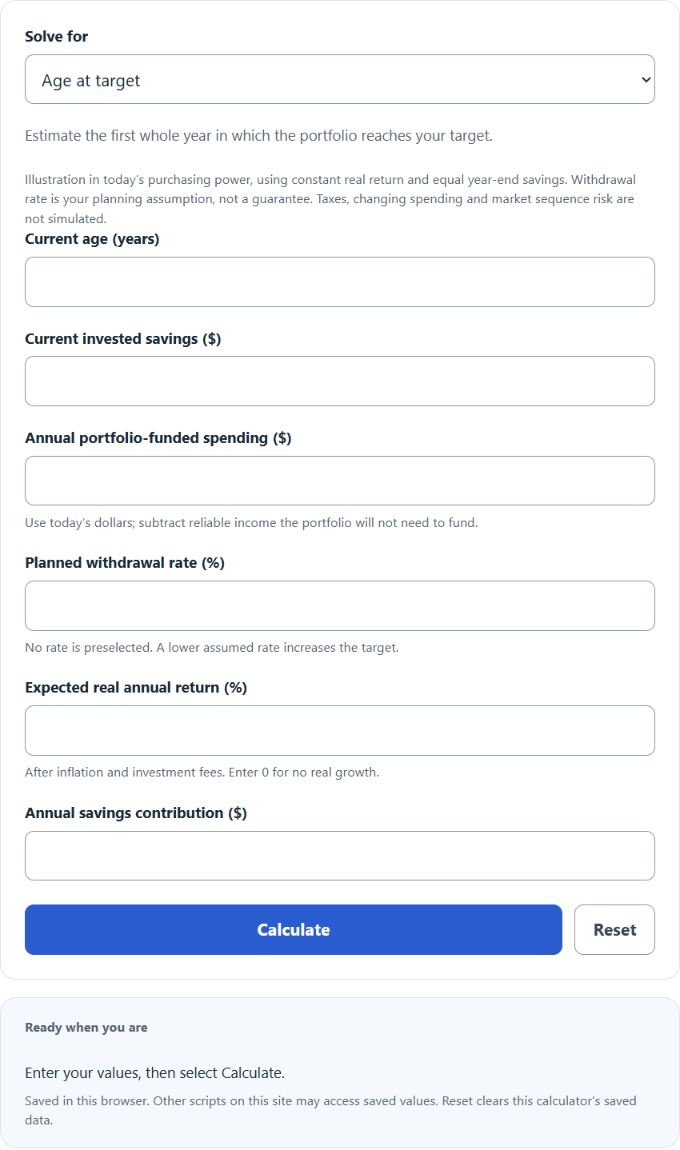
Use the FIRE Calculator to estimate your financial independence number, FIRE age, years to target, or annual savings needed by a chosen age and spending goal.
FIRE Calculator Formula
This model’s portfolio target is annual portfolio-funded spending divided by the planned withdrawal rate. Reaching that arithmetic target does not establish a safe retirement date or guarantee that funds will last.
The target is:
FIRE\ Number=Annual\ Spending/Withdrawal\ Rate
With equal contributions at each year end, savings at a whole-year checkpoint are projected with:
B_n=B_0(1+r)^n+C*((1+r)^n-1)/r
Variables:
- B0 is current savings
- Bn is the future balance
- r is real annual return
- C is annual savings
- n is years
Estimated-age mode reports the first whole-year checkpoint reaching the FIRE number, up to 100 years from now. Contribution-needed mode uses the same year-end schedule. At a fractional deadline, only deposits already made by that date are counted and grown to the deadline; at zero return the contribution factor equals the number of completed deposits.
Using a real return keeps spending and balances in today’s purchasing power.
A lower withdrawal rate creates a larger target and more margin for a long retirement.
FIRE Number by Spending
The withdrawal rate strongly affects the portfolio target.
| Annual spending | 4.0% | 3.5% | 3.0% |
|---|---|---|---|
| $40,000 | $1,000,000 | $1,142,857 | $1,333,333 |
| $60,000 | $1,500,000 | $1,714,286 | $2,000,000 |
| $80,000 | $2,000,000 | $2,285,714 | $2,666,667 |
| $100,000 | $2,500,000 | $2,857,143 | $3,333,333 |
Example Problems
Example 1: Estimate a FIRE age.
At current age 32, with $150,000 invested, $30,000 saved at each year end, a 5 percent real return, $60,000 spending, and a 4 percent assumed withdrawal rate, the target is $1.5 million. The first whole-year crossing is 22 years later, at age 54: the balance is about $1,593,945.54, versus $1,489,471.94 one year earlier.
Example 2: Solve for savings.
Using those same assumptions and a target age of 45, current savings grow for 13 years. Dividing the remaining gap by the year-end contribution factor gives about $68,715.28 per year ($5,726.27 per month as a budgeting equivalent). The monthly figure does not simulate monthly deposits; displayed dollars are rounded while projections use unrounded values.
Frequently Asked Questions
What spending should I include?
Include the recurring expenses the portfolio must support after subtracting reliable pension or Social Security income.
What return should I use?
Use a conservative real return that reflects inflation, fees, and your expected asset allocation.
Is the FIRE number a guarantee?
No. Longevity, market sequence, taxes, and spending changes can produce a different outcome.