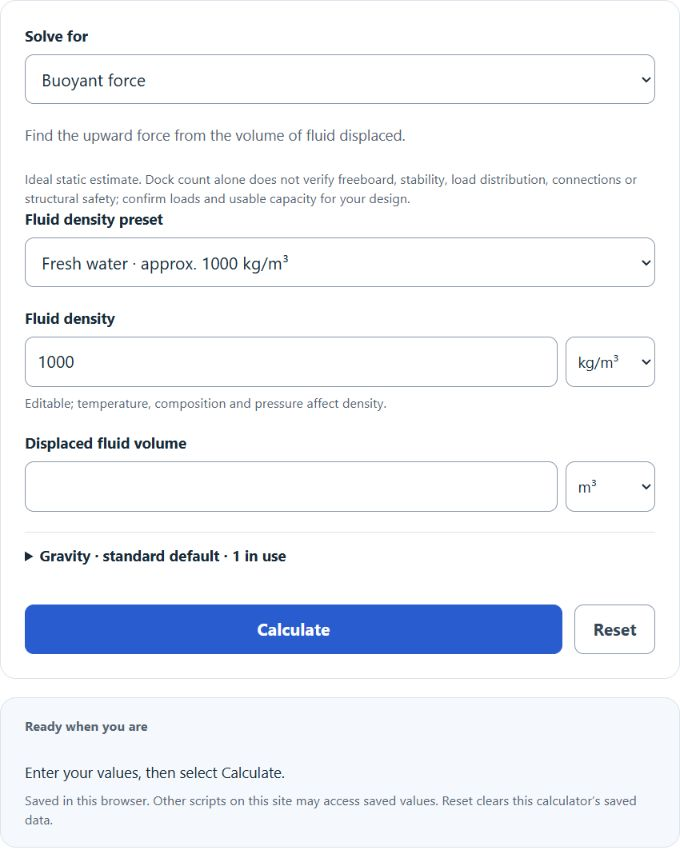
Calculate buoyant force, sink-or-float status, or dock float count from fluid density, volume, mass, and load in fresh water, seawater, or air.
Related Calculators
- Force Of Moving Water Calculator
- Pressure Volume Energy Calculator
- Orifice Beta Ratio Calculator
- Pitot Tube Calculator
- All Physics Calculators
Float Weight Formula
The calculator uses three formulas, one per selected mode.
Buoyant force mode. Archimedes' principle gives the upward force on a submerged or partly submerged object.
- B = buoyant force (N)
- ρ = fluid density (kg/m³)
- V = submerged or displaced volume (m³)
- g = gravitational acceleration; standard gravity is 9.80665 m/s²
Inputs are converted to SI before the math runs. The result is shown in newtons, pounds-force, and kilograms-force. The displaced fluid mass equals ρ × V.
Sink or float mode. The object floats when its average density is less than the fluid density.
- m = object mass (kg)
- V = total object volume (m³)
- ρ_object = average object density (kg/m³)
- ρ_fluid = fluid density (kg/m³)
- f_submerged = fraction of volume below the surface at equilibrium
If f_submerged is less than 1, the object floats and that fraction sits below the waterline. If it is greater than 1, the object sinks. The tool also reports the net upward force at full submersion, which is (ρ_fluid − ρ_object) × V × g.
Dock float count mode. The number of floats needed is the required buoyancy divided by the capacity per float, rounded up.
- L = dock length (ft)
- W = dock width (ft)
- q = required buoyancy per square foot (lb/ft²)
- C = buoyancy capacity of one float (lb)
- N = number of floats
Enter the design buoyancy requirement including dead load, live load and required reserve. The 28, 31 and 35 lbf/ft² source scenarios are illustrative, not verified load ratings for your dock. Use manufacturer usable capacity at the intended immersion and confirm stability and structural design separately.
Reference Tables
Density values below are approximate and vary with conditions. Float dimensions alone do not establish usable capacity; obtain a current manufacturer rating for the exact model and intended immersion. The listed float capacities are illustrative source examples, not product ratings.
| Fluid | Density (kg/m³) | Density (lb/ft³) |
|---|---|---|
| Fresh water (4 °C) | 1000 | 62.4 |
| Seawater | 1025 | 64.0 |
| Gasoline | 740 | 46.2 |
| Engine oil (SAE 30) | 900 | 56.2 |
| Air at sea level | 1.225 | 0.0765 |
| Common dock float size | Approx. buoyancy (lb) | Typical use |
|---|---|---|
| 12 × 24 × 36 in | 325 | Light walkways |
| 12 × 36 × 48 in | 645 | Residential dock |
| 16 × 36 × 48 in | 860 | Heavier residential |
| 20 × 48 × 96 in | 2300 | Boat lifts, commercial |
Worked Examples
Example 1: Buoyant force on a sealed barrel. A 55-gallon drum is fully submerged in fresh water. Volume = 55 gal = 0.2082 m³. ρ = 1000 kg/m³. g = 9.80665 m/s².
Using 55 US liquid gallons = 0.20819764812 m³, B ≈ 2041.72 N, or 459 lbf. Its total downward force must exceed this buoyancy to sink; this assumes a sealed rigid drum.
Example 2: Will a block of oak float in water? Mass = 5 kg, volume = 7 L = 0.007 m³. Object density = 5 / 0.007 = 714 kg/m³. Fluid density = 1000 kg/m³. f_submerged = 0.714, so the block floats with about 71% of its volume below the surface.
Example 3: Floats for a 6 ft by 20 ft dock. Area = 120 ft². Using 28 lb/ft², required buoyancy = 3360 lb. With 645 lb floats, N = ceil(3360 / 645) = 6 floats. Supplied buoyancy = 3870 lb, reserve = 510 lb (about 15%).
FAQ
What weight do I need for an object to sink? The object plus any added ballast must weigh more than the buoyant force B = ρ × V × g, where V is the volume of the object underwater. Run the buoyant force mode to get that number, then make sure your total weight exceeds it.
Why is submerged volume unavailable for an object that sinks? It would need to displace more than its total volume. The tool reports "Sinks" and does not label a capped 100% value as a floating equilibrium.
Should I use 28 lb/ft² or a higher number for my dock? The retained 28, 31 and 35 lbf/ft² scenarios do not establish a safe design load. Use project-specific dead load, live load and required reserve, along with the float manufacturer’s usable buoyancy and design guidance.
Does salt water change the answer much? Seawater is about 2.5% denser than fresh water, so buoyant force and float capacity rise by roughly 2.5% in salt. For dock sizing this is small but meaningful at the margin.
Why is gravity an input? So the buoyant force mode works on other planets, in centrifuges, or with non-standard g values used in physics problems. Leave it at 9.80665 m/s² for normal Earth conditions.