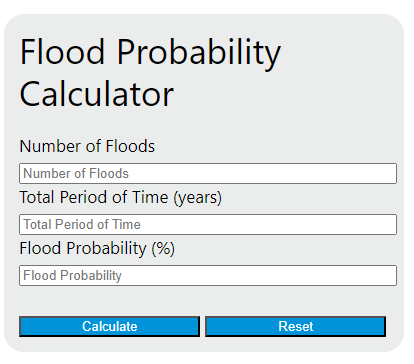
Calculate flood probability from the number of floods and time period, or solve for missing floods or duration using years, months, or days.
- All Construction Calculators
- Standardized Precipitation Index Calculator
- Gpm To Precipitation Rate Calculator
Flood Probability Formula
The following formula is used to estimate the annual probability of at least one flood, assuming floods occur as random events with a constant average rate (a Poisson process).
Variables:
- FP is the estimated annual flood probability (%) of at least one flood
- NF is the number of floods observed during the time period
- TP is the total observation period (usually in years)
First compute the average flood rate, λ = NF / TP (floods per year). Under the Poisson assumption, the annual probability of at least one flood is FP = (1 − e−λ) × 100. For small rates (λ ≪ 1), a common approximation is FP ≈ (NF / TP) × 100, but it can overestimate the probability as λ increases.
What is a Flood Probability?
Flood probability refers to the statistical likelihood of a flood occurring in a specific area within a certain time period. It is often expressed as an annual probability (annual exceedance probability), such as a "1 in 100" chance, indicating about a 1% chance of a flood occurring in any given year. These probabilities are used to inform flood risk assessments, urban planning, and insurance policies.
How to Calculate Flood Probability?
The following steps outline how to calculate the Flood Probability.
- First, determine the number of floods that occurred during the historical observation period (NF).
- Next, determine the total observation period (TP), usually in years.
- Compute the average flood rate λ = NF / TP (in floods per year).
- Use the formula FP = (1 − e−λ) × 100 to estimate the annual flood probability.
- After calculating the result, check your answer with the calculator above.
Example Problem:
Use the following variables as an example problem to test your knowledge.
Number of floods (NF) = 5
Total period of time (TP) = 10 years
For the example above, λ = NF / TP = 5 / 10 = 0.5 floods/year, so FP = (1 − e−0.5) × 100 ≈ 39.35%.