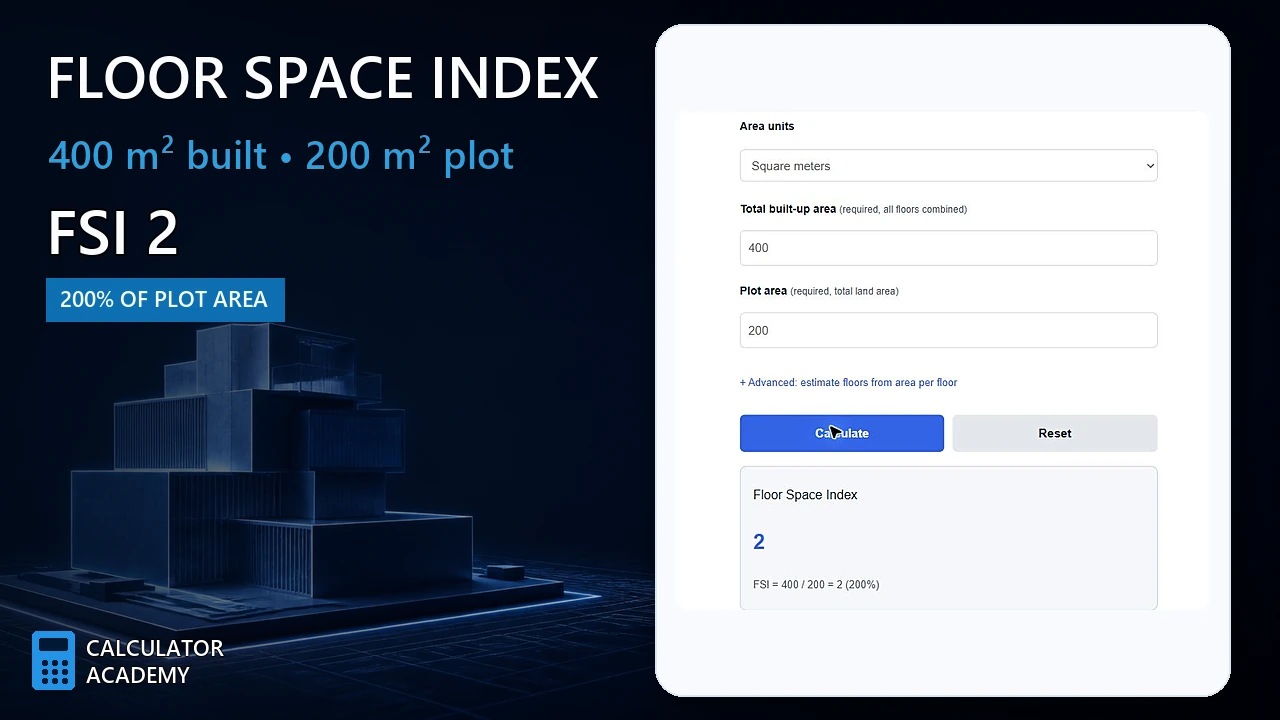
Calculate Floor Space Index, total floor area, or plot area from any two values in sq ft, sq m, or sq yd units with the third value filled in.
- All Construction Calculators
- Gross Floor Area Calculator
- Floor to Area Ratio Calculator
- Land to Building Ratio Calculator
Floor Space Index Formula
- FSI = Floor Space Index (dimensionless ratio)
- TFA = Total Floor Area across all floors (sq ft or sq m)
- TA = Total Area of the plot (sq ft or sq m)
FSI is a dimensionless ratio. An FSI of 2.0 on a 10,000 sq ft plot permits a maximum of 20,000 sq ft of total floor area, which could be achieved as a 4-story building covering 50% of the plot, a 2-story building covering the full plot, or any equivalent combination.
What is a Floor Space Index?
Floor Space Index (FSI), also called Floor Area Ratio (FAR) in the United States and Plot Ratio in some Commonwealth countries, is the primary regulatory lever municipalities use to control urban density. It answers one question: how much building mass is allowed per unit of land? A higher FSI permits taller or larger buildings; a lower FSI enforces low-rise, less dense development.
FSI does not directly specify building height. Two plots can share the same FSI yet produce very different buildings: one could be a slender tower covering a small footprint, another a low podium covering the full lot. Height limits and setback rules typically work alongside FSI to shape the final built form.
Global FSI Benchmarks by City
FSI limits vary dramatically across the world, reflecting differences in land scarcity, infrastructure capacity, and planning philosophy.
| City / Zone | Typical FSI Range | Notes |
|---|---|---|
| New York City (CBD) | 15 (up to 25 pre-1961) | Empire State Building FAR ~25 |
| Singapore (city-wide) | 8 to 25 | 88% homeownership; high-transit model |
| Hong Kong (urban) | 12+ | >90% public transit usage |
| Mumbai (residential) | 1.33 base; up to 3.0 | Higher FSI along Metro corridors |
| Mumbai (commercial) | up to 5.0 | Recent upward revision for commercial zones |
| Delhi (Master Plan) | 1.2 to 3.5 | Per Delhi Master Plan 2021 |
| Bangalore (residential) | 1.75 to 3.35 | Varies by road width and zone |
The gap between Indian metros (~1.3 to 3.5) and cities like Singapore or New York (8 to 25) is directly correlated with land prices, housing affordability, and vertical growth. Indian cities with constrained FSI have faced compounding housing shortages as populations grow but building density cannot keep pace.
FSI by Zone Type
| Zone Type | Typical FSI | Rationale |
|---|---|---|
| Low-density residential | 0.5 to 1.0 | Preserves open space; suburban character |
| Medium-density residential | 1.0 to 2.5 | Apartment blocks; walkable neighborhoods |
| Commercial / mixed-use | 2.0 to 5.0 | Higher economic activity density |
| Transit-oriented development | 3.0 to 8.0+ | Maximizes ridership catchment near stations |
| Central business district | 5.0 to 25+ | Maximum land value extraction; high infrastructure capacity |
| Industrial | 0.5 to 1.5 | Large footprint single-story facilities common |
Base FSI, Premium FSI, and TDR
Most jurisdictions offer more than a single FSI number. The layered system allows developers to access higher density by paying charges or surrendering land:
- Base FSI is the standard permissible limit set in the local development plan. No additional payment is needed to build up to this limit.
- Premium FSI allows construction beyond the base limit by paying a premium charge to the local authority. This is common in Indian metros where governments use it to fund infrastructure while allowing denser private development.
- Transfer of Development Rights (TDR) are credits awarded when a landowner surrenders land for public purposes (road widening, reservations, slum rehabilitation). These credits can be used on the same plot or sold to developers who apply them in designated receiving zones. Mumbai, Hyderabad, and Ahmedabad operate active TDR markets. Four categories exist: Road TDR, Reserved Plot TDR, Slum TDR, and Heritage TDR.
The effective FSI on any given project is therefore: Base FSI + Premium FSI + TDR FSI. Developers stack all three to maximize buildable area, which is why projects in Mumbai can sometimes achieve effective FSIs well above the published base figure.
FSI vs FAR: Same Concept, Different Names
FSI and FAR are mathematically identical. The term FSI is predominantly used in India, while FAR is the standard in the United States and most of North America. Some countries, including the UK, use the term Plot Ratio. The calculation is always the same: total floor area divided by plot area.