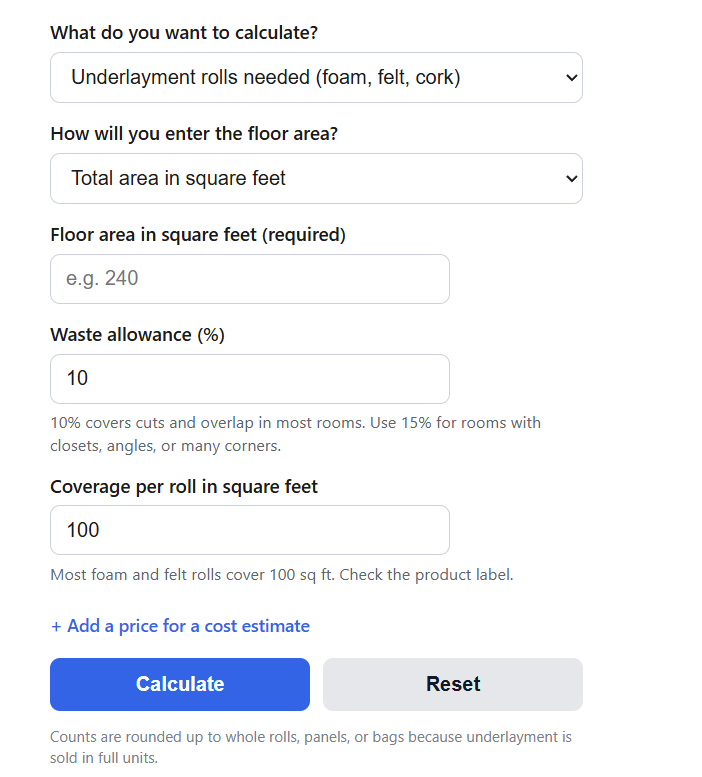
Calculate how many rolls, panels, or self-leveling bags of underlayment your floor needs, plus estimated cost, from room size and waste allowance.
Floor Underlayment Formula
Rolls = ceil((A * (1 + W/100)) / C)
Panels = ceil((A * (1 + W/100)) / P)
Bags = ceil((A * (1 + W/100) * (T / 0.125)) / B)
- A = measured floor area in square feet
- W = waste allowance as a percentage
- C = coverage per roll in square feet
- P = coverage per panel in square feet
- T = pour thickness in inches
- B = bag coverage at 1/8 inch depth in square feet
The calculator has three modes that share the same first steps. It takes your floor area, either entered directly or computed from room length times width, then inflates it by the waste allowance. In roll mode it divides the adjusted area by the coverage printed on the roll and rounds up to whole rolls, which is how foam, felt, and cork underlayment for laminate and vinyl plank is sold. In panel mode it does the same division using the panel footprint, such as 32 square feet for a 4 x 8 sheet of plywood or 15 square feet for a 3 x 5 sheet of cement board. In self-leveling mode it first scales the area by the ratio of your pour thickness to the 1/8 inch reference depth that bag coverage is rated at, then divides by the bag coverage to get whole bags. Adding a price per unit converts the count into an estimated material cost.
Underlayment Coverage and Cost by Type
Underlayment is sold in different units depending on the material. The table below shows how each common type is packaged, roughly how much one unit covers, and what it typically costs per square foot of floor.
| Underlayment type | Sold as | Coverage per unit | Typical cost per sq ft |
|---|---|---|---|
| Standard foam | Roll | 100 sq ft | $0.15 to $0.40 |
| Foam with vapor barrier | Roll | 100 sq ft | $0.30 to $0.60 |
| Felt | Roll | 100 sq ft | $0.30 to $0.70 |
| Cork | Roll or sheet | 100 to 200 sq ft per roll | $0.60 to $1.25 |
| Rubber | Roll | 100 sq ft | $0.75 to $1.50 |
| Plywood panel | 4 x 8 sheet | 32 sq ft | $0.60 to $1.10 |
| Cement board | 3 x 5 sheet | 15 sq ft | $0.75 to $1.40 |
| Self-leveling compound | 50 lb bag | 40 to 50 sq ft at 1/8 in | $0.75 to $2.00 per 1/8 in of depth |
Coverage counts fall fast as pour depth increases. A bag rated for 48 square feet at 1/8 inch covers only 24 square feet at 1/4 inch and 12 square feet at 1/2 inch, which is why deep pours consume far more bags than most people expect.
The second table matches underlayment to the flooring going on top of it. Using the wrong pairing is one of the most common flooring mistakes, and manufacturers can deny warranty claims over it.
| Flooring type | Good underlayment choices | Avoid |
|---|---|---|
| Laminate | Foam, felt, or cork, 2 to 3 mm thick | A second pad under planks with an attached pad |
| Vinyl plank (LVP) | Thin, dense underlayment rated for LVP, 1 to 1.5 mm | Thick soft foam, which lets joints flex and fail |
| Nail-down hardwood | Felt paper or rosin paper | Foam, which compresses under nailed boards |
| Tile | Cement board or an uncoupling membrane | Foam, cork, or any compressible layer |
| Carpet | Dedicated carpet pad, 6 to 10 lb density | Flooring foam rolls, which are too thin and firm |
Floor Underlayment Example Problems
Example 1: You are installing laminate in a 12 ft by 20 ft room using foam underlayment sold in 100 sq ft rolls at $25 per roll. The floor area is 12 * 20 = 240 sq ft. With a 10% waste allowance the adjusted area is 240 * 1.10 = 264 sq ft. Dividing by the roll coverage gives 264 / 100 = 2.64, which rounds up to 3 rolls. The estimated cost is 3 * $25 = $75, and you will have 36 sq ft of leftover coverage.
Example 2: You need to level 150 sq ft of concrete before vinyl plank goes down, with an average pour depth of 1/4 inch and bags rated at 48 sq ft per 1/8 inch. With 10% waste the adjusted area is 165 sq ft. Scaling for depth gives 165 * (0.25 / 0.125) = 330 equivalent sq ft at the reference depth. Dividing by the bag rating gives 330 / 48 = 6.88, which rounds up to 7 bags.
Floor Underlayment FAQ
Do I need underlayment if my flooring has an attached pad?
No, and you should not add one. Laminate and vinyl plank with a pre-attached pad is designed to sit directly on the subfloor, and stacking a second foam layer makes the floor too soft, which stresses the locking joints and usually voids the warranty. The one exception is a plain 6 mil vapor barrier over concrete, which most manufacturers still require because an attached pad is not a moisture barrier.
How much waste allowance should I use?
Use 10% for a simple rectangular room. Move up to 15% when the space has closets, hallways, angled walls, or several doorways, because every extra edge creates cuts and overlap. Roll underlayment loses less to waste than plank flooring does, but seams must overlap or butt cleanly, so the allowance still matters.
Is thicker underlayment always better?
No. Thickness helps with sound and minor subfloor imperfections, but every flooring type has a maximum the manufacturer allows. Laminate is usually limited to 3 mm of combined underlayment, and vinyl plank often to 1.5 mm, because a floating floor flexes more on a thick soft layer and the click joints wear out. Fix bigger height problems with self-leveling compound instead of thicker padding.