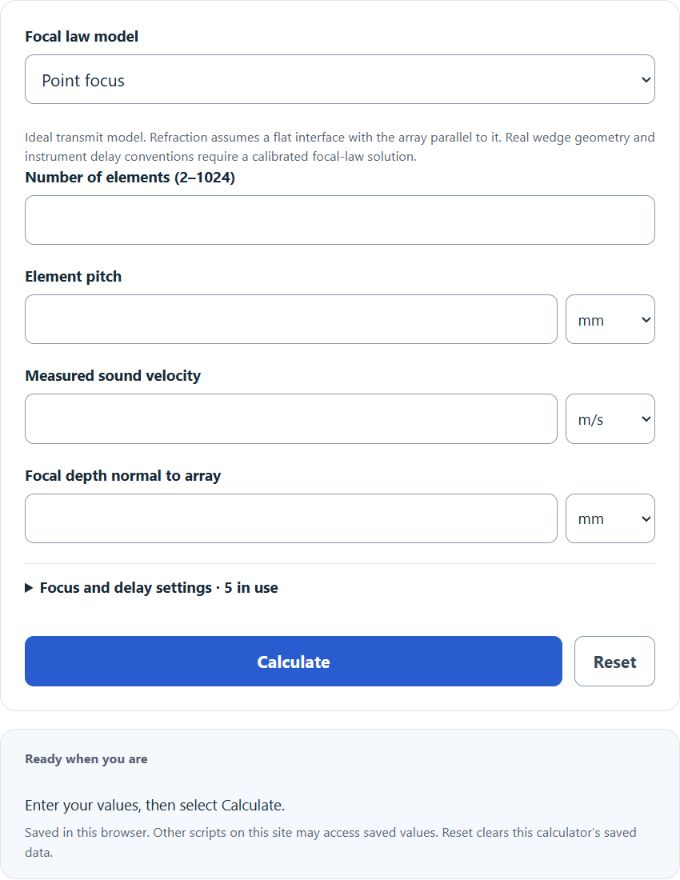
Calculate phased array ultrasonic focal law delays and apodization for point focus, angle steering, or wedge refraction settings.
Related Calculators
- Cavity Resonance Calculator
- Critical Angle Calculator
- Wave Speed Calculator
- Audio Delay Calculator
- Speaker Delay Calculator
- Focal Ratio Calculator
- All Physics Calculators
Focal Law Formula
In phased-array ultrasonic testing, a “focal law” is a set of relative delays applied across the elements so that wavefronts add in phase at a desired location (focus) or along a desired direction (steering). A common starting point is the one‑way travel time from each element to the target point, then subtracting each travel time from a reference time to obtain transmit firing delays.
Variables:
- ti is the one‑way travel time from element i to the target point (s)
- di is the path length (distance) from element i to the target point (m)
- v is the velocity of sound in the material (m/s)
- Δti is the delay applied to element i relative to a chosen reference time tref (s)
Note: ti = di/v is a one‑way time-of-flight along the chosen ray path. Some inspection setups (e.g., pulse‑echo from a reflector at depth) use two‑way propagation, but a transmit/receive focal law is typically built from one‑way paths and then referenced to produce the relative delays actually programmed into the instrument.
What is the Focal Law?
A Focal Law is a set of time delays used in phased array ultrasonic technology that determines the timing for each element in an array to produce a focused (or steered) beam at a specific point or direction in the material being tested. By applying appropriate relative delays across the aperture, the ultrasonic beam can be controlled in terms of angle, focus, and sweep, which supports detection and characterization of defects within the material.
How to Calculate Focal Law?
The following steps outline how to calculate relative element delays using ti = di/v and Δti = tref − ti.
- Define the array geometry (number of elements and pitch) and the target (focus point or steering angle).
- For each element i, determine the path length di from that element to the target point (for a point focus this is typically a straight‑line distance in a simple model).
- Determine the sound velocity v in the relevant material (and, if applicable, apply refraction rules across a wedge/interface).
- Compute the one‑way travel time for each element: ti = di/v.
- Choose a reference time tref (the maximum travel time for non-negative transmit delays, or the center or first element time for signed offsets) and compute transmit delays: Δti = tref − ti. Longer paths fire earlier. A common offset can shift all delays non-negative.
Example Problem :
Use the following variables as an example problem to test your knowledge.
distance from the element to the focal point (d) = 0.05 m
velocity of sound in the material (v) = 5900 m/s (typical longitudinal-wave speed in steel), so the one‑way travel time is t = d/v = 0.05/5900 ≈ 8.475×10⁻⁶ s (≈ 8.475 µs).