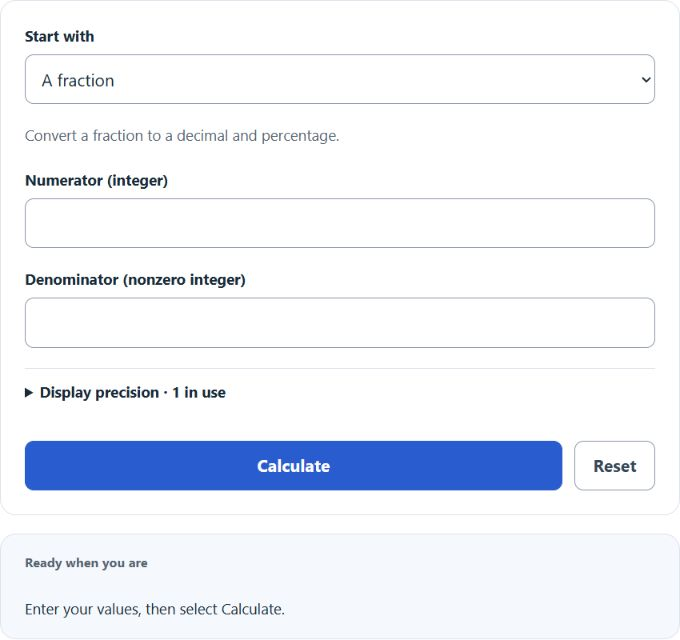
How do I use this calculator?
Choose a starting fraction, finite decimal or percentage. The calculator shows the equivalent reduced fraction, decimal, percentage and mixed number, with optional display precision.
Calculator Operations:
- For a fraction, enter an integer numerator and a nonzero integer denominator.
- For a decimal, enter the finite decimal to obtain its exact reduced fraction.
- For a percentage, enter its numeric value; a trailing percent sign is optional.
- Negative values and improper fractions are supported.
Decimal and percentage displays are rounded to the selected places. Exact fraction reduction preserves the entered digits; repeating-decimal notation is not supported.
Use the calculate button when all known values have been entered and the reset button to clear the values from the calculator.
Convert fractions, decimals, or percentages in any direction, reduce exact fractions, show mixed numbers, control rounding, and identify terminating decimals.
- All Unit Converters
- Percent To Decimal Calculator
- Fraction To Percent Calculator
- Decimal To Fraction Calculator
- Fraction To Decimal Calculator
- Mm To Fraction Calculator
Fraction To Decimal To Percentage Formula
The following formula is used to convert a fraction to a decimal and then to a percentage.
Decimal = Numerator / Denominator; Step 2: Percentage = Decimal * 100
Variables:
- Numerator is the top number in a fraction
- Denominator is the bottom number in a fraction
- Decimal is the result of dividing the numerator by the denominator
- Percentage is the decimal multiplied by 100
To calculate the decimal, divide the numerator by the denominator. To convert the decimal to a percentage, multiply the decimal by 100.
| Fraction | Decimal | Percentage (%) |
|---|---|---|
| 1/16 | 0.0625 | 6.25 |
| 1/12 | 0.0833 | 8.33 |
| 1/10 | 0.1000 | 10.00 |
| 1/9 | 0.1111 | 11.11 |
| 1/8 | 0.1250 | 12.50 |
| 1/7 | 0.1429 | 14.29 |
| 1/6 | 0.1667 | 16.67 |
| 1/5 | 0.2000 | 20.00 |
| 1/4 | 0.2500 | 25.00 |
| 1/3 | 0.3333 | 33.33 |
| 3/8 | 0.3750 | 37.50 |
| 2/5 | 0.4000 | 40.00 |
| 1/2 | 0.5000 | 50.00 |
| 3/5 | 0.6000 | 60.00 |
| 2/3 | 0.6667 | 66.67 |
| 3/4 | 0.7500 | 75.00 |
| 4/5 | 0.8000 | 80.00 |
| 5/6 | 0.8333 | 83.33 |
| 7/8 | 0.8750 | 87.50 |
| 1 | 1.0000 | 100.00 |
| Decimals rounded to 4 places; percentages to 2 places. Repeating decimals are approximations. | ||
What Does “Fraction to Decimal to Percentage” Mean?
Converting a fraction to a decimal and then to a percentage is a mathematical conversion process. It starts with a fraction, which is a way of expressing a quantity by dividing two numbers. This fraction is then converted into a decimal, a system of numbers that uses a point to separate the whole number from the fractional part. Finally, the decimal is converted into a percentage, which is a way of expressing a number as a part of 100. This process is often used in mathematics and statistics to simplify numbers and make them easier to understand and compare.
How to Calculate Fraction To Decimal To Percentage?
The following steps outline how to convert a fraction to a decimal and then to a percentage using the given formula:
- First, determine the numerator and denominator of the fraction.
- Next, divide the numerator by the denominator to find the decimal value.
- Finally, multiply the decimal value by 100 to find the percentage.
Example Problem:
Use the following variables as an example problem to test your knowledge:
Numerator = 3
Denominator = 4
Decimal = Numerator / Denominator = 3 / 4 = 0.75
Percentage = Decimal * 100 = 0.75 * 100 = 75%