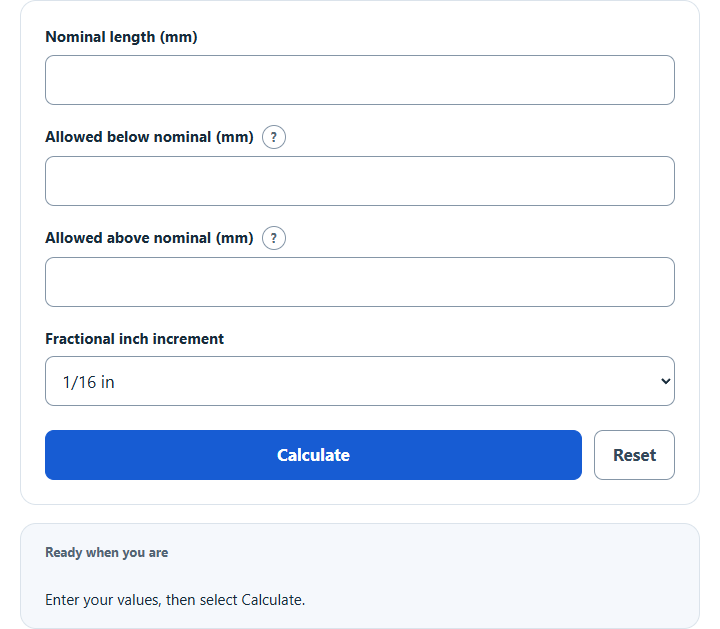
Find the closest fractional inch size (1/8 to 1/128 in) within a millimeter tolerance, and list every fraction that fits with its error and margins.
- Mm To Fraction Calculator
- Unit Converters
- Tolerance Factor Calculator
- Fractional Ruler Layout Calculator
Fractional Inch Tolerance Formula
For nominal length N, allowance below nominal a and allowance above nominal b, all in millimeters:
L = N − a; U = N + b
Choose an increment of 1/D inch, where D is 8, 16, 32, 64 or 128. The permitted integer ticks run from:
kfirst = ceil(LD/25.4); klast = floor(UD/25.4)
The count is max(0, klast − kfirst + 1). Each tick k represents k/D inches = 25.4k/D mm. Both bounds are included. NIST defines one inch as exactly 25.4 mm.
How to Use the Calculator
- Enter the nominal length and the allowance below it. Leave the upper allowance blank for the same ± value, or enter it separately; enter 0 for no allowance.
- Choose the fractional increment and select Calculate.
- Open the details to compare every matching size. A finer increment can produce more matches.
Inputs must be between 0 and 1,000,000 mm, with up to six decimal places. The lower allowance cannot exceed nominal length. Ranges containing more than 200 sizes are rejected; narrow the allowances or choose a coarser increment.
Worked Example
For 25 mm with 0.5 mm below and 0.5 mm above, the range is 24.5–25.5 mm. At 1/64 inch, ticks 62–64 fit:
- 31/32 in: 24.60625 mm; error −0.39375 mm.
- 63/64 in: 25.003125 mm; error +0.003125 mm.
- 1 in: 25.4 mm; error +0.4 mm.
The closest is 63/64 inch. Its margins are 0.503125 mm above the lower bound and 0.496875 mm below the upper bound.
One-sided allowance: At 1/16 inch, 25 mm with 0 below and 0.5 mm above admits only 1 inch (25.4 mm), within 25–25.5 mm.
No match: At 1/8 inch, 1 mm with 0.01 mm below and above gives 0.99–1.01 mm; neither neighboring size, 0 or 3.175 mm, fits.
Frequently Asked Questions
What do error and margins mean?
Signed error is converted length minus nominal length. The two margins show how far a matching size lies inside each bound; zero means it lies exactly on that bound.
What if no size fits, or two sizes are equally close?
No matches is a valid result: the range contains no multiple of the selected increment. Equal-distance ties select the larger permitted size.
Does a matching number guarantee physical fit?
No. This tool compares exact numerical lengths; it does not account for measurement uncertainty or physical fit.
Sources
NIST: SI Units — Length, inch-to-millimeter definition.