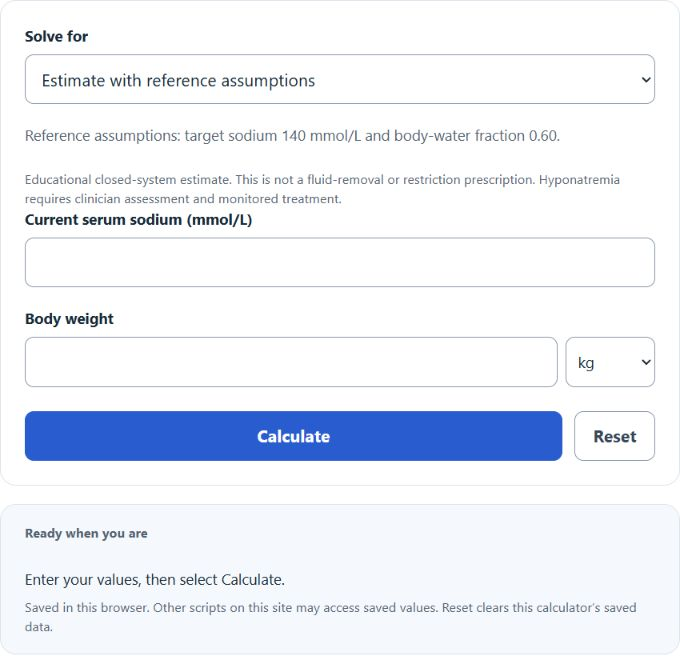
Estimate free water excess in hyponatremia from serum sodium, target sodium, body weight, and patient type; results show liters, mL, and cups.
Related Calculators
- Urine Osmolality Calculator
- mEq Calculator
- Drip Rate Calculator
- ACR Calculator
- All Health and Medical Calculators
Free Water Excess Formula
The following formula is used to calculate the free water excess (for hyponatremia, this estimates a closed-system comparison volume; it does not prescribe fluid removal, restriction, or a correction rate):
Variables:
- FWE is the free water excess (liters)
- Na is the current sodium level (mmol/L)
- Nadesired is the desired sodium level (mmol/L)
- TBW is total body water (liters), commonly estimated as: TBW ≈ (TBW factor) × weight (kg)
To calculate the free water excess, estimate total body water (TBW) and multiply it by (1 − Na/Nadesired). For hyponatremia (Na < Nadesired), this gives a positive value (a closed-system comparison volume, not a treatment amount); if Na > Nadesired, the result is negative (a signed model difference; it is not a hypernatremia treatment plan).
Important context: This “free water excess” framing is primarily used for hyponatremia estimation. Hypernatremia evaluation/treatment is typically approached using a free water deficit framework and should be guided by clinician oversight.
What is Free Water Excess?
Free water excess is an estimate of how much electrolyte-free water is contributing to a low serum sodium relative to a chosen target. It illustrates a simplified constant-solute model. Actual treatment depends on the cause, symptoms, duration, and ongoing fluid and electrolyte balance and requires clinician monitoring. (If you use a lower target than the current sodium, the calculation will produce a negative value, which is a signed model difference and should not be used as a hypernatremia treatment plan.)
How to Calculate Free Water Excess?
The following steps outline how to calculate the Free Water Excess:
- First, determine the current sodium level (Na) in mmol/L.
- Next, determine the desired sodium level (Nadesired) in mmol/L.
- Next, determine the patient’s weight in kilograms (or convert from pounds).
- Estimate total body water (TBW) in liters using a TBW factor: TBW ≈ (TBW factor) × weight (kg).
- Use the formula: FWE = TBW × (1 − Na/Nadesired).
- Finally, calculate the Free Water Excess (FWE) in liters.
- After inserting the variables and calculating the result, check your answer with the calculator above.
Example Problem:
Use the following variables as an example problem to test your knowledge.
Current sodium level (Na) = 125 mmol/L
Desired sodium level (Nadesired) = 135 mmol/L
Weight of the patient = 70 kg
Assume TBW factor = 0.60 (typical adult male). Then TBW ≈ 0.60 × 70 = 42 L.
FWE = 42 × (1 − 125/135) ≈ 3.111 L.