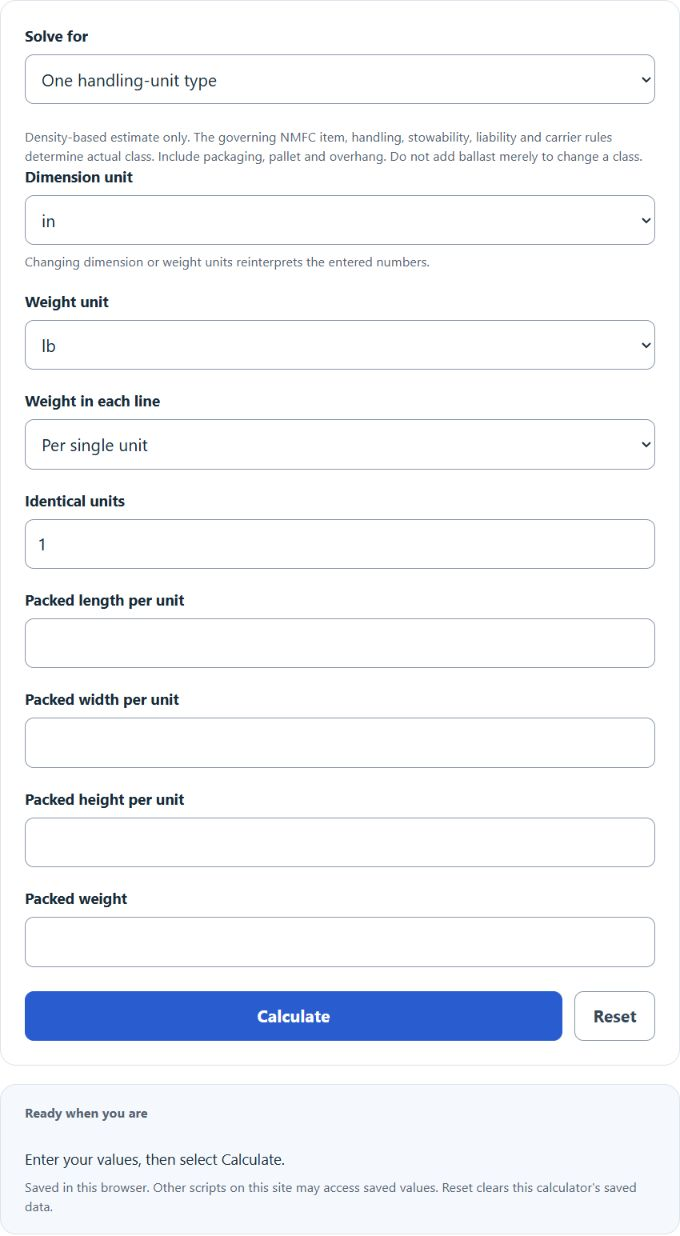
Estimate packed shipment density and the corresponding class on the standard 13-band density scale, or calculate a target class weight interval. Actual classification depends on the governing NMFC item and carrier rules.
Freight Class Density Formula
V = (L * W * H) / 1728
D = WT / V
- V is the volume of the shipment in cubic feet (ft³)
- L, W, H are the length, width, and height of one handling unit in inches, measured at the extreme points including the pallet, packaging, and any overhang
- 1728 is the number of cubic inches in one cubic foot
- WT is the total shipment weight in pounds, including pallets and packaging
- D is the shipment density in pounds per cubic foot (pcf)
Choose one handling-unit type, or enter up to five types as lines of quantity, length, width, height and weight. Dimensions and weight include the pallet, packaging and overhang. The calculator converts to cubic feet and pounds, sums volumes and weights, and compares unrounded density against the standard 13-band scale. Multiple commodities or units may require separate classification under governing NMFC rules.
The second mode works the formula in reverse. You pick a target freight class and enter your dimensions, and the calculator multiplies your total volume by the density boundaries of that class to return the total weight range that would land in it. The interval estimates density boundaries only; it does not guarantee an applicable class or a lower shipping charge. Do not add ballast merely to cross a boundary.
NMFC Density Scale and Pallet Weight Breakpoints
The table below is the full 13-sub density scale that has been in effect since July 19, 2025, when the NMFTA expanded the previous 11-sub scale under Docket 2025-1. Many freight class charts published online still show the old scale, which ended at class 60 for anything over 30 pcf. The current scale adds breaks at 35 and 50 pcf, so very dense freight can now rate class 55 or class 50.
| Sub | Density (lb/ft³) | Freight Class |
|---|---|---|
| 1 | Less than 1 | 400 |
| 2 | 1 but less than 2 | 300 |
| 3 | 2 but less than 4 | 250 |
| 4 | 4 but less than 6 | 175 |
| 5 | 6 but less than 8 | 125 |
| 6 | 8 but less than 10 | 100 |
| 7 | 10 but less than 12 | 92.5 |
| 8 | 12 but less than 15 | 85 |
| 9 | 15 but less than 22.5 | 70 |
| 10 | 22.5 but less than 30 | 65 |
| 11 | 30 but less than 35 | 60 |
| 12 | 35 but less than 50 | 55 |
| 13 | 50 or greater | 50 |
The next table converts those density breaks into minimum total weights for a standard 48 x 40 inch pallet at three common heights. Height is measured to the top of the freight and includes the pallet itself. These are mathematical density thresholds, not a quote or classification guarantee. Minimum weights below are rounded up to whole pounds; exact boundaries use unrounded volume.
| Class (min density) | 40 in tall (44.4 ft³) | 48 in tall (53.3 ft³) | 60 in tall (66.7 ft³) |
|---|---|---|---|
| 125 (6 pcf) | 267 lb | 320 lb | 400 lb |
| 100 (8 pcf) | 356 lb | 427 lb | 534 lb |
| 92.5 (10 pcf) | 445 lb | 534 lb | 667 lb |
| 85 (12 pcf) | 534 lb | 640 lb | 800 lb |
| 70 (15 pcf) | 667 lb | 800 lb | 1,000 lb |
| 65 (22.5 pcf) | 1,000 lb | 1,200 lb | 1,500 lb |
| 60 (30 pcf) | 1,334 lb | 1,600 lb | 2,000 lb |
| 55 (35 pcf) | 1,556 lb | 1,867 lb | 2,334 lb |
| 50 (50 pcf) | 2,223 lb | 2,667 lb | 3,334 lb |
Example Problems
Example 1. One pallet measures 48 inches long, 40 inches wide, and 48 inches tall including the pallet, and weighs 800 pounds. Volume is (48 * 40 * 48) / 1728 = 53.33 ft³. Density is 800 / 53.33 = 15.0 pcf. A density of 15 pcf falls in the range of 15 but less than 22.5, so the shipment rates class 70.
Example 2. You ship two crates, each 36 x 36 x 30 inches and 210 pounds. Each crate is (36 * 36 * 30) / 1728 = 22.5 ft³, so the total is 45 ft³ and 420 pounds. Density is 420 / 45 = 9.33 pcf, which falls in the range of 8 but less than 10, so the shipment rates class 100. Note that you compute density from the combined totals, not per crate.
Frequently Asked Questions
Does density alone determine my freight class? Not always. Density is one of four classification factors, alongside handling, stowability, and liability. Since the July 2025 NMFC changes, commodities without handling, stowability, or liability issues are classed purely by density, which now covers most general freight. However, some commodities keep their own NMFC item number with an assigned class regardless of density, so always confirm the NMFC item for your product before booking.
What changed with the NMFC density scale in 2025? Effective July 19, 2025, the NMFTA expanded the standard density scale from 11 to 13 subprovisions and moved roughly 2,000 commodity listings to density-based classification. The new sub 12 assigns class 55 to freight from 35 to under 50 pcf, and sub 13 assigns class 50 to freight at 50 pcf or greater. Under the old scale, everything over 30 pcf rated class 60, so the standard scale includes two additional classes for dense freight; the applicable item and rate agreement govern actual charges.
What happens if the carrier measures a different density than I declared? Most LTL terminals run freight across dimensioners that capture exact dimensions and weight. If the measured density puts your shipment in a different class, the carrier reclassifies it and issues an adjusted invoice, often with an inspection fee added. To avoid this, measure at the extreme points of the packed unit, include the pallet in both height and weight, and round dimensions up rather than down. Measurements near any density boundary deserve care: small differences can change the density-based estimate. The calculator displays unrounded-comparison results without guaranteeing a rate.