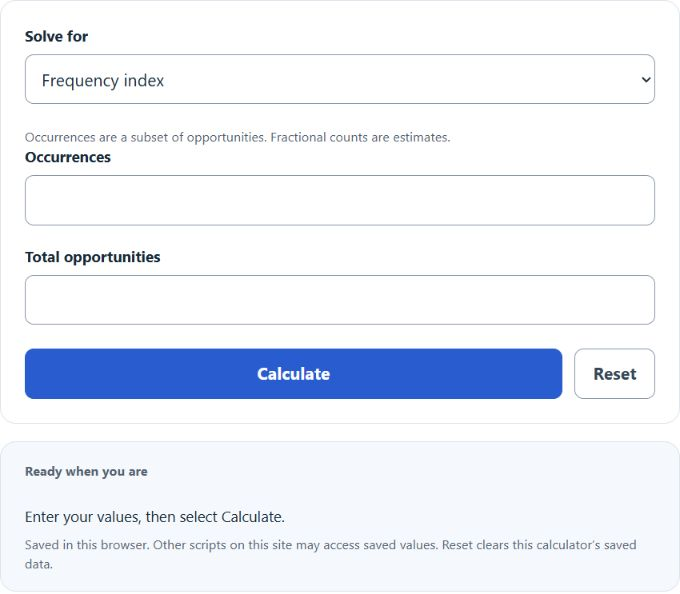
Calculate Frequency Index (%) from occurrences and total opportunities, or find the missing value when two fields are known.
- All Statistics Calculators
- Crossover Frequency Calculator
- Conditional Frequency Calculator
- Percentage to Frequency Calculator
Frequency Index Formula
The following formula is used to calculate the Frequency Index.
Variables:
- FI is the Frequency Index (%)
- N is the number of occurrences of an event
- T is the total number of opportunities for the event to occur
To calculate the Frequency Index, divide the number of occurrences of an event by the total number of opportunities for the event to occur. Multiply the result by 100 to convert it to a percentage. This will give you the Frequency Index, which represents the frequency of occurrence of an event relative to the total number of opportunities for the event to occur.
What is a Frequency Index?
In this calculator, frequency index means relative frequency expressed as a percentage: occurrences divided by total opportunities, multiplied by 100. The occurrences must be a subset of the opportunities in the same data set or period, with at most one counted occurrence per opportunity. Inverse calculations may produce fractional count estimates when the percentage is rounded.
How to Calculate Frequency Index?
The following steps outline how to calculate the Frequency Index.
- First, determine the number of occurrences of an event (N).
- Next, determine the total number of opportunities for the event to occur (T).
- Next, gather the formula from above = FI = (N / T) * 100.
- Finally, calculate the Frequency Index.
- After inserting the variables and calculating the result, check your answer with the calculator above.
Example Problem :
Use the following variables as an example problem to test your knowledge.
Number of occurrences of an event (N) = 25
Total number of opportunities for the event to occur (T) = 100