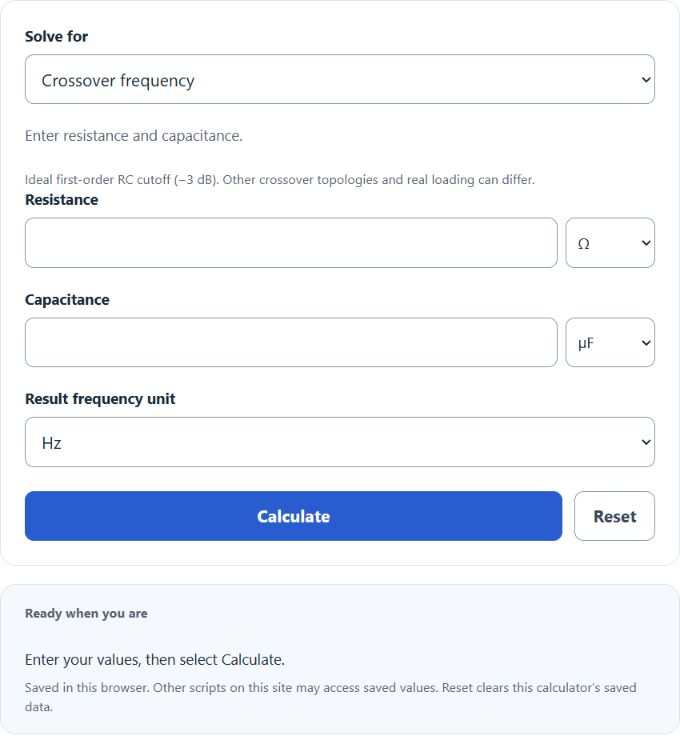
Calculate crossover frequency, resistance, or capacitance from any two values using the 1/(2πRC) formula in Hz, kHz, or MHz.
Crossover Frequency Formula
The crossover frequency for a simple first-order RC circuit is the frequency where the signal is reduced by 3 dB. This calculator uses resistance, capacitance, and crossover frequency, and lets you select the quantity to solve for and enter the other two values.
- fc = crossover frequency in hertz (Hz)
- R = resistance in ohms (Ω)
- C = capacitance in farads (F)
- π = pi, approximately 3.14159
To solve for resistance, the formula is rearranged as:
To solve for capacitance, the formula is rearranged as:
The calculator converts your selected units to base units before calculating: ohms for resistance, farads for capacitance, and hertz for frequency. After the calculation, it converts the result to the selected result unit.
- Calculate crossover frequency: enter resistance and capacitance to find the RC cutoff or crossover frequency.
- Calculate resistance: enter capacitance and target frequency to find the required resistor value.
- Calculate capacitance: enter resistance and target frequency to find the required capacitor value.
Common RC Crossover Values
These values show approximate crossover frequencies for common resistor and capacitor combinations. They are useful for checking whether your result is in a reasonable range.
| Resistance | Capacitance | Approx. Crossover Frequency |
|---|---|---|
| 1 kΩ | 1 μF | 159.15 Hz |
| 10 kΩ | 100 nF | 159.15 Hz |
| 10 kΩ | 10 nF | 1.591 kHz |
| 1 kΩ | 100 nF | 1.591 kHz |
| 1 kΩ | 10 nF | 15.915 kHz |
Unit Conversions Used
Use these conversions when checking inputs manually. The formula must use ohms, farads, and hertz.
| Quantity | Unit | Base Unit Equivalent |
|---|---|---|
| Resistance | 1 kΩ | 1,000 Ω |
| Resistance | 1 MΩ | 1,000,000 Ω |
| Capacitance | 1 mF | 0.001 F |
| Capacitance | 1 μF | 0.000001 F |
| Capacitance | 1 nF | 0.000000001 F |
| Frequency | 1 kHz | 1,000 Hz |
| Frequency | 1 MHz | 1,000,000 Hz |
Example Calculations
Example 1: Calculate crossover frequency
You have a resistor of 10 kΩ and a capacitor of 100 nF.
- R = 10 kΩ = 10,000 Ω
- C = 100 nF = 0.0000001 F
The result is approximately 159.155 Hz.
Example 2: Calculate capacitance
You want a crossover frequency of 1 kHz using a 10 kΩ resistor.
- fc = 1 kHz = 1,000 Hz
- R = 10 kΩ = 10,000 Ω
The result is approximately 0.0000000159 F, which is 15.915 nF.
FAQs
What is crossover frequency in an RC circuit?
Crossover frequency, often called cutoff frequency in RC filters, is the frequency where the output level is reduced to about 70.7% of the passband level. This point is also described as the -3 dB frequency. For a simple RC filter, it depends only on resistance and capacitance.
Do I need to enter values in ohms, farads, and hertz?
No. You can select kΩ, MΩ, mF, μF, nF, Hz, kHz, or MHz in the calculator. Internally, the calculation is done using ohms, farads, and hertz because the standard RC formula requires base units.
Why does increasing capacitance or resistance lower the crossover frequency?
The formula places resistance and capacitance in the denominator. When either value increases, the denominator gets larger, so the crossover frequency gets smaller. This is why larger capacitors or larger resistors produce lower cutoff frequencies in a first-order RC circuit.