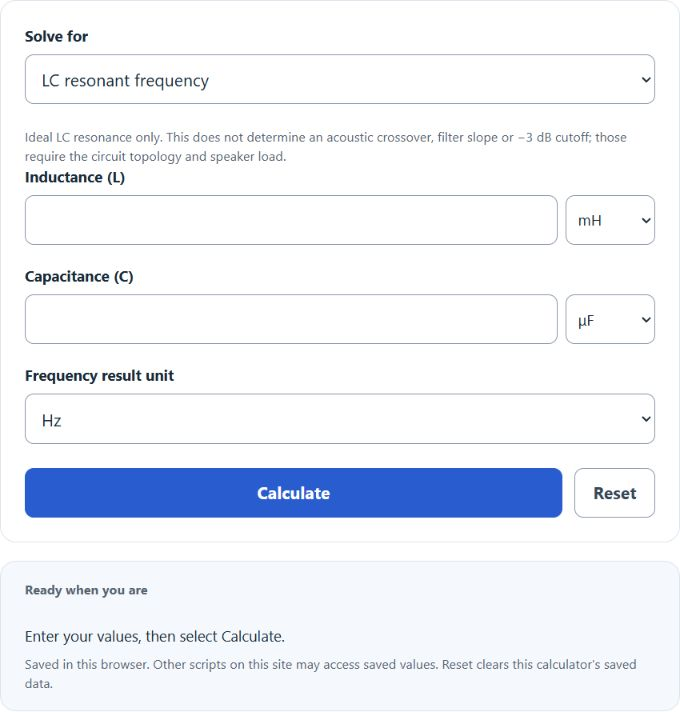
Calculate LC resonant frequency for passive crossover circuits or solve for inductance and capacitance from L, C, and target frequency.
Related Calculators
- Output Voltage Calculator
- Voltage Calculator
- Sampling Frequency Calculator
- Ripple Factor Calculator
- All Physics Calculators
LC Resonant Frequency Formula (Ideal Passive Crossover Section)
This calculator estimates the ideal resonant or target frequency of an LC network used in passive subwoofer crossover sections. It is most useful for quickly sizing an inductor and capacitor pair or for checking what frequency a given LC combination is centered around. In real speaker systems, the final crossover behavior can shift because driver impedance changes with frequency, the filter topology affects slope, and the enclosure and speaker themselves add acoustic roll-off.
If you already know the desired frequency and one component value, the same relationship can be rearranged to solve for the missing part.
Variable Definitions
- f0 = resonant or target frequency in hertz (Hz)
- L = inductance in henries (H)
- C = capacitance in farads (F)
How to Use the Subwoofer Crossover Calculator
- Select the value to solve for, then enter the two known values.
- Select the unit beside each input. Enter 10 with mH and 330 with μF; the calculator converts them to 0.01 H and 0.00033 F.
- Calculate the missing value.
- Use the result as a design starting point, then verify the system by listening or measurement because the actual acoustic handoff may not occur exactly at the ideal LC frequency.
Example
If the inductor is 10 mH and the capacitor is 330 μF, the ideal LC frequency is about 87.6 Hz.
This is a practical bass crossover region for many subwoofer systems, especially when the main speakers are not intended to reproduce deep low-end content at high output.
What This Calculator Is Really Telling You
The result is the ideal resonant frequency of the LC network, not a guarantee of the exact in-room crossover point. In passive speaker design, the true transition between woofer and subwoofer is influenced by more than just the component values. The loudspeaker load is not perfectly constant, and the driver’s natural response interacts with the electrical filter. The LC frequency alone does not establish a −3 dB cutoff, filter slope or appropriate acoustic crossover. Verify the loaded circuit and speaker response separately.
Practical Starting Ranges for Subwoofer Integration
| Speaker Pairing | Common Starting Range | Why It Often Works |
|---|---|---|
| Large floor-standing speakers | 60–80 Hz | Keeps bass directional cues low while letting the mains handle more upper bass. |
| Bookshelf speakers | 80–100 Hz | Reduces low-frequency strain on smaller woofers and usually improves clarity. |
| Small satellites or compact desktop speakers | 100–120 Hz | Lets the subwoofer cover a wider bass range when the main speakers have limited extension. |
| Mixed home theater systems | 80–120 Hz | Useful when center and surround channels are significantly smaller than the front speakers. |
These are starting points, not hard rules. The best final setting depends on the speakers, enclosure alignment, room acoustics, listening distance, and how steep the crossover slope is.
Why Real-World Crossover Performance Can Shift
- Speaker impedance is not flat. Passive crossover behavior changes as the load varies across frequency.
- Filter topology matters. First-order, second-order, and other alignments do not sum the same way.
- Component losses matter. Inductor resistance and capacitor tolerance can move the effective response.
- The driver and box add their own roll-off. Electrical and acoustic slopes combine to create the final result.
- Placement and phase affect blending. A mathematically correct frequency can still sound wrong if timing and placement are off.
Quick Design Tips
- If your calculated frequency is far too high or too low, check your unit conversions first.
- For passive designs, always think about the actual speaker impedance, not just the nominal rating printed on the driver.
- Choose a target frequency that overlaps cleanly with the usable low-end of your main speakers.
- If the handoff sounds boomy, the crossover may be too high or the phase alignment may be off.
- If there is a gap in bass response, the crossover may be too low or the slopes may not be summing well.
Common Input Errors
- Entering a number with the wrong selected inductance unit.
- Entering a number with the wrong selected capacitance unit.
- Assuming the ideal LC frequency equals the final acoustic crossover every time.
- Using this formula for active or DSP crossover design, which follows different filter relationships.
When This Calculator Is Most Useful
This tool is ideal when you want to estimate the center or target frequency of a passive LC section, compare component choices, or back-solve the inductor or capacitor needed for a desired low-frequency crossover region. It is especially helpful during early design, troubleshooting, and quick component selection before final measurement and tuning.
Using f0 = 1 / (2π√(LC)) with L = 0.01 H and C = 0.00033 F gives f0 ≈ 87.6 Hz.