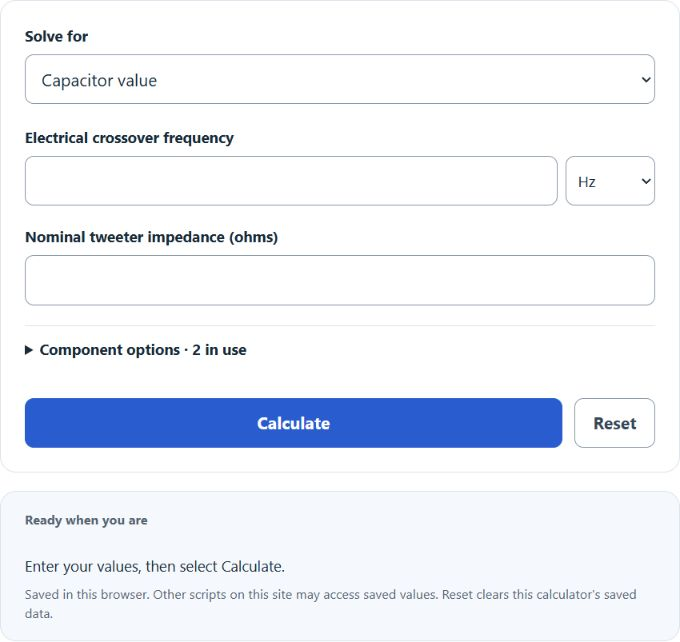
Calculate a first-order tweeter crossover capacitor, cutoff frequency, or nominal impedance from any two values, with Hz, kHz, F, µF, and nF.
Tweeter Capacitor Formula
This calculator finds the capacitor value for a simple first-order tweeter crossover. In this setup, a capacitor is placed in series with the tweeter so lower frequencies are reduced before they reach the high-frequency driver. It is a fast way to estimate a starting crossover point when you know the tweeter impedance and the target crossover frequency.
For a basic passive network, this capacitor creates a 6 dB/octave electrical high-pass filter. The result is most useful for quick design, repair, replacement, and speaker experimentation where a single series capacitor is being used.
Variable Definitions
- C: capacitance of the tweeter capacitor
- f: desired crossover frequency in hertz (Hz)
- R: nominal tweeter impedance in ohms (Ω)
Useful Rearrangements
The last form is often the most practical because speaker capacitors are commonly chosen in microfarads (µF).
How to Use the Tweeter Capacitor Calculator
- Enter the desired crossover frequency.
- Enter the tweeter's nominal impedance, such as 4 Ω, 6 Ω, or 8 Ω.
- Calculate the capacitance.
- Select the nearest standard capacitor value if an exact part value is not available.
If the calculated value falls between common capacitor sizes, a smaller capacitor shifts the crossover higher, while a larger capacitor shifts it lower.
Common Starting Values
| Crossover Frequency | 4 Ω Tweeter | 6 Ω Tweeter | 8 Ω Tweeter |
|---|---|---|---|
| 2,000 Hz | 19.9 µF | 13.3 µF | 9.95 µF |
| 3,000 Hz | 13.3 µF | 8.84 µF | 6.63 µF |
| 4,000 Hz | 9.95 µF | 6.63 µF | 4.97 µF |
| 5,000 Hz | 7.96 µF | 5.31 µF | 3.98 µF |
| 6,000 Hz | 6.63 µF | 4.42 µF | 3.32 µF |
Example
If you want to cross an 8 Ω tweeter at 4,000 Hz, the required capacitor is about 4.97 µF, which is commonly rounded to a standard 4.7 µF or 5.0 µF part depending on the design goal.
How Capacitor Size Affects the Tweeter
- Larger capacitance lowers the crossover point and allows more lower-frequency content to reach the tweeter.
- Smaller capacitance raises the crossover point and gives the tweeter more protection from low frequencies.
- Lower impedance tweeters require larger capacitors for the same crossover frequency.
- Higher impedance tweeters require smaller capacitors for the same crossover frequency.
Practical Selection Tips
- For passive speaker crossovers, non-polarized capacitors are typically used.
- Film capacitors are often preferred for tweeters because they are stable and low loss.
- Electrolytic non-polar capacitors can be used where budget or large values matter more than ultimate precision.
- Choose a voltage rating with comfortable headroom for the amplifier and speaker system.
- Always compare the final crossover point to the tweeter manufacturer's recommended minimum crossover frequency.
Important Design Notes
This calculator assumes a simple first-order crossover and a nominally resistive tweeter impedance. Real tweeters do not maintain a perfectly flat impedance across frequency, so the true acoustic crossover may differ from the calculated electrical crossover point.
If your system also uses an L-pad, additional resistors, a second-order crossover, or impedance-shaping components, the capacitor value should be chosen using the full network rather than the simple single-capacitor equation alone.
When This Calculator Is Most Useful
- Replacing a damaged tweeter crossover capacitor
- Building a basic speaker crossover from scratch
- Testing alternate crossover points during speaker tuning
- Estimating a preliminary electrical crossover component value