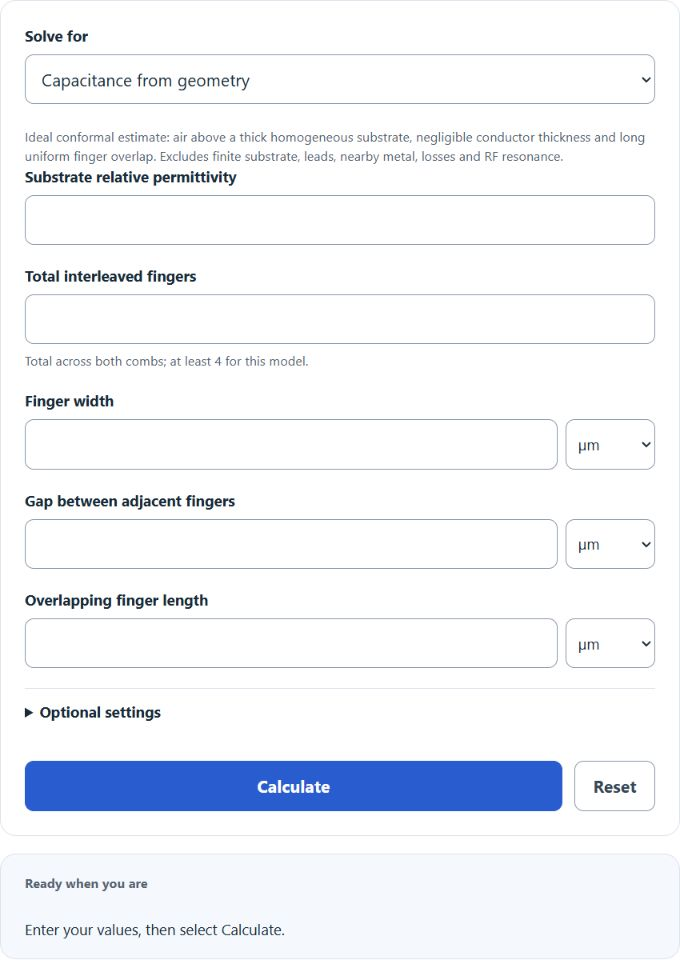
Estimate interdigitated capacitor capacitance with a conformal-mapping elliptic-integral model or reverse-solve finger length using width, gap, count, and permittivity.
- All Physics Calculators
- Capacitor Power Calculator
- Capacitor Charge Current Calculator
- Capacitor Voltage Calculator
Interdigitated Capacitor Formula and Calculator Guide
An interdigitated capacitor, also called an interdigital capacitor, is a planar capacitor made from two comb-like conductors whose fingers interleave without touching. This layout is useful when you want meaningful capacitance in a compact printed area. The calculator above gives a fast first-pass estimate using substrate relative permittivity, finger width, gap, overlap length, and total finger count.
Formula Used by This Calculator
C = L[(N−3)ci/2 + 2cice/(ci+ce)]. Here ci and ce are capacitance per length in F/m; L is in metres, so C is in farads.
The Igreja–Dias conformal model uses η = W/(W+G), ki = sin(πη/2), and ke = 2√η/(1+η). For each modulus, c = ε0(εr+1)K(k)/K(k′), where k′ = √(1−k²) and K is the complete elliptic integral of the first kind. It assumes air above a thick homogeneous substrate, negligible conductor thickness and long uniform overlap. Use it for preliminary sizing, then validate a practical design. See Igreja and Dias (2004).
Input Definitions
| Input / Output | Meaning | Important Note |
|---|---|---|
| Capacitance, C | Estimated capacitance of the interdigitated structure | Reported in pF |
| Dielectric Constant, εr | Relative permittivity of the substrate below the fingers; air is assumed above | Higher values generally increase capacitance |
| Finger Width, W | Width of each conductive finger | Choose the unit beside each dimension; conversions are automatic |
| Gap, G | Positive spacing between adjacent fingers | Uniform gap; choose its own length unit |
| Finger Length, L | Overlapping length of the interleaved fingers | Longer fingers generally increase capacitance |
| Number of Fingers, n | Total fingers in the pattern | Enter an integer of at least four across both combs |
How to Use the Calculator
- Enter substrate relative permittivity for the relevant material and conditions; air is assumed above.
- Enter finger width, gap and overlap length with their individual units, or choose inverse length and enter target capacitance.
- Enter the total number of fingers as a whole number.
- Calculate the missing value or the capacitance estimate.
- Use the result as a design estimate, then validate with testing or simulation if precision matters.
Each length unit is converted to metres independently. Width and gap determine the metallization ratio; overlap length sets the linear scale of capacitance.
Solving for a Missing Variable
The calculator implements capacitance from geometry and the inverse overlapping length. With permittivity, width, gap and finger count fixed, define M = (N−3)ci/2 + 2cice/(ci+ce). Then C = LM and L = C/M. The inverse uses the same model assumptions; the tool does not solve for width, permittivity or integer finger count.
How Each Input Affects the Result
| Parameter | Effect in This Calculator | Design Interpretation |
|---|---|---|
| Higher dielectric constant | Increases capacitance | More electric field energy is stored in higher-permittivity materials |
| Longer fingers | Increases capacitance | More overlap length creates more effective coupling area |
| More fingers | Increases capacitance | Additional interleaving creates more coupled edges |
| Wider fingers | Increases capacitance when the gap is fixed | Changing width also changes W/(W+G); scaling width and gap together leaves ideal capacitance per length unchanged |
Accuracy and Design Notes
- This calculator explicitly includes finger gap and reports sensitivity at 10% smaller and larger gaps, with all other quantities fixed.
- It does not model finite conductor or substrate thickness, a back ground plane, shielding, nearby metal, end-tip/busbar parasitics, losses or self-resonance. Optional frequency only gives ideal |Xc| = 1/(2πfC).
- Real interdigitated capacitors rely heavily on fringing electric fields, so measured capacitance can differ from the estimate.
- Changes in fabrication tolerance, dielectric uniformity, temperature, contamination, and test setup can all shift the final value.
- For RF circuits, precision sensors, or production hardware, use this result as a starting point and then validate with EM simulation or bench measurement.
Quick Check
For substrate relative permittivity 4, ten total fingers, width 10 µm, gap 10 µm and overlap length 1 mm, the estimate is approximately 0.2089494 pF. A target of 1 pF with the same cross-section requires about 4.7858478 mm overlap.
These values illustrate the stated ideal model; actual device capacitance needs measurement or a suitable field solution.
This makes the calculator useful for checking how sensitive capacitance is to geometry before moving into a more detailed layout or prototype stage.
Common Applications of Interdigitated Capacitors
- Printed and planar RF matching networks
- Touch and proximity sensing electrodes
- Humidity, chemical, and material-permittivity sensors
- MEMS and microfabricated capacitor structures
- Compact PCB layouts where a vertical parallel-plate capacitor is impractical
Common Input Mistakes
- Selecting units that do not match the entered dimensions
- Entering a non-integer value for the number of fingers
- Assuming the gap-based half-space estimate includes finite thickness, leads, nearby conductors or RF parasitics
- Using a dielectric constant that does not match the actual operating material or condition