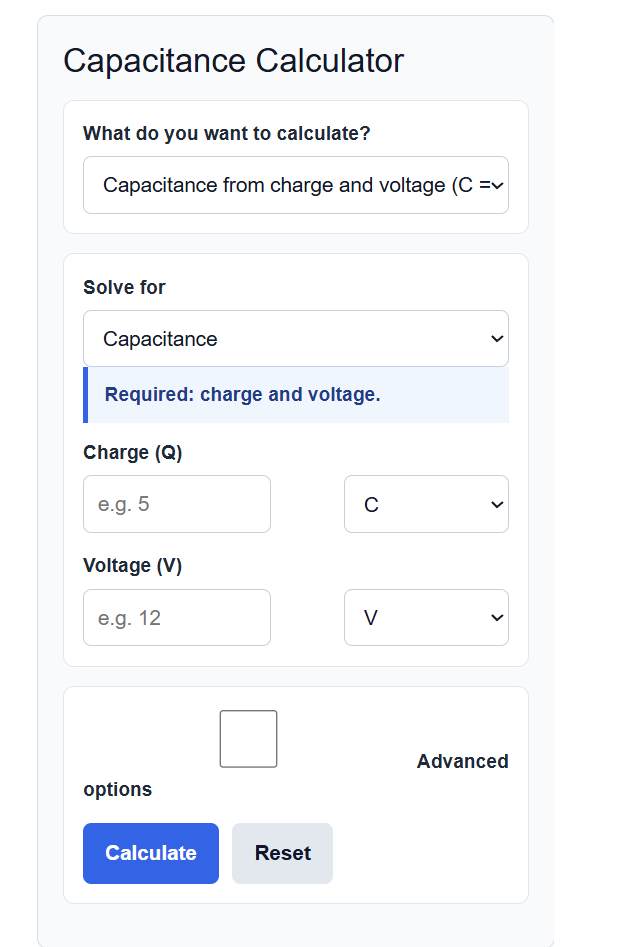
Calculate capacitance from charge and voltage, parallel-plate geometry, or the energy stored in a capacitor using C = Q/V.
Capacitance Formula
This calculator solves capacitance three ways. The first relates capacitance to stored charge and voltage. The second finds the capacitance of a parallel-plate capacitor from its geometry. The third finds the energy a charged capacitor holds.
C = Q / V
C = K * e0 * A / d
E = 1/2 * C * V^2
- C is the capacitance in farads (F).
- Q is the stored charge in coulombs (C).
- V is the voltage across the capacitor in volts (V).
- K is the dielectric constant of the material between the plates (1 for a vacuum or air).
- e0 is the permittivity of free space, 8.854 x 10^-12 F/m.
- A is the plate area in square meters.
- d is the distance between the plates in meters.
- E is the energy stored in joules (J).
In the charge and voltage mode you pick which value to solve for, and the calculator rearranges C = Q / V to give Q = C x V or V = Q / C as needed. The parallel-plate mode multiplies the dielectric constant, the permittivity of free space, and the plate area, then divides by the gap between the plates; an advanced setting lets you set the number of stacked plates, which uses (N - 1) in place of a single pair. The energy mode squares the voltage, multiplies by the capacitance, and halves the result, and also reports the charge from Q = C x V.
Dielectric Constants and Capacitance Units
Use the dielectric constant of the insulator between the plates when working in parallel-plate mode. The unit table shows how the prefixes the calculator accepts relate to farads.
| Material | Dielectric constant (K) |
|---|---|
| Vacuum | 1 |
| Air | 1.0006 |
| Paper | 3 to 4 |
| Glass | 4 to 10 |
| Mica | 5 to 7 |
| Water | 80 |
| Unit | Value in farads |
|---|---|
| picofarad (pF) | 0.000000000001 F |
| nanofarad (nF) | 0.000000001 F |
| microfarad (uF) | 0.000001 F |
| millifarad (mF) | 0.001 F |
| farad (F) | 1 F |
Example Problems
Example 1. A capacitor stores 0.0005 coulombs of charge at 10 volts. The capacitance is C = Q / V = 0.0005 / 10 = 0.00005 F, which is 50 uF.
Example 2. A 470 uF capacitor is charged to 25 volts. The stored energy is E = 1/2 x C x V^2 = 0.5 x 0.00047 x 25^2 = 0.147 J. The charge held is Q = C x V = 0.00047 x 25 = 0.01175 C.
Frequently Asked Questions
What is capacitance? Capacitance is the amount of electric charge a component stores for each volt applied across it. A higher capacitance holds more charge at the same voltage. It is measured in farads, where one farad equals one coulomb per volt.
Why does plate area increase capacitance while gap distance lowers it? A larger plate area gives charge more room to collect, so the capacitor holds more charge at the same voltage. A wider gap weakens the electric field linking the plates, so less charge is held. That is why C rises with area A and falls as the separation d grows.
Does the dielectric material matter? Yes. Placing an insulator with a dielectric constant above 1 between the plates raises the capacitance by that factor. Replacing air with a material that has K of 4, for example, makes the capacitance about four times larger for the same size.