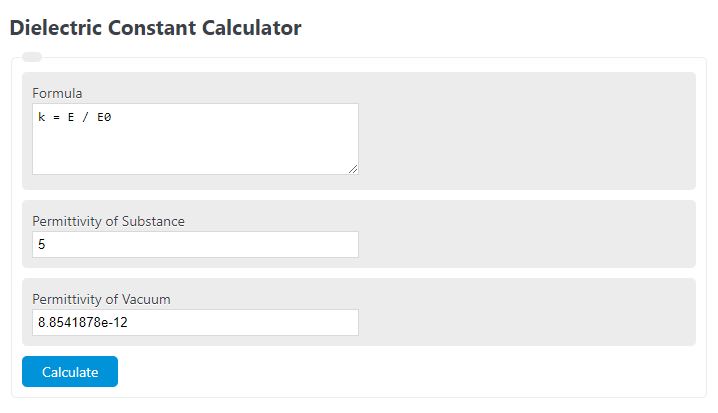
Calculate dielectric constant from a selected material or measured capacitance and vacuum capacitance, with results shown as εᵣ.
Dielectric Constant Formula
The following formula is used to calculate a dielectric constant.
- Where k is the dielectric constant
- E is the permittivity of the substance
- E0 is the permittivity of a vacuum. (8.8541878128(13)×10−12 F⋅m−1 )
To calculate a dielectric constant, divide the permittivity of the substance by the permittivity of a vacuum.
In the case of this formula, permittivity can be swapped out for capacitance of the substance or system, and capacitance in a vacuum.
Dielectric Constant Definition
A dielectric constant is a measure of the permittivity of a substance compared to the permittivity of a vacuum.
Dielectric Constant Example
How to calculate a dielectric constant?
- First, determine the permittivity of the substance.
Measure of calculate the permittivity of the substance.
- Next, determine the permittivity of the vacuum.
This is typically (8.8541878128(13)×10−12 F⋅m−1 ).
- Finally, calculate the dielectric constant.
Calculate the dielectric constant using the formula above.
FAQ
In simple terms, a dielectric constant is a measure of the relative permittivity of an object when compared to a vacuum.
Permittivity is a measure of how much polarizability a given dielectric has. In other words, how much energy it can store when exposed to an electric field.
A dielectric is a substance or object that acts as an electrical insulator. When exposed to an electric field it becomes polarized, thus store energy.