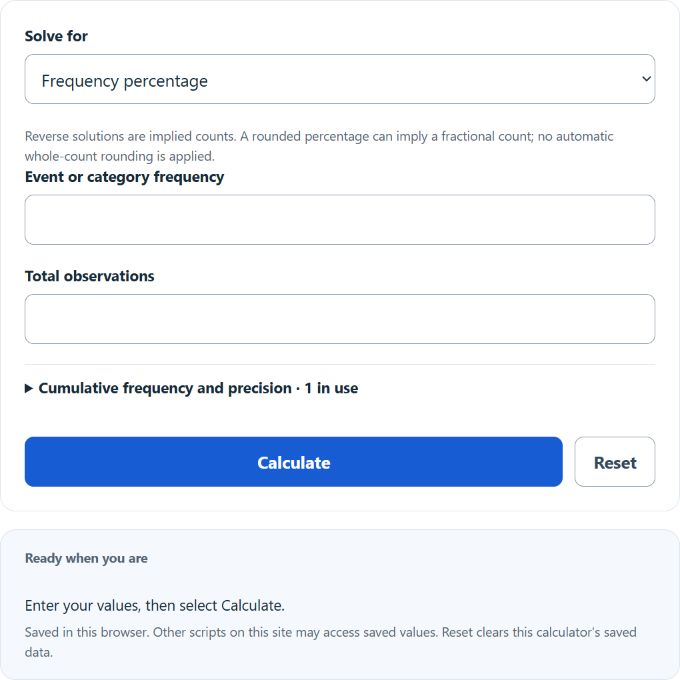
Calculate frequency percentage from a count and total, or solve frequency or total observations, with relative frequency and optional cumulative results.
Related Calculators
- Expected Frequency Calculator
- Pick Rate Calculator
- Pass Rate Calculator
- Chances Of Winning Calculator
- All Statistics Calculators
Frequency Percentage Formula
The following formula is used to calculate the frequency percentage.
Variables:
- P is the frequency percentage (%)
- F is the frequency (count of occurrences)
- T is the total number of observations
Rearranged: F = (P / 100) x T to find an implied count; T = (F x 100) / P to find an implied total when P is greater than zero. Rounded percentages can imply fractional counts. Zero frequency with zero percent does not determine a total.
Frequency Types Compared
| Type | Formula | Output | Primary Use |
|---|---|---|---|
| Absolute Frequency | Count (F) | Integer | Tallying raw occurrences |
| Relative Frequency | F / T | Decimal 0-1 | Probability estimation |
| Frequency Percentage | (F / T) x 100 | Percent 0-100% | Reporting and cross-group comparison |
| Cumulative Frequency | Running sum of F values | Integer | Percentile ranking |
| Cumulative Percentage | (Cumulative F / T) x 100 | Percent 0-100% | Distribution analysis |
What is Frequency Percentage?
Frequency percentage converts a raw count into a proportion of the whole, expressed as a percent. It is scale-independent: 3 out of 6 and 300 out of 600 both equal 50%, making it the standard metric for comparing datasets of unequal size. Frequency percentage is useful for comparing groups of different sizes; retain counts and sample sizes to interpret those comparisons.
Frequency percentage is the empirical counterpart to theoretical probability. For independent trials with a stable event probability, the frequency percentage converges toward that probability as sample size grows (Law of Large Numbers). Flip a coin 10,000 times and the heads frequency percentage will be near 50%, providing a practical estimate of the 0.5 theoretical probability. This convergence property makes frequency percentage fundamental in polling, clinical trials, and quality control sampling, where true probabilities are unknown and must be estimated from observed data.
Frequency Percentage Worked Examples
| Event frequency | Total observations | Frequency percentage |
|---|---|---|
| 3 | 6 | 50% |
| 300 | 600 | 50% |
| 18 | 60 | 30% |
These are illustrative count examples, not population estimates. Relative frequency is the event frequency divided by the total; multiply it by 100 for a percentage.