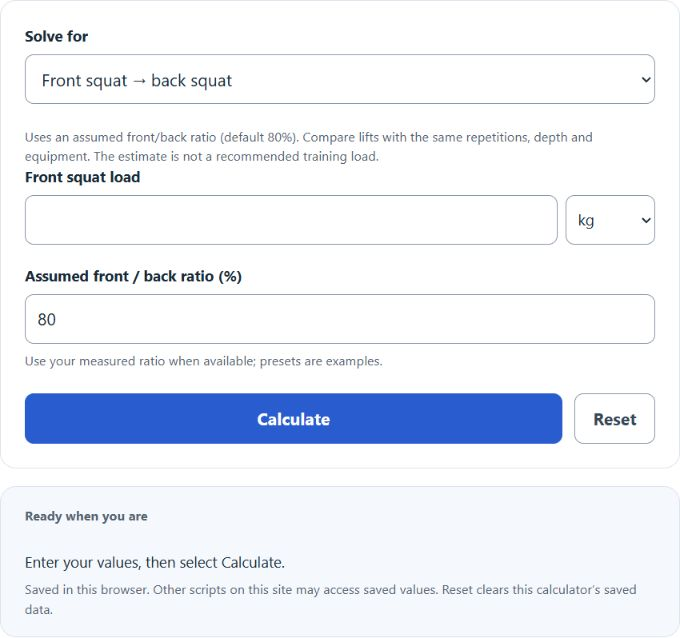
Estimate either squat load from the other using kg or lb and an assumed front-squat-to-back-squat ratio. Choose a ratio based on your own matched lift performances when available.
Quick Overview
Front squat to back squat comparisons are commonly used to estimate lower-body strength across different squat variations.
- 70% example: Back squat = front squat / 0.70
- 75% example: Back squat = front squat / 0.75
- 80% default assumption: Back squat = front squat / 0.80
- 85% example: Back squat = front squat / 0.85
For example, if your front squat is 100 and you assume an 80% ratio, your estimated back squat is 125.
Front Squat to Back Squat Formula
The following formula is used to estimate the back squat from a known front squat and an assumed strength ratio.
Variables:
- BS is the estimated back squat
- FS is the front squat
- r is the front-squat-to-back-squat ratio
To calculate the back squat, divide the front squat by the ratio that represents how large the front squat is relative to the back squat.
What is a Front Squat to Back Squat Conversion?
A front squat to back squat conversion is an estimate of how much a person can back squat based on their known front squat performance. Because the back squat places the bar in a more mechanically favorable position and usually allows greater total loading, most lifters can back squat more than they can front squat.
The 70%, 75%, 80% and 85% choices are illustrative assumptions, not validated categories for beginner or advanced lifters. Ratios vary with technique, training, mobility and the squat variation. Compare loads for the same repetition count, depth and equipment; this tool does not infer a one-repetition maximum or prescribe a training load.
How to Calculate Front Squat to Back Squat?
The following steps outline how to estimate a back squat from a front squat.
- First, determine your front squat weight (FS).
- Next, choose an assumed ratio or your measured front/back ratio, such as 0.70, 0.75, 0.80, or 0.85.
- Then calculate the estimated back squat using the formula BS = FS / r.
- Finally, compare the result with the calculator above to check your estimate.
Front Squat to Back Squat Conversion Table
The table below shows example conversions for a 100 kg front squat using illustrative front-squat-to-back-squat ratios.
| Example Assumption | Front Squat as % of Back Squat | If Front Squat = 100 kg, Estimated Back Squat |
|---|---|---|
| 70% example | 70% | ≈ 143 kg |
| 75% example | 75% | ≈ 133 kg |
| 80% default assumption | 80% | 125 kg |
| 85% example | 85% | ≈ 118 kg |
These values illustrate the formula rather than establishing strength benchmarks. Actual performance differences between the two lifts can vary from person to person based on training style, mobility, torso length, quadriceps strength, upper-back stability, and comfort in the rack position.
Example Problem:
Use the following variables as an example problem to test your knowledge.
Front Squat (FS) = 100 kg
Ratio (r) = 0.80
Estimated Back Squat (BS) = 100 / 0.80 = 125 kg