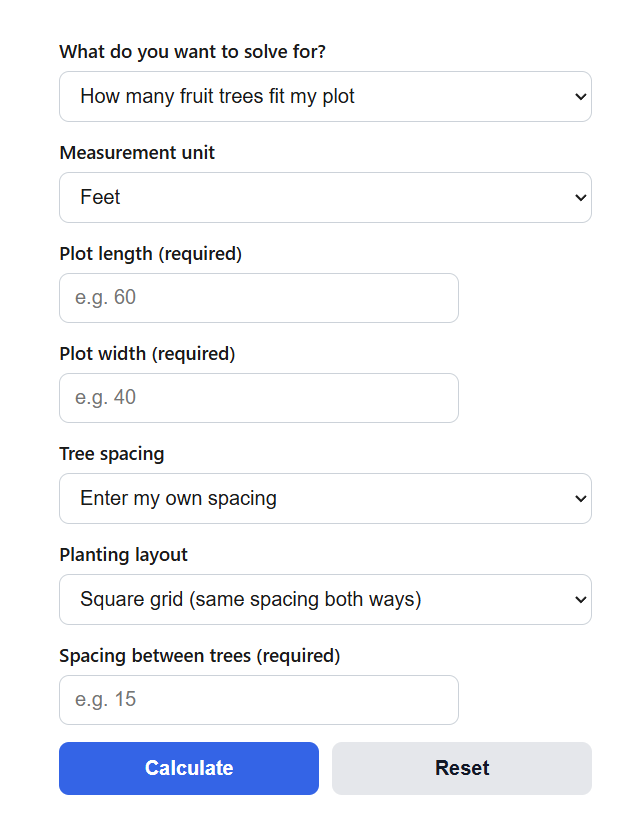
Calculate how far apart to plant fruit trees, how many trees fit your plot, and trees per acre, with spacing for dwarf, semi-dwarf, and standard sizes.
Fruit Tree Spacing Formula
To find how many trees fit a rectangular plot on a square grid, the calculator uses the following formula:
T = floor(L / S) * floor(W / S)
To find planting density from row spacing, it uses:
TPA = 43560 / (RS * IS)
For a triangular (offset row) layout, the rows sit closer together, so density becomes:
TPA = 43560 / (0.866 * S^2)
Variables:
- T is the number of trees that fit in the plot
- L is the plot length and W is the plot width, in feet
- S is the spacing between trees, measured trunk to trunk, in feet
- RS is the spacing between rows and IS is the spacing between trees within a row, in feet
- TPA is the number of trees per acre, and 43,560 is the number of square feet in one acre
- 0.866 is the row offset factor for triangular planting, which shortens the distance between rows while keeping every tree S feet from its neighbors
The first mode of the calculator applies the plot formula. Enter the length and width of your planting area, then either type your own spacing or pick a fruit tree and size to load a recommended spacing, and the tool returns the total tree count along with the row by row layout. The floor function rounds each direction down, because a partial spacing cell cannot hold a healthy tree.
The second mode looks up the recommended trunk to trunk distance for 17 common fruit trees in dwarf, semi-dwarf, and standard sizes, and reports the ground area each tree needs. The third mode applies the density formulas, converting any row and tree spacing into trees per acre and trees per hectare. Choosing the triangular layout in either the plot or density mode applies the 0.866 factor, which fits roughly 15 percent more trees in the same area than a square grid.
Recommended Spacing by Fruit Tree and Size
The distances below are typical trunk to trunk guidelines for healthy, full sun backyard trees. The trees per acre column assumes a square grid at the standard spacing.
| Fruit tree | Dwarf | Semi-dwarf | Standard | Trees per acre (standard) |
|---|---|---|---|---|
| Apple | 10 ft | 15 ft | 25 ft | 69 |
| Apricot | 10 ft | – | 25 ft | 69 |
| Avocado | 10 ft | – | 30 ft | 48 |
| Sweet cherry | 15 ft | 20 ft | 25 ft | 69 |
| Sour cherry | 10 ft | – | 20 ft | 108 |
| Fig | 10 ft | – | 20 ft | 108 |
| Grapefruit | 12 ft | – | 25 ft | 69 |
| Lemon | 10 ft | – | 20 ft | 108 |
| Lime | 8 ft | – | 15 ft | 193 |
| Mango | 15 ft | – | 30 ft | 48 |
| Nectarine | 8 ft | 18 ft | 25 ft | 69 |
| Orange | 8 ft | – | 20 ft | 108 |
| Peach | 10 ft | 15 ft | 20 ft | 108 |
| Pear | 8 ft | 12 ft | 20 ft | 108 |
| Persimmon | 10 ft | – | 25 ft | 69 |
| Plum | 10 ft | 15 ft | 20 ft | 108 |
| Pomegranate | 8 ft | – | 18 ft | 134 |
Cross-Pollination Distance Guide
Spacing is not only about canopy room. Several fruit trees will not set fruit unless a second, compatible variety blooms nearby, and bees do most of their work over short distances. Use this table to check whether your layout keeps pollination partners close enough.
| Fruit tree | Pollination need | Partner distance |
|---|---|---|
| Apple | Most varieties need a second variety that blooms at the same time | Within 50 ft is ideal, 100 ft maximum |
| Pear | Needs a second variety | Within 50 ft is ideal, 100 ft maximum |
| Sweet cherry | Most varieties need a partner | Within 50 ft is ideal, 100 ft maximum |
| Plum | Many varieties need a partner of the same type, Japanese with Japanese and European with European | Within 50 ft is ideal, 100 ft maximum |
| Avocado | Sets some fruit alone, but a type A plus type B pair raises yield | Same yard |
| Apricot, sour cherry, fig, citrus, mango, nectarine, peach, persimmon, pomegranate | Self-fruitful, one tree sets fruit on its own | No partner required |
This matters most on small plots. If only one standard apple fits your yard, it may bloom heavily and still produce almost nothing. Switching to two dwarf trees of different varieties at 10 ft spacing usually beats one lonely standard tree.
Fruit Tree Spacing Example Problems
Example 1: A backyard plot measures 60 ft long by 40 ft wide, and you want standard peach trees at 20 ft spacing on a square grid. Along the length, floor(60 / 20) = 3 trees fit per row. Across the width, floor(40 / 20) = 2 rows fit. The plot holds 3 * 2 = 6 peach trees, each with 400 sq ft of ground, which is a density of 43560 / 400, or about 108 trees per acre.
Example 2: A small orchard uses rows 18 ft apart with trees every 12 ft within the row. Each tree occupies 18 * 12 = 216 sq ft. Trees per acre equals 43560 / 216, which rounds down to 201 trees. Per hectare, 107639 / 216 gives about 498 trees.
Fruit Tree Spacing Frequently Asked Questions
How far apart should fruit trees be planted?
Dwarf fruit trees generally need 8 to 10 ft between trunks, semi-dwarf trees need 12 to 18 ft, and standard trees need 20 to 30 ft. The distance applies in every direction, including to buildings and fences, because roots and branches spread all around the trunk. When in doubt, plant farther apart. Crowded trees shade each other, dry more slowly after rain, and become more prone to fungal disease.
Can I plant fruit trees closer than the recommended spacing?
Yes, if you commit to controlling size. Backyard orchard culture deliberately plants two to four trees in a single wide hole or in a hedgerow as close as 2 to 3 ft, then relies on aggressive summer pruning to hold each tree small. You trade maximum yield per tree for more varieties and a longer harvest season in the same space. If you will not prune hard at least twice a year, keep the standard distances instead.
Do I always need two fruit trees to get fruit?
No. Peaches, nectarines, apricots, sour cherries, figs, citrus, persimmons, and pomegranates are self-fruitful, so a single tree produces on its own. Apples, pears, sweet cherries, and many plums need a second, compatible variety blooming within about 100 ft, and within 50 ft works better. A neighbor’s tree inside that range can serve as the partner, and a crabapple can pollinate most apples.