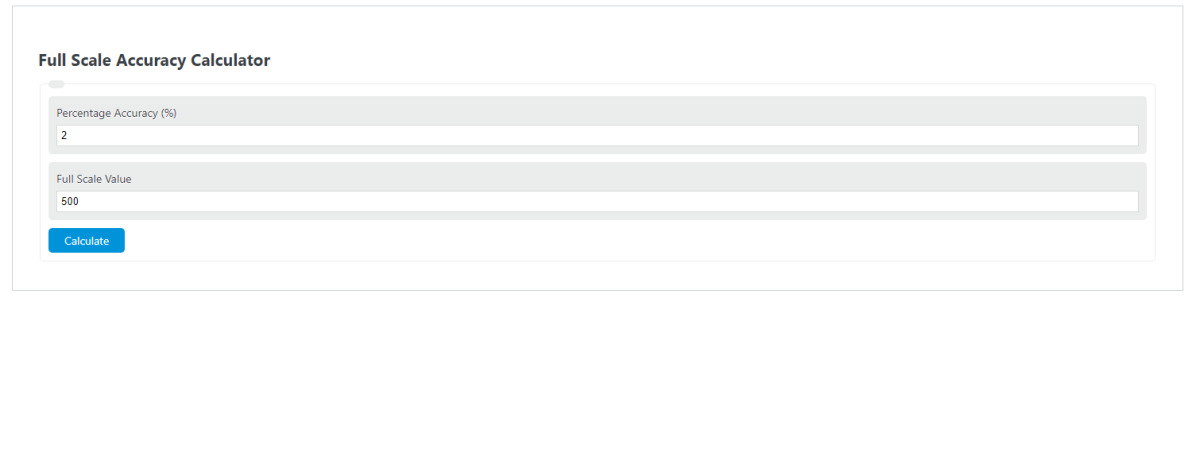
How do I use this calculator?
The basic portion of this calculator allows you to calculate any of the variables shown directly above.
Calculator Operations:
- Enter the percentage accuracy and full scale value to calculate the full scale accuracy.
- Enter the full scale accuracy and full scale value to calculate the percentage accuracy.
- Enter the full scale accuracy and percentage accuracy to calculate the full scale value.
The advanced version of this calculator allows you to calculate the required full scale accuracy based on the minimum accuracy threshold and target full scale value.
Use the calculate button when all known values have been entered and use the reset button when you want to clear the values from the calculator.
Calculate percent-of-full-scale error, accuracy percentage, or range span with bipolar ranges, reading limits, and percent-of-reading comparison.
- All Physics Calculators
- Percentage Accuracy Calculator
- Accuracy Calculator
- Reading Accuracy Rate Calculator
Full Scale Accuracy Formula
Full-scale accuracy converts an instrument’s percent-of-full-scale specification into an absolute error amount in the same units as the instrument range. This is useful for gauges, transmitters, meters, and sensors where the stated accuracy is tied to the maximum rated value rather than the current reading.
- FSA
- Full-scale accuracy expressed as an absolute amount of error.
- A
- Accuracy percentage stated by the instrument specification.
- FSV
- Full-scale value, or the maximum rated value of the instrument. For pressure applications, this is the full-scale pressure.
How to Use the Calculator
- Enter the instrument accuracy as a percentage, not a decimal.
- Enter the full-scale value using the units of your system, such as psi, bar, Pa, gpm, V, or A.
- Calculate the unknown value. The result for full-scale accuracy will be in the same units as the full-scale value.
How to Interpret the Result
The calculated full-scale accuracy is the allowable absolute error band associated with the device’s specification. If an instrument is rated at a percent of full scale, the error magnitude stays constant across the range, even though the reading itself changes.
- A larger full-scale range produces a larger absolute error for the same percentage accuracy.
- At lower readings, the same absolute error represents a larger percentage of the measured value.
- The result is an error magnitude, not a correction factor.
Example
Suppose a pressure gauge has an accuracy rating of 2% of full scale and a full-scale value of 500 psi.
This means the gauge can be off by as much as 10 psi high or low anywhere on its range.
| Gauge Reading | Absolute Error Band | Relative Error at That Reading |
|---|---|---|
| 50 psi | ±10 psi | 20% |
| 100 psi | ±10 psi | 10% |
| 250 psi | ±10 psi | 4% |
| 500 psi | ±10 psi | 2% |
Why Full-Scale Accuracy Matters
Two instruments can have the same percentage specification but very different absolute error bands if their full-scale ranges are different. Selecting a range much larger than the process value often reduces practical measurement quality at the low end of the scale.
Because of this, range selection is just as important as the published accuracy percentage.
Full-Scale Accuracy vs. Accuracy of Reading
- Percent of full scale: absolute error remains fixed across the instrument range.
- Percent of reading: error changes with the measured value.
If your specification sheet states accuracy as a percent of full scale, this calculator is the correct tool for converting that specification into a usable error amount.
Practical Tips
- Keep units consistent. If the full-scale value is entered in psi, the calculated full-scale accuracy will also be in psi.
- Enter the percentage as a whole percent value. For example, use 0.5 for 0.5%.
- Use the instrument’s maximum rated range as the full-scale value, not the current reading.
- If readings are consistently near the bottom of the scale, a lower-range instrument usually provides tighter usable accuracy.
- Resolution, hysteresis, temperature effects, and calibration drift are separate performance limits and may add to total measurement uncertainty.