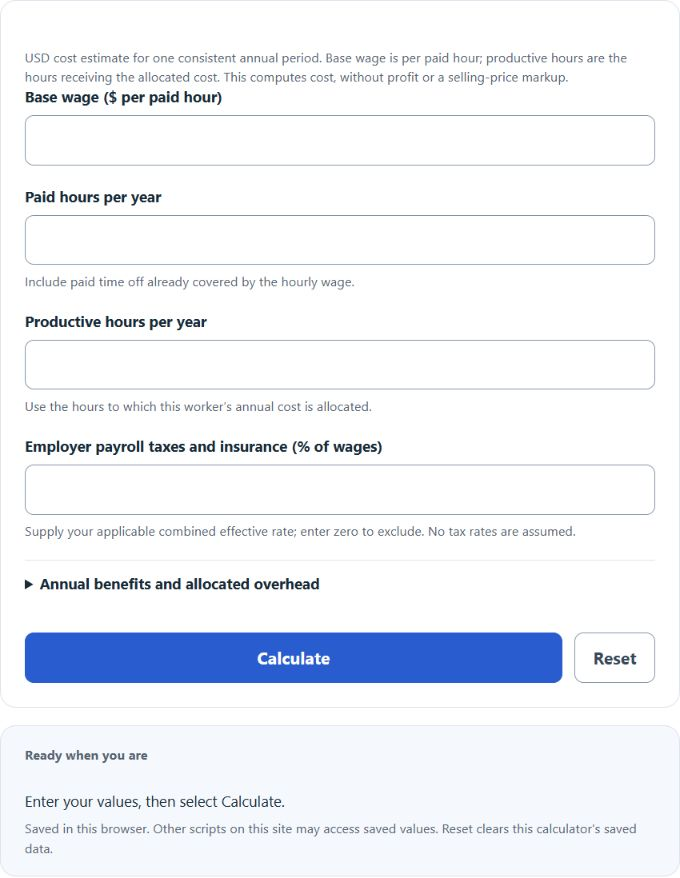
Estimate employer labor cost per productive hour in USD from the wage per paid hour, annual paid and productive hours, payroll burden, annual benefits and allocated overhead. This is a cost estimate, without profit or a charge-out markup.
Related Calculators
- Charge Out Rate Calculator
- Cost Per Hour Calculator
- Direct Labor Costs Calculator
- Predetermined Overhead Rate Calculator
- All Business Calculators
Fully Burdened Labor Rate Formula
The following formula is used to calculate the fully burdened labor rate.
Variables:
- FBLR is estimated employer labor cost in USD per productive hour.
- BR is the entered wage in USD per paid hour, applied uniformly to the paid hours in this estimate.
- H_paid is annual paid hours, including paid leave when those wages are included in BR × H_paid.
- H_prod is annual productive hours for this allocation, with 0 < H_prod ≤ H_paid.
- T is the entered nonnegative payroll taxes/insurance burden as a percentage of annual wages; no tax rate is inferred.
- B and O are additional annual employer benefits and allocated overhead in USD, respectively. Each is optional; a blank is explicitly treated as zero.
First compute annual wages W = BR × H_paid and annual payroll burden = W × T / 100. Add W, that payroll burden, B and O, then divide the annual total by H_prod. Enter the wage, paid hours, productive hours and payroll percentage explicitly; there is no assumed 2,080-hour year or payroll rate. Wage and payroll percentage may be zero; paid hours and productive hours must be positive, with productive hours no greater than paid hours. The payroll percentage has no arbitrary 100% cap.
What is a Fully Burdened Labor Rate?
Here, fully burdened labor cost means the entered annual employer costs allocated over the productive hours you specify for the same worker or consistent cost pool and year. Productive hours are a user-defined cost-allocation basis, not necessarily billable hours or a statutory hours-worked measure. Profit and selling-price markup are separate pricing decisions and are not included. Count each cost once: paid-leave wages already included in annual paid wages must not be added again as benefits, and payroll taxes/insurance or benefits already included elsewhere must not also be added to overhead. Include any allocated G&A within O only once. Use employer-paid amounts and consistent records; this simple percentage model does not determine legal payroll obligations, wage caps, overtime premiums or a market charge-out rate.
How to Calculate Fully Burdened Labor Rate?
The following steps outline how to calculate the Fully Burdened Labor Rate.
- Enter the wage BR in USD per paid hour for the annual estimate.
- Enter annual paid hours and annual productive hours explicitly. Include paid nonproductive time in paid hours; productive hours must be positive and no greater than paid hours.
- Enter the applicable payroll burden T as a percentage of annual wages, using your own employer-cost estimate.
- Enter additional annual employer benefits B in USD, excluding amounts already included in wages or the payroll burden. Leave blank only to use zero.
- Enter the annual overhead O allocated to the same worker or cost pool in USD, excluding costs already counted. Leave blank only to use zero.
- Compute annual wages W = BR × H_paid, then total annual cost = W + W × T / 100 + B + O.
- Divide total annual cost by H_prod to obtain USD per productive hour.
- Check the annual-cost breakdown and input assumptions. Use the result for cost planning; any selling-price or profit calculation is separate.
Example Problem :
The following values are entirely hypothetical; they are not suggested wages, payroll rates, benefits, overhead or work-year defaults.
Wage BR = $30.00 per paid hour.
Annual paid hours H_paid = 2,080; annual productive hours H_prod = 1,800.
Payroll burden T = 12% of annual wages.
Additional annual employer benefits B = $12,000.
Annual allocated overhead O = $8,000. Annual wages = $30 × 2,080 = $62,400; payroll burden = $62,400 × 12% = $7,488. Total annual cost = $62,400 + $7,488 + $12,000 + $8,000 = $89,888. Divide by 1,800 productive hours: FBLR = $49.937777… per productive hour, displayed as $49.94. No profit is included.