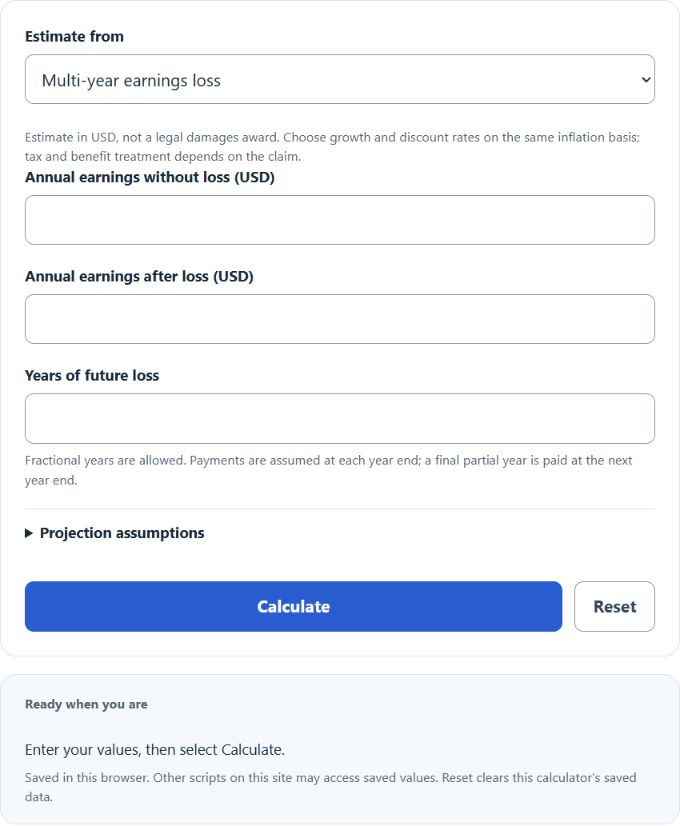
Estimate future loss of earnings from annual pay and days lost, hourly missed time, or pre- and post-injury income with present value.
Related Calculators
- Reduced Salary Calculator
- Hours To Money Calculator
- Days To Retirement Calculator
- Real Wage Rate Calculator
- All Personal Finance Calculators
Future Loss of Earnings Formula
For the Annual earnings and days lost mode, the following formula estimates gross earnings lost from a given number of days missed.
- Where FLE is the future loss of earnings ($)
- AS is the average annual salary or earnings ($)
- DPY is the days-per-year basis used to convert annual earnings to a daily rate (for example, 365 calendar days or 260 working days)
- DL is the total number of days lost (use the same type of days as DPY)
For daily loss, multiply AS / DPY by DL. The hourly mode uses hourly pay × hours lost. The multi-year mode projects the positive annual earnings gap with growth, adds the selected benefits percentage, subtracts fixed annual avoided expenses, floors loss at zero, and applies employment probability. It discounts each modeled year-end payment by (1 + discount rate) raised to its payment year; a final fractional year is prorated at the next year end. The optional flat tax percentage reduces that present value. These USD estimates are simplified scenarios, not legal damages awards. Growth and discount rates must use a consistent inflation basis.
What is a future loss of earnings?
Definition:
A future loss of earnings is an estimate of the earnings (or earning capacity) expected to be lost in the future due to an injury or other event that reduces the ability to work. When losses extend across multiple years, they are often projected over time and discounted to present value.
These events are commonly workplace injuries. In business contexts, similar methods are used to estimate future lost income or profits from events such as contract breaches or intellectual property infringement.
How to calculate future loss of earnings?
Example Problem:
The following example outlines the step-by-step process to calculate a future loss of earnings.
First, select Annual earnings and days lost and enter the average annual earnings. In this example, the average annual earnings are $100,000.00.
Next, determine the estimated number of days that will be lost. In this case, the event is an injury that causes a person to miss 100 working days.
Then, select a days-per-year basis that matches your definition of “days lost.” For working days, a common basis is 260 working days per year.
Finally, calculate the future loss of earnings using the formula above:
FLE = AS / DPY * DL
FLE = 100000 / 260 * 100
FLE = $38,461.54