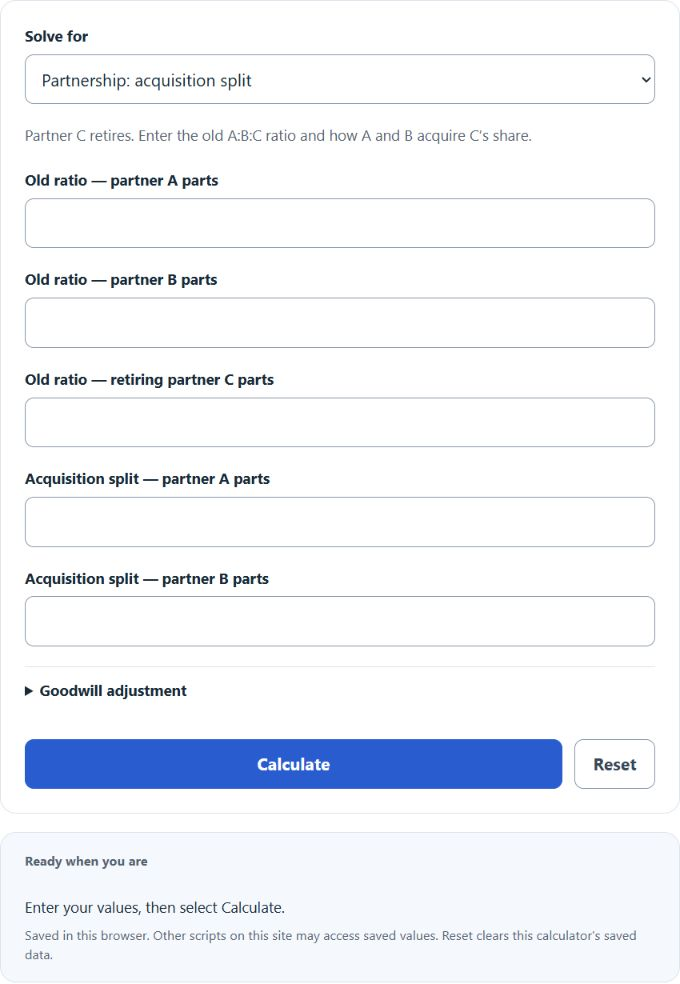
Calculate partnership gaining shares and goodwill when C retires, using either an acquisition split or a new A:B profit-sharing ratio. Separate machine-learning modes calculate the C4.5 information gain ratio from binary branch counts or precomputed information values.
- All Statistics Calculators
- All Ratio Calculators
- Profitability Ratio Calculator
- Operating Ratio Calculator
Gaining (Gain) Ratio Formula
The following formulas are used in partnership accounting to determine the gaining ratio (often called the “gain ratio”) when a partner retires.
- Where Gaini is the increase in profit share of continuing partner i (dimensionless fraction/ratio)
- New Sharei is partner i’s new profit-sharing fraction after retirement
- Old Sharei is partner i’s old profit-sharing fraction before retirement
In words: each continuing partner’s gain is their new profit-sharing share minus their old share. The gaining ratio is the ratio of these gains among the continuing partners. If an acquisition split is given, the retiring partner’s share is distributed to the continuing partners in that split, and the gaining ratio follows the same split.
How to Calculate Gain Ratio?
The following example problem outlines how to calculate the gaining (gain) ratio.
Example Problem #1:
- First, determine the old profit-sharing ratio (parts).
- The old ratio is given as A : B : C = 3 : 2 : 1.
- Next, identify the retiring partner and the acquisition ratio among the continuing partners.
- Partner C retires, and C’s share is acquired by A and B in the ratio 3 : 2.
- Finally, calculate each continuing partner’s gain and express it as a ratio:
Old shares: A = 3/6, B = 2/6, C = 1/6, so the retiring partner’s share is 1/6.
Gain of A = (1/6) × (3/(3+2)) = (1/6) × (3/5) = 1/10
Gain of B = (1/6) × (2/(3+2)) = (1/6) × (2/5) = 1/15
Gaining (Gain) Ratio = Gain of A : Gain of B = (1/10) : (1/15) = 3 : 2
FAQ
What is the significance of the Gain (Gaining) Ratio in business partnerships?
In partnership accounting, the gaining ratio describes continuing partners’ increases in profit share and is used to allocate a retiring partner’s goodwill adjustment. Reserves, accumulated profits/losses and revaluation results generally belong to all old partners in their old profit-sharing ratio; they should not simply be allocated in the gaining ratio. NCERT: Retirement/Death of a Partner.
Can the Gain Ratio be negative?
A continuing partner can lose share under an agreed new ratio even when another partner retires. A negative new-share-minus-old-share value is a sacrifice. The calculator shows the signed changes and withholds the simple retirement-only goodwill allocation when this occurs; the full agreement must account for the sacrificing partner as well.
How does the acquisition ratio affect the Gain (Gaining) Ratio?
The acquisition ratio states how the retiring partner’s share is taken over by the continuing partners. That split determines each continuing partner’s gain, so the gaining ratio matches the acquisition ratio (for example, if A and B acquire the retiring partner’s share in the ratio 3:2, their gaining ratio is 3:2).
The separate machine-learning gain ratio is information gain divided by split information. Both use base-2 entropy in bits. Branch-count mode requires a complete split of binary-class cases; known-value mode uses information values for the same split. It does not apply a universal strong/weak cutoff or automatically choose a tree split. Quinlan’s C4.5 explanation.