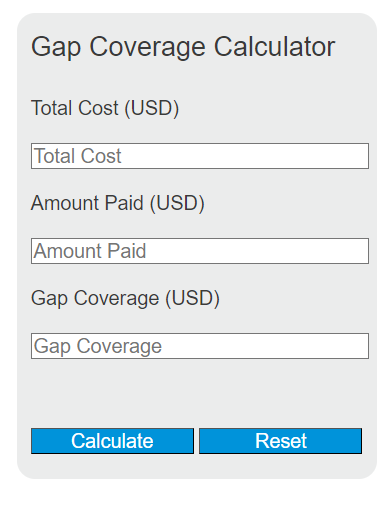
How do I use this calculator?
The basic portion of this calculator allows you to calculate any of the variables shown directly above.
Calculator Operations:
- Enter the total cost and amount paid to calculate the gap coverage.
- Enter the total cost and gap coverage to calculate the amount paid.
- Enter the amount paid and gap coverage to calculate the total cost.
The advanced version of this calculator adds an additional parameter of insurance coverage into the equation to calculate a more accurate adjusted gap coverage.
Use the calculate button when all known values have been entered and use the reset button when you want to clear the values from the calculator.
Calculate an auto loan or lease coverage gap, reverse-solve balance or insurance payout, and compare policy limits, uncovered shortfall, LTV, and coverage cost.
Related Calculators
- 20-4-10 Rule Calculator
- Car Insurance Cost Per Month Calculator
- Money Factor to Interest Rate Calculator
- Actual Cash Value Calculator
- Total Loss Calculator
- Auto Loan Per Diem Calculator
- Residual Value Calculator
- All Automotive Calculators
Gap Coverage Formula
The gap coverage amount is the remaining balance that still needs to be covered after subtracting the amount already paid from the total cost. This calculator is useful when you know any two values and want to solve for the third.
| Variable | Meaning | Typical Unit |
|---|---|---|
| GC | Gap coverage, or the remaining amount still to be covered | USD |
| TC | Total cost, total balance, or total amount owed | USD |
| AP | Amount already paid toward the total cost | USD |
If you need to solve for a different variable, the same relationship can be rearranged:
How to Calculate Gap Coverage
- Identify the total cost or total amount owed.
- Determine how much has already been paid toward that amount.
- Subtract the amount paid from the total cost.
- The result is the remaining gap coverage needed.
This is a straightforward remaining-balance calculation, but it becomes especially useful when comparing payoff amounts, partial payments, and expected reimbursements.
Adjusted Gap Coverage with Insurance
In some situations, such as auto loans or financed assets, you may also want to consider an insurance payout or another outside payment source. In that case, the uncovered portion can be estimated with an adjusted formula:
| Variable | Meaning | Typical Unit |
|---|---|---|
| AGC | Adjusted gap coverage after insurance or reimbursement | USD |
| IC | Insurance coverage or payout applied to the remaining balance | USD |
If the adjusted result is negative, that usually means the balance has already been fully covered. In practical terms, the remaining uncovered gap would be treated as zero.
Examples
Example 1: Basic Gap Coverage
Suppose the total cost is $25,000 and the amount already paid is $10,000.
The remaining gap coverage needed is $15,000.
Example 2: Gap Coverage After Insurance
Using the same numbers, assume an insurance payment of $8,000 is also available.
After accounting for the insurance payment, the remaining uncovered amount is $7,000.
How to Interpret the Result
- Positive result: There is still a balance that needs to be covered.
- Zero result: The amount owed has been fully covered.
- Negative result: Payments and reimbursements exceed the target amount; for remaining-gap purposes, this is generally treated as no gap.
When This Calculator Is Useful
- Auto financing: Estimate how much balance remains after down payments or reimbursements.
- Vehicle loss scenarios: Compare a payoff amount against payments already made and any insurance settlement.
- Equipment or asset financing: Measure the unpaid difference on financed property.
- Loan planning: See how much is left to cover after a lump-sum payment.
- Budgeting: Identify the exact shortfall before making another payment decision.
Input Tips for Better Accuracy
- Use the same currency for every field.
- Make sure all values are based on the same point in time.
- Only include amounts that have actually been paid or are reasonably expected to be applied.
- If you include taxes, fees, or add-ons in total cost, keep your other inputs on that same basis.
- For insurance-related estimates, distinguish between the total amount owed and the amount already paid by you.
Common Mistakes
- Confusing total purchase price with current remaining balance.
- Entering an expected reimbursement as part of the amount already paid.
- Mixing gross totals with net payouts.
- Using values from different dates, which can distort the result.
Frequently Asked Questions
What does gap coverage mean?
Gap coverage is the amount still left to cover after subtracting what has already been paid from the total cost or balance.
Is a lower gap coverage value better?
Usually, yes. A lower value means less remains unpaid. A value of zero means the balance has been fully covered.
Can this calculator be used outside of car loans?
Yes. The same math works for any situation involving a total amount and partial payments, including equipment purchases, service balances, and other financed costs.
Should I include insurance in the basic calculation?
Not unless you are specifically trying to estimate the remaining uncovered portion after insurance. For the basic formula, use only total cost and amount already paid.
What if I only know the gap coverage and the amount paid?
You can solve for the total cost by adding them together.
This makes the calculator flexible whether you are solving for the remaining gap, reconstructing the total cost, or checking how much has already been paid.