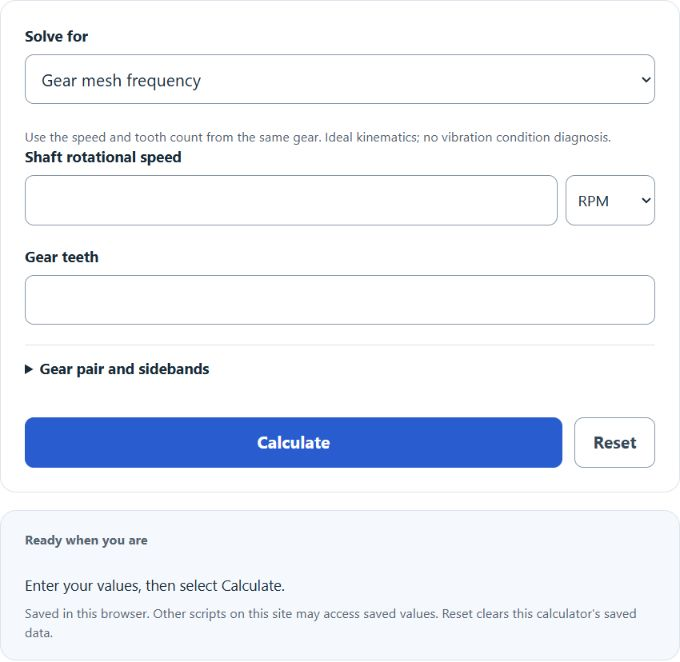
Calculate gear mesh frequency from shaft speed and tooth count, or solve for shaft speed or teeth, with RPM, Hz, CPM, gear ratio, and sideband results.
- All Frequency Calculators
- RPM Gear Ratio Calculator
- Gearbox Efficiency Calculator
- Worm Gear Torque Calculator
- All Automotive Calculators
Gear Mesh Frequency Formula
Gear mesh frequency, often abbreviated as GMF, is the tooth-passing frequency created as gear teeth engage. In practical terms, it tells you how many tooth contacts occur during a unit of time. This makes it a key value for gearbox design, vibration analysis, fault detection, and general rotating equipment diagnostics.
If the rotational speed is entered in revolutions per minute, the result is in cycles per minute. If the speed is entered in revolutions per second, the result is in cycles per second. The calculator can also work from angular speed in radians per second by converting angular motion into revolutions first.
Variable Definitions
- GMF = gear mesh frequency
- R = rotational speed of the gear
- N = number of teeth on the gear
The most important concept is that each full revolution produces one tooth pass for every tooth on the gear. A 20-tooth gear generates 20 tooth engagements per revolution, so the mesh frequency is much higher than shaft rotational frequency.
Rearranged Forms
Because this calculator can solve for a missing value, the equation can also be rearranged to find rotational speed or tooth count.
Use these forms when you know the measured mesh frequency and want to estimate shaft speed, or when you know the frequency and speed and need to confirm the likely tooth count.
Common Unit Forms
| Input Speed | Formula | Output Unit |
|---|---|---|
| RPM | GMFCPM = RPM × N |
cycles per minute |
| RPS | GMFCPS = RPS × N |
cycles per second |
| rad/s | GMFCPS = (ω × N) / (2π) |
cycles per second |
| Convert CPM to CPS | GMFCPS = GMFCPM / 60 |
Hz |
| Convert CPM to CPH | GMFCPH = GMFCPM × 60 |
cycles per hour |
For a Pair of Meshing Gears
In a gear pair, both gears share the same mesh frequency even though their shaft speeds are different. You can calculate GMF from either gear as long as you use the matching speed and tooth count from that same gear.
This is useful when checking a driver and driven gear. The larger gear rotates more slowly, but it has more teeth, so the tooth engagement rate remains the same at the mesh.
How to Calculate Gear Mesh Frequency
- Determine the gear speed in RPM, RPS, or radians per second.
- Count the number of teeth on the gear.
- Match the speed unit to the correct form of the equation.
- Multiply the rotational speed by the tooth count.
- Convert the result to the desired unit if needed.
Example
A gear rotates at 300 RPM and has 20 teeth.
That means the gear produces 6,000 tooth engagements per minute.
So the same operating condition can be described as 6,000 CPM, 100 CPS, or 360,000 CPH depending on the unit system you need.
Why Gear Mesh Frequency Matters
- Vibration analysis: GMF is one of the first frequencies checked when diagnosing gearbox vibration.
- Noise prediction: Tooth engagement creates periodic excitation that can drive audible noise.
- Fault detection: Tooth wear, broken teeth, eccentricity, and alignment problems often affect vibration near the mesh frequency and its harmonics.
- Design verification: Engineers compare GMF to natural frequencies to reduce resonance risk.
Common Input Tips
- The number of teeth should normally be a whole number greater than zero.
- Do not mix tooth count from one gear with speed from the other gear unless you first convert using the gear ratio.
- RPM gives GMF in cycles per minute, not hertz, unless you divide by 60.
- Gear mesh frequency is an excitation frequency, not the same thing as shaft speed.
- If you enter angular speed in radians per second, convert to revolutions per second by dividing by 2π.
Quick Interpretation Guide
A higher tooth count raises the gear mesh frequency even if shaft speed stays constant. A higher shaft speed also raises the mesh frequency even if tooth count does not change. Because both variables scale the result directly, doubling either one doubles the gear mesh frequency.
That direct relationship makes GMF fast to estimate and easy to validate with the calculator above.