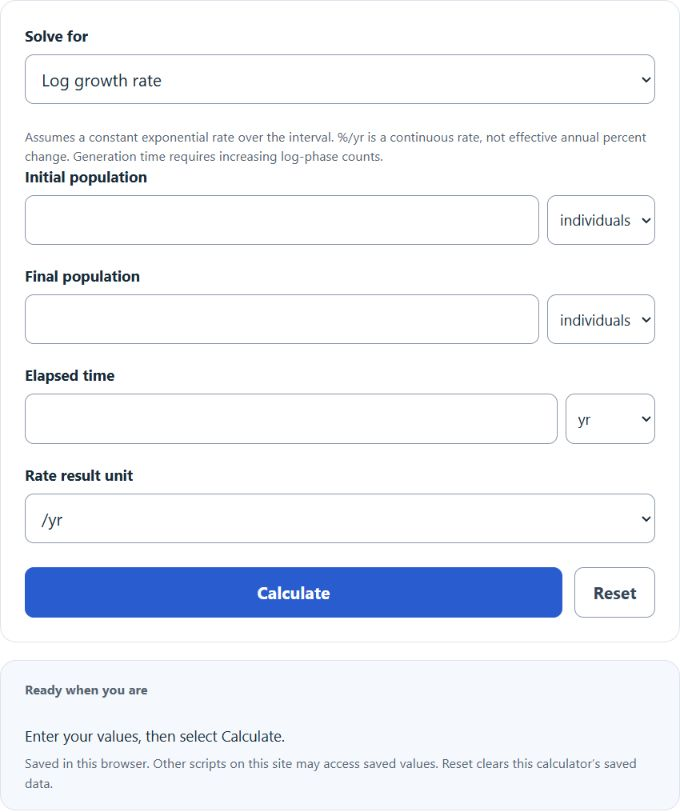
Calculate log growth rate, population, or time from initial and final population values, with generation time from count changes over time.
Log Growth Rate Formula
The following formula calculates the average continuous log growth rate over a positive elapsed time, using positive population values. A constant-rate projection uses P1 = P0 × exp(r × t); its continuous rate differs from an effective percentage change.
Variables:
- r is the continuous log growth rate, in inverse time units (a negative rate represents decline)
- P0 is the initial population
- P1 is the final population
- t is the time over which the growth occurs
To calculate the log growth rate, divide the natural logarithm of the final population divided by the initial population by the time over which the growth occurs.
What is Log Growth Rate?
Log growth rate is a measure of the rate at which a population grows exponentially over time. It is a common concept in biology, demography, and other fields where understanding the dynamics of population growth is important. The log growth rate is based on the natural logarithm and provides a way to quantify the growth in a way that can be easily compared across different populations or time periods.
How to Calculate Log Growth Rate?
The following steps outline how to calculate the Log Growth Rate.
- First, determine the initial population (P0).
- Next, determine the final population (P1).
- Next, determine the time over which the growth occurs (t).
- Next, gather the formula from above = r = (ln(P1 / P0)) / t.
- Finally, calculate the Log Growth Rate (r).
- After inserting the variables and calculating the result, check your answer with the calculator above.
Example Problem :
Use the following variables as an example problem to test your knowledge.
Initial Population (P0) = 100
Final Population (P1) = 200
Time (t) = 5 years