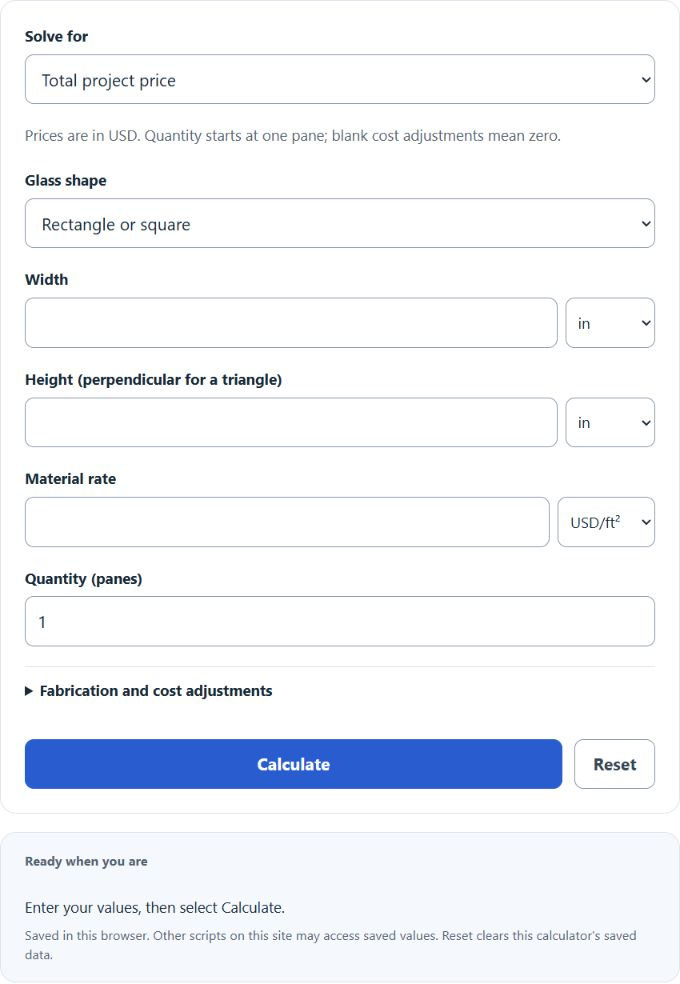
Estimate custom glass price by shape, dimensions, area rate, quantity, waste, edgework, cutouts, fixed costs, and markup—or reverse-check a supplier’s material rate.
Glass Price Formula
The glass price calculator estimates project cost from the selected shape, dimensions, area rate and quantity, with optional waste, edgework, fabrication, cutouts, fixed costs and markup. Prices are expressed in USD. This is useful for pricing windows, mirrors, shelves, table tops, cabinet inserts, partitions, and other custom-cut panels. In its simplest form, total price rises in direct proportion to area, so larger panes cost more when the price per unit area stays the same.
| Variable | Meaning | Typical Unit |
|---|---|---|
| GP | Base material price before optional adjustments | dollars |
| GA | Glass area | in² when using cost per in² |
| GCSI | Glass cost per square inch | dollars per in² |
The simple area-only relationship can be rearranged as shown below. The calculator offers Total project price and Material rate from a quote; both use the entered pane dimensions. In the reverse mode, it removes the entered markup and extras before finding the material rate.
Rearranged Forms
How to Calculate Glass Price
- Measure the finished glass dimensions, not just the rough opening.
- Calculate the glass area using the correct shape formula.
- Make sure the area unit and price unit are compatible.
- Select the shape and enter its dimensions, quantity and material rate, or enter a supplier quote in the reverse mode.
- Enter included waste, edgework, fabrication, cutout and fixed charges in the optional section before calculating. Avoid double-counting charges already included in a rate.
Area Formulas for Common Glass Shapes
Many glass pieces are rectangular, but circles and triangular inserts are also common. Use the appropriate area formula before pricing the panel.
For rectangles, measure length and width in the same unit. For circles, the formula uses radius, while the calculator asks for diameter and divides it by two. For triangles, multiply the base by the perpendicular height and divide by two.
Unit Conversion Notes
Glass is often quoted by square foot, while some calculators or fabrication sheets use square inches. Matching units is essential; otherwise the result will be off by a large factor.
In the second equation, GCSF means the glass cost per square foot. Divide the square-foot price by 144 to convert it to a square-inch price.
Examples
Example 1: Price from square inches
A piece of glass has an area of 50 in² and a cost of $12 per in².
The total glass price is $600.
Example 2: Converting a square-foot quote
A panel has an area of 8 ft², and the supplier price is $18 per ft².
Since 8 ft² equals 1,152 in², the total price is $144.
What Can Increase the Final Glass Cost?
The calculator gives a strong base estimate, but final quotes often include more than raw sheet area. Total project cost can rise due to:
- Glass type: tempered, laminated, insulated, frosted, tinted, or low-iron glass usually costs more than basic clear glass.
- Thickness: thicker glass generally has a higher unit price.
- Edge finishing: seamed, polished, beveled, or mitered edges add fabrication cost.
- Cutouts and holes: notches, drill holes, hinge cutouts, and hardware prep increase labor.
- Custom shapes: circles, arches, and irregular templates can price differently than standard rectangles.
- Minimum order charges: small pieces may still be subject to shop minimums.
- Shipping and installation: delivery, handling, and on-site labor are often separate from material price.
Adding Waste or Overage
When ordering multiple pieces or planning around breakage risk, it can be smart to add an overage percentage to the estimated price.
Here, w is the waste rate written as a decimal. For example, 10% waste means using 0.10.
Tips for Accurate Estimates
- Measure twice and use final finished dimensions.
- Keep all dimensions in the same unit before calculating area.
- Confirm whether the supplier quote is material-only or includes fabrication.
- Ask whether edgework, holes, and tempering are included in the unit price.
- Use the calculator to compare multiple thicknesses or glass types quickly.
- For quote comparison, choose Material rate from a quote and enter the same dimensions and included adjustments for each supplier.
Common Questions
Does this calculator include labor?
Include labor in the entered material rate, fabrication per pane or fixed costs when appropriate. Do not include the same charge twice. Taxes, minimum charges and installation are excluded unless entered in the rates or costs.
Can I use square feet instead of square inches?
Yes, but your area and price units must match. If your cost is quoted per square foot, convert it before using a square-inch pricing formula.
Why is my supplier quote higher than the calculator result?
Supplier quotes may include tempering, edge polishing, cutouts, minimum charges, packing, freight, or installation that are not part of the base area-only estimate.
Can this formula be used for mirrors?
Yes. The same pricing structure applies to mirrors and many other flat glass products as long as the price is based on area.