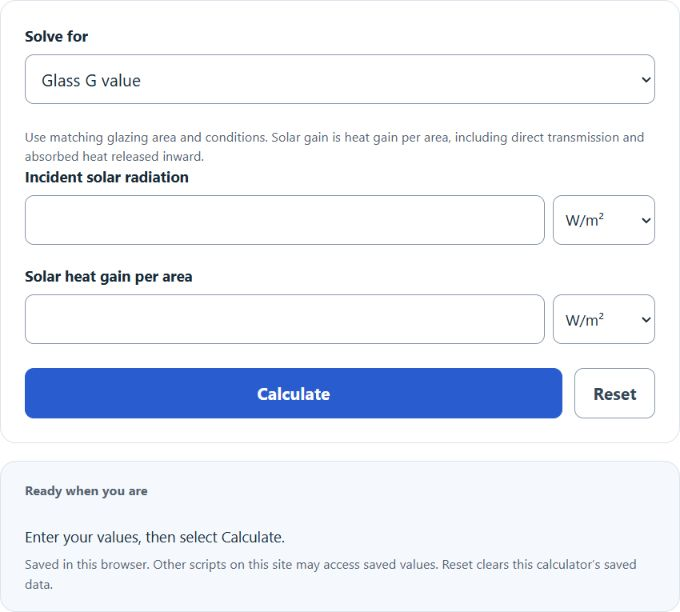
Choose glass G value, incident solar radiation, or solar heat gain per area to calculate, with W/m² and Btu/(h·ft²) units for windows and glazing.
Related Calculators
- Insulation K Value Calculator
- sq ft To Btu Calculator
- Chimney Effect Calculator
- Wind Pressure & Force Calculator
- All Construction Calculators
Glass G Value Formula
The glass G value compares the solar heat gained inward through glazing (directly transmitted plus absorbed heat released inward) to the incident solar radiation. When G value is entered as a percentage, divide it by 100 before using it as a multiplier.
- G = glass G value, expressed as a percentage
- TSG = solar heat gain per unit glazing area, not total window watts
- ISR = incident solar radiation hitting the glass
Select what to calculate, then enter the two required values. Radiation and gain must refer to the same glazing area and conditions. G value uses percentages from 0 to 100.
The calculator supports W/m² and BTU/hr·ft². Both radiation values are converted to W/m² during the calculation, then converted back to the selected output unit.
Typical Glass G Value Ranges
G value depends on glass type, coating, tint, and glazing system. The ranges below are broad illustrations, not product ratings; use the tested manufacturer value for the exact glazing. Lower values mean less inward solar heat gain.
| Glass or glazing type | Typical G value | General meaning |
|---|---|---|
| Clear single glazing | 75% to 90% | High solar heat gain |
| Clear double glazing | 60% to 80% | Moderate to high solar heat gain |
| Tinted glazing | 35% to 65% | Reduced solar gain |
| Low-e solar control glazing | 20% to 50% | Lower heat gain, often used for cooling control |
| Highly reflective or specialist solar control glass | 10% to 30% | Very low solar heat gain |
Radiation Unit Conversion
| Conversion | Factor |
|---|---|
| BTU/hr·ft² to W/m² | multiply by 3.154590745 (International Table Btu) |
| W/m² to BTU/hr·ft² | multiply by 0.316998331 (International Table Btu) |
Example Calculations
Example 1: Calculate glass G value
You have incident solar radiation of 800 W/m² and total solar gain of 480 W/m².
The glass G value is 60%.
Example 2: Calculate total solar gain
You have incident solar radiation of 700 W/m² and a glass G value of 45%.
The total solar gain is 315 W/m².
FAQs
What does glass G value mean?
Glass G value is the percentage of incident solar energy that becomes inward heat gain, including direct transmission and the inward part of absorbed heat. A G value of 60% means an inward gain equal to 60% of the incident radiation under the specified conditions.
Is G value the same as solar heat gain coefficient?
They describe closely related solar heat gain fractions. This calculator represents G as a percentage: 60% is the fraction 0.60. Glazing-only and whole-window ratings can differ; compare ratings for the same assembly and test conditions.
Is a lower glass G value always better?
Not always. A lower G value reduces solar heat gain, which can help reduce cooling demand. A higher G value allows more solar heat in, which can be useful in colder climates or during winter. The better value depends on climate, window direction, shading, and heating or cooling needs.