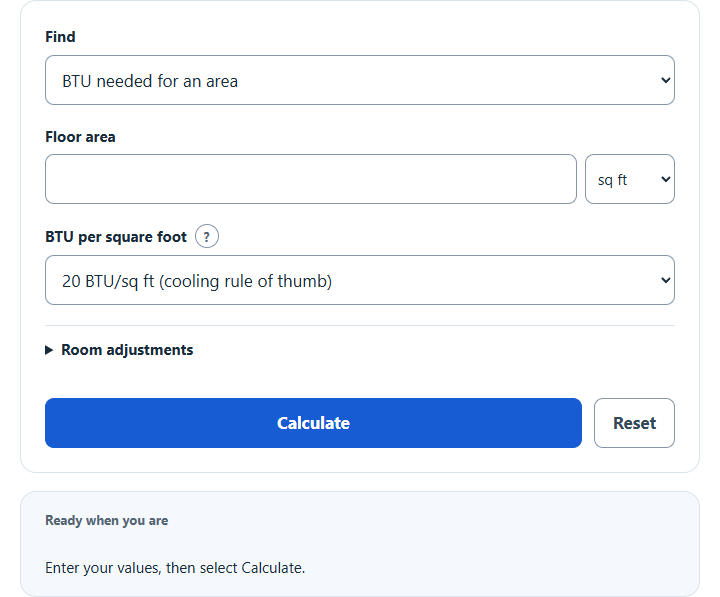
Estimate how many BTUs you need from square footage using 20 BTU per sq ft or your own value, or find how many square feet a BTU rating will cover.
Related Calculators
- Bathroom Area Calculator
- People Per Square Foot Calculator
- Hot Water Demand Calculator
- 3 Phase Breaker Calculator
- All Construction Calculators
Calculator Functions
| Function | What it does | What it requires |
|---|---|---|
| BTU needed for an area | Estimates the heating or cooling capacity for a floor area | Requires the floor area and a BTU per square foot figure |
| Square feet a BTU rating covers | Estimates the floor area a unit can serve | Requires the capacity in BTU/h, kW or tons and a BTU per square foot figure |
| BTU per square foot | Finds the BTU per square foot a unit supplies over a floor area | Requires the floor area and the capacity |
BTU per square foot can be 20 (a cooling rule of thumb), 25 (a higher load) or a custom figure in BTU/h per sq ft or W/m². Floor area can be entered in square feet or square metres. Four optional room adjustments change the result: climate (×0.90 to ×1.30), insulation (×0.85 to ×1.20), ceiling height and the number of regular occupants.
Sq Ft to BTU Formulas
| Q | Capacity needed (BTU/h) |
| A | Floor area (sq ft) |
| L | BTU/h per square foot: 20, 25 or custom |
| K | Room adjustment: climate × insulation × (ceiling height ÷ 8). It is 1 with no adjustments |
| P | 600 BTU/h for each regular occupant above two [1] |
BTU needed for an area
A 500 sq ft space at 20 BTU/h per sq ft needs 500 × 20 = 10,000 BTU/h, which is 0.83 tons or 2.93 kW. One ton is 12,000 BTU/h and 1 kW is 3,412.14 BTU/h [2]. With every adjustment in use, the same 500 sq ft in a severe climate (×1.30) with limited insulation (×1.20), a 10 ft ceiling (10 ÷ 8 = 1.25) and four occupants needs 500 × 20 × 1.30 × 1.20 × 1.25 + 1,200 = 20,700 BTU/h. The 8 ft ceiling base and the 600 BTU/h per extra occupant match the ENERGY STAR room air conditioner guidance [1].
Square feet a BTU rating covers
A 12,000 BTU/h (1 ton) unit at 20 BTU/h per sq ft covers 12,000 ÷ 20 = 600 sq ft. At 25 BTU/h per sq ft it covers 480 sq ft.
BTU per square foot
An 18,000 BTU/h unit serving 800 sq ft supplies 18,000 ÷ 800 = 22.5 BTU/h per sq ft, which is 70.98 W/m².
BTU by square footage
| Floor area (sq ft) | At 20 BTU/sq ft | At 25 BTU/sq ft | ENERGY STAR room AC chart [1] |
|---|---|---|---|
| 150 | 3,000 | 3,750 | 6,000 |
| 300 | 6,000 | 7,500 | 8,000 |
| 500 | 10,000 | 12,500 | 12,000 |
| 600 | 12,000 | 15,000 | 14,000 |
| 700 | 14,000 | 17,500 | 18,000 |
| 1,000 | 20,000 | 25,000 | 21,000 |
| 1,200 | 24,000 | 30,000 | 23,000 |
| 1,500 | 30,000 | 37,500 | 30,000 |
| 1,800 | 36,000 | 45,000 | 30,000 |
| 2,000 | 40,000 | 50,000 | 34,000 |
The first two columns are floor area times 20 or 25, in BTU/h, with no room adjustments. The last column is the capacity ENERGY STAR lists for a room air conditioner cooling that area. Its chart is not a flat rate: for the sizes in this table it works out to about 17 to 26 BTU/h per sq ft from 500 to 2,000 sq ft, and 27 to 40 for the two smallest rooms.
Limits of This Estimate
- This is a rule-of-thumb estimate from floor area. It does not replace a room-by-room load calculation by an HVAC contractor, which is how central heating and cooling equipment is sized.
- The 20 BTU/h per sq ft figure is for cooling. Heating loads depend far more on climate and insulation, and are often higher.
- The climate and insulation multipliers are planning factors built into this calculator, not values from a standard. These estimates are based on the best available data and estimations.
- ENERGY STAR also adjusts 10% down for a heavily shaded room, 10% up for a very sunny one, and adds 4,000 BTU/h for a kitchen [1]. The calculator has no inputs for these.
Sources
- ENERGY STAR (U.S. EPA), Room Air Conditioners: room air conditioner sizing chart, the 8-foot ceiling basis and the adjustments for shade, sun, occupants and kitchens
- NIST, Guide for the Use of the International System of Units (SP 811), Appendix B.8: the ton of refrigeration as 12,000 BTU per hour, and BTU per hour in watts