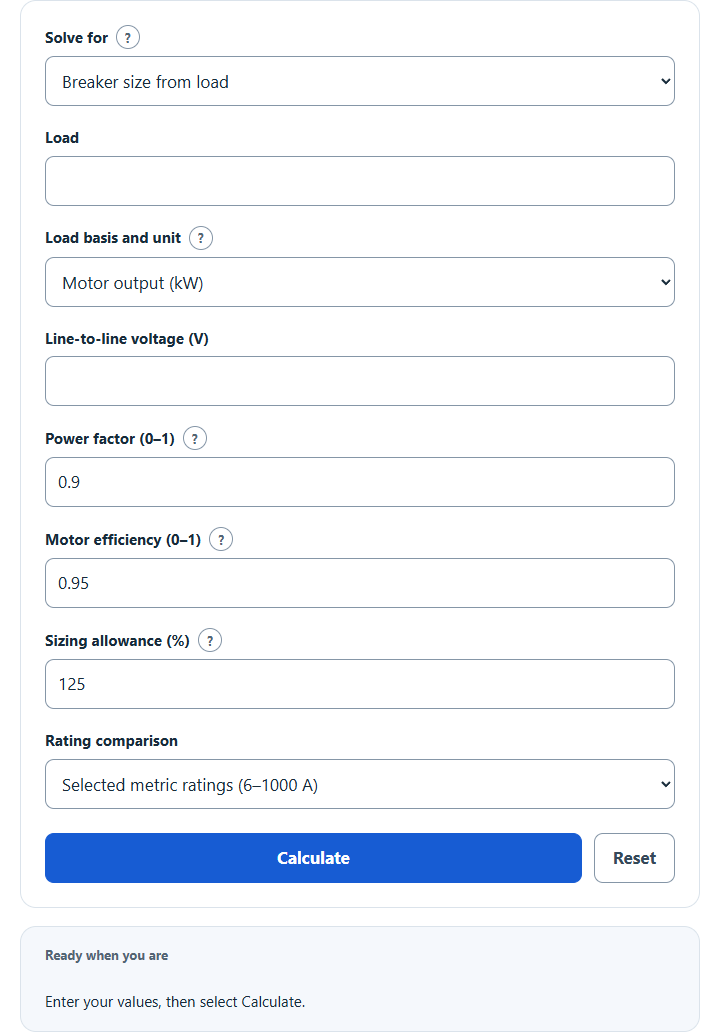
Calculate 3 phase breaker size and line current from motor kW, hp or kVA and voltage, using a typical power factor, efficiency and 125% allowance.
Related Calculators
- Fault Current Calculator
- Transformer Wire Size Calculator
- Electric Panel Cost Calculator
- Dimmer Wattage Calculator
- All Construction Calculators
3 Phase Breaker Formula
The following equation is used to calculate the total load, line voltage, or circuit current in a balanced three-phase electrical system at unity power factor (PF = 1).
- Where TL is the total load in kilowatts (kW) at PF = 1
- V is line-to-line RMS voltage in volts (V)
- I is calculated line current in amperes (A), not an approved breaker rating
For electrical input power P, I = P × 1000 / (√3 × V × PF). For motor output kW, divide by efficiency as well. Apparent kVA uses I = kVA × 1000 / (√3 × V); mechanical hp is first converted to output kW using 0.745699871582. The selected rating is the next listed value at or above I × allowance / 100. The 125% default is only an adjustable calculation allowance; it is not a universal motor-breaker rule. Lists are comparison subsets. Applicable code and table current, motor starting current, trip characteristics, conductor and overload protection, fault-interrupting capacity and manufacturer coordination still determine suitable equipment. See ABB’s three-phase power relationships and Schneider’s motor-protection selection qualifications.
What is a 3 Phase Breaker Calculator?
Definition:
This calculator provides balanced three-phase arithmetic estimates. Choose a mode to compare calculated current with listed ratings, estimate motor output from a rating and allowance, or calculate voltage from power and current. It does not establish an approved breaker or a motor’s permissible supply voltage.
How to Use the 3 Phase Breaker Calculator?
Example Problem:
Choose “Breaker size from load” for this example.
Enter load 20, choose electrical input (kW), enter line-to-line voltage 400 V and PF 1. Efficiency affects the displayed motor-output conversion, not current for this input-power basis.
Use an allowance of 125% and the selected metric ratings, then select Calculate.
The calculated line current is:
I = (TL × 1000) / (√3 × V)
I = (20 × 1000) / (√3 × 400)
I ≈ 28.87 A. Multiplying by 1.25 gives approximately 36.08 A, so the next value in the selected metric list is 40 A. This comparison does not establish that a 40 A breaker is suitable.
FAQ
What parameters are required for the 3 Phase Breaker Calculator?
Select a calculation mode and complete its visible fields. Current comparison uses load, basis, voltage, PF, efficiency and an allowance. Power estimation uses a rating, voltage, PF, efficiency and allowance. Voltage estimation uses load, basis, current, PF and efficiency.
How do I choose the calculation?
Use the “Solve for” menu. Irrelevant fields are hidden. Changing the load basis reinterprets the entered magnitude; it does not automatically convert that value.
Can this calculator be applied to all three‐phase systems?
It estimates balanced three-phase RMS relationships using the entered PF and efficiency. Defaults are PF 0.9 and efficiency 0.95; use applicable values. It does not model imbalance, harmonics, motor starting or protection coordination. Final equipment selection requires applicable code, nameplate and manufacturer data.