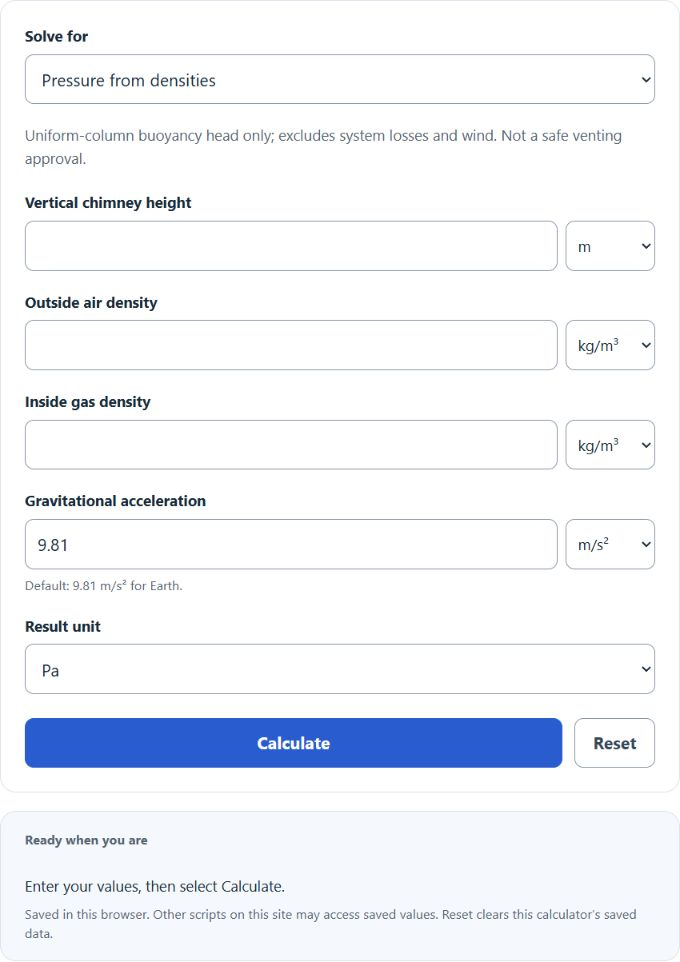
Calculate theoretical chimney-effect pressure from uniform column densities or an ideal temperature approximation. Optional flow is an illustrative outdoor-air estimate, not a guaranteed appliance flow.
Chimney Effect Formula
The following uniform-column formula estimates buoyancy pressure from the chimney effect. It excludes flow losses, wind and building pressure.
Variables:
- ΔP is the pressure difference (Pa)
- H is the height of the chimney (m)
- ρ_o is the density of outside air (kg/m³)
- ρ_i is the density of inside air (kg/m³)
- g is the gravitational acceleration (m/s²)
To calculate the pressure difference due to the chimney effect, multiply the height of the chimney by the difference in densities of the outside and inside air, and then multiply by the gravitational acceleration.
What is the Chimney Effect?
The chimney effect, also known as stack effect, is the movement of air into and out of buildings, chimneys, flue gas stacks, or other containers, resulting from air buoyancy. Buoyancy occurs due to a difference in indoor-to-outdoor air density resulting from temperature and moisture differences. The greater the height of the structure, the greater the buoyancy force, and thus the stack effect. This phenomenon is commonly observed in chimneys, where the warm air inside the chimney rises and creates a pressure difference that draws cooler outside air into the building.
How to Calculate Chimney Effect?
Select Pressure from densities for the steps below, or choose another value to solve. Temperature mode assumes both columns have the same gas constant and pressure; use absolute temperatures internally and a density appropriate to outside conditions.
- First, determine the height of the chimney (H).
- Next, determine the density of the outside air (ρ_o).
- Next, determine the density of the inside air (ρ_i).
- Next, use the gravitational acceleration (g), which is typically 9.81 m/s².
- Finally, calculate the pressure difference using the formula ΔP = H * (ρ_o - ρ_i) * g.
- After inserting the values and calculating the result, check your answer with the calculator above.
Example Problem :
Use the following variables as an example problem to test your knowledge.
Height of Chimney (H) = 10 m
Density of Outside Air (ρ_o) = 1.2 kg/m³
Density of Inside Air (ρ_i) = 1.0 kg/m³
Gravitational Acceleration (g) = 9.81 m/s². The example theoretical pressure is 10 × (1.2 − 1.0) × 9.81 = 19.62 Pa.