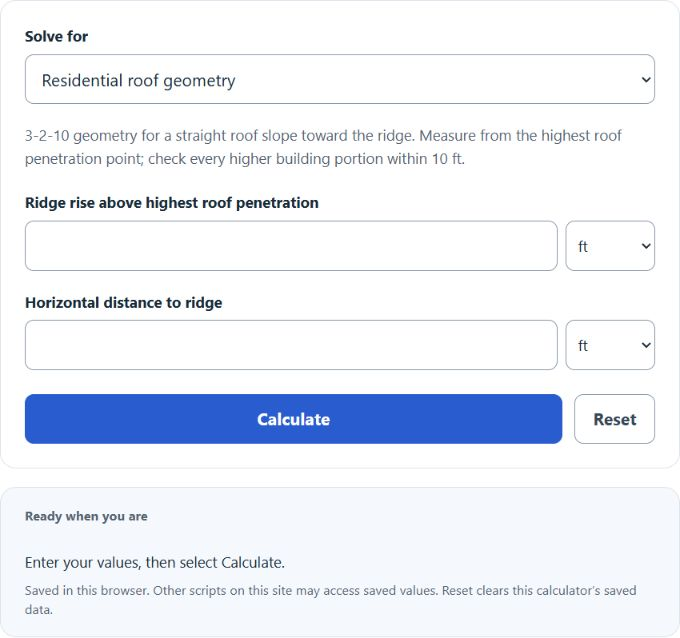
Calculate roof-clearance geometry for the residential 3-2-10 rule, or an empirical Indian SO₂ stack-height criterion. These estimates do not establish a complete safe design or permit approval.
Chimney Height Formula
The chimney height calculator has two modes: residential chimney height using the 3-2-10 rule, and industrial stack height based on estimated SO₂ emissions.
Residential 3-2-10 Rule
For a straight roof slope, if the ridge is within 10 feet horizontally:
For a straight roof slope toward a ridge more than 10 feet horizontally away:
- H = calculated chimney height above the highest roof penetration point, in feet
- R = ridge rise above the highest point where the chimney passes through the roof, in feet
- D = horizontal distance from the chimney to the ridge, in feet
- 3 = minimum required height above the highest roof penetration point, in feet
- 2 = required clearance above anything within 10 feet horizontally, in feet
Industrial SO₂ Stack Height
First, the calculator estimates the SO₂ emission rate:
Then it estimates stack height:
- Q = estimated SO₂ emission rate, in kg/hr
- F = fuel burn rate, in kg/hr
- S = sulfur content of the fuel, as a mass percent
- H = empirical Indian SO₂ stack-height estimate, in meters
- 2 = conversion factor based on sulfur becoming sulfur dioxide, since SO₂ has about twice the mass of sulfur alone
Residential mode compares the 3 ft minimum with 2 ft above a straight roof slope or ridge within 10 ft. Check all other higher building portions within that radius; ridge-only inputs cannot establish full compliance. Industrial mode assumes complete sulfur-to-SO₂ conversion without controls and applies an Indian empirical criterion; sector and local minimums may govern.
Common Chimney Height Reference Values
| Situation | Rule Applied | Minimum Height Basis |
|---|---|---|
| Chimney exits a flat or low nearby roof area | 3 ft minimum | At least 3 ft above the roof penetration |
| Ridge is within 10 ft horizontally | 2 ft above nearby structure | Ridge height plus 2 ft |
| Ridge is more than 10 ft away | 2 ft above the roof at the 10-ft point | Estimated roof height 10 ft from chimney plus 2 ft |
Illustrative Sulfur Values for Industrial Stack Estimates
The values below are examples only, not verified fuel compositions. Use measured sulfur content for the actual fuel.
| Fuel Type | Illustrative Sulfur Content | Effect on Stack Height |
|---|---|---|
| Wood / biomass | 0.05% | Very low SO₂ estimate |
| Diesel / gas oil | 0.1% | Low SO₂ estimate |
| Light fuel oil | 0.5% | Moderate SO₂ estimate |
| Bituminous coal | 1.0% | Higher SO₂ estimate |
| Heavy fuel oil | 1.5% | High SO₂ estimate |
| High-sulfur coal | 2.5% | Very high SO₂ estimate |
Example Calculations
Example 1: Residential chimney near the ridge
A chimney exits the roof 6 ft below the ridge, and the ridge is 8 ft away horizontally.
The minimum chimney height is 8 ft above the roof penetration.
Example 2: Industrial stack using fuel sulfur content
A boiler burns 500 kg/hr of fuel with 1.0% sulfur.
The empirical Indian SO₂ stack-height estimate is about 27.93 m, or about 91.65 ft.
FAQs
What is the 3-2-10 rule for chimney height?
The 3-2-10 rule means the chimney must extend at least 3 ft above the highest point where it passes through the roof, and it must also be at least 2 ft higher than any part of the building within 10 ft horizontally. The required chimney height is whichever of those two conditions gives the taller result.
Is chimney height measured from the ground or from the roof?
For the residential calculation, measure height and ridge rise from the highest point where the chimney passes through the roof. The straight-slope model also requires checking all higher building portions within 10 ft horizontally.
Does the industrial result replace local air-quality or building requirements?
No. The industrial mode gives an estimate based on fuel burn rate and sulfur content. Actual stack height may also depend on local regulations, nearby buildings, terrain, exhaust temperature, exit velocity, dispersion modeling, and permitted emissions limits.