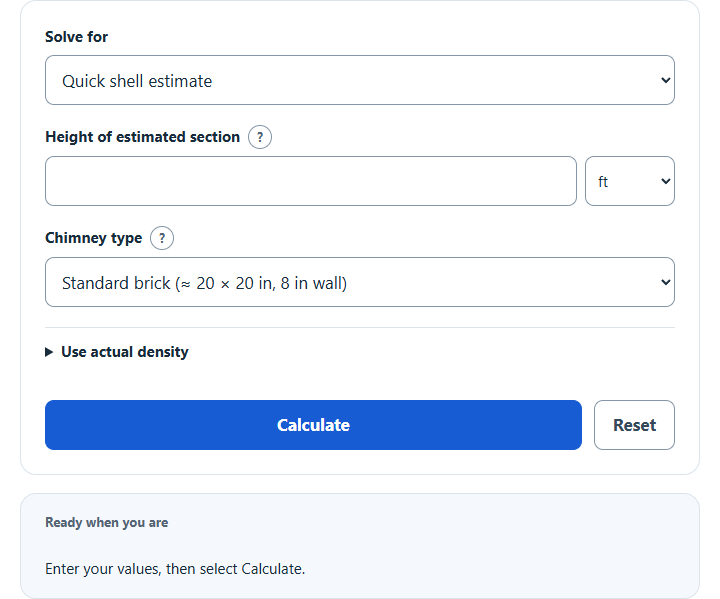
Estimate how much a chimney weighs in lb and kg from its height and type (brick, concrete or stone), or from your own dimensions or material volume.
- All Construction Calculators
- All Weight Calculators
- Brick Weight Calculator
- Brick Circle Calculator
- Floor Weight Capacity Calculator
- Bricks Per Square Foot Calculator
Chimney Weight Formula
The calculator estimates mass as material volume multiplied by mass density. Shell modes subtract one rectangular flue opening; the known-volume mode supports the historical 120 lb/ft³ example.
Variables:
- CHIM is the Chimney Weight (lb)
- CV is material volume excluding voids (ft³); rho is mass density (lb/ft³)
Multiply material volume in cubic feet by the appropriate density in lb/ft³. The historical 120 lb/ft³ and shell-mode densities are illustrative assumptions, not universal material or product values. Account for block cores, mortar, grout, liners, caps and other components as applicable.
How to Calculate Chimney Weight?
The following steps outline how to calculate the Chimney Weight.
- First, determine the material volume excluding the flue and other voids (ft³).
- Next, gather the formula from above: CHIM = CV * rho.
- Finally, calculate the Chimney Weight.
- After inserting the variables and calculating the result, check your answer with the calculator above.
Example Problem :
Use the following variables as an example problem to test your knowledge.
Material volume = 20 ft³; assumed mass density = 120 lb/ft³
CHIM = CV × rho = 20 × 120 = 2,400 lb (1,088.62 kg)