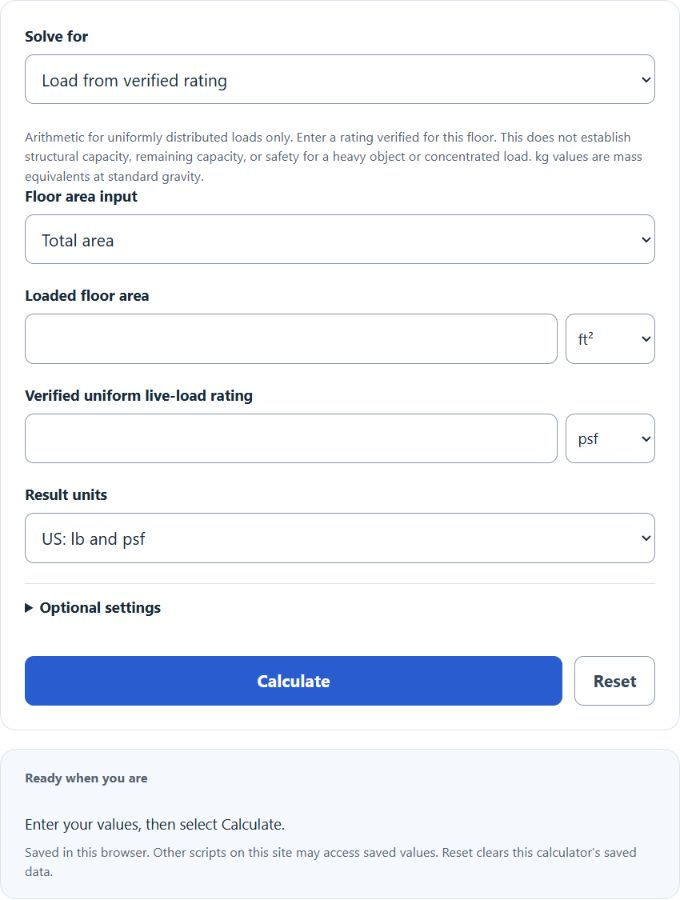
Calculate the uniformly distributed live-load equivalent of a verified floor rating, or the average intensity of a planned distributed load. This arithmetic does not establish structural capacity, remaining capacity or safety for a concentrated load. Permanent dead load is shown separately and is not extra added-load allowance.
- All Construction Calculators
- All Weight Calculators
- Glulam Weight Calculator
- Gross Floor Area Calculator
- Deck Weight Limit Calculator
Floor Weight Capacity Formula
The following two example problems outline the steps and information needed to calculate the Floor Weight Capacity.
Variables:
- FC is the arithmetic uniformly distributed live-load equivalent (lb), not an allowable single-object weight
- FA is the total floor area (ft^2)
- CPA is the verified uniform live-load rating (lb/ft^2)
- No average rating establishes a specific floor’s capacity. Obtain the applicable rating and conditions from verified design information or a structural professional. The American Wood Council span tables use separate live/dead-load assumptions, member properties and spans; their examples are not ratings for an unknown floor.
For uniform live-load arithmetic, multiply the loaded area by its verified live-load rating. Inverse mode divides the planned distributed load by that area. Dead-load weight is area times permanent dead-load intensity; adding it shows an unfactored arithmetic total, not spare live-load capacity or a complete structural design check. Do not divide a localized heavy object’s weight by the whole room area to assess safety.
How to Calculate Floor Weight Capacity?
The following steps outline how to calculate the Floor Weight Capacity.
Example Problem #1:
- First, determine the total floor area (ft^2).
- The total floor area (ft^2) is given as 1200.
- Next, determine the capacity per unit of area (lb/ft^2).
- For this hypothetical arithmetic example only, the verified uniform live-load rating is assumed to be 25 lb/ft^2. This is not a recommended or code-compliant rating.
- Finally, calculate the Floor Weight Capacity using the equation above:
FC = FA * CPA
The values provided above are inserted into the equation below and computed.
FC = 1200 * 25 = 30,000 (lbs)
Example Problem #2:
For this problem, the variables required are provided below:
total floor area (ft^2) = 1000
hypothetical verified uniform live-load rating (lb/ft^2) = 30; this is an arithmetic input, not an established rating for a real floor
Test your knowledge and check your answer with the calculator.
FC = 1000 * 30 = 30,000 lb of distributed live-load equivalent. A real assessment must also address concentrated loads, floor condition, spans, supports and applicable design requirements.