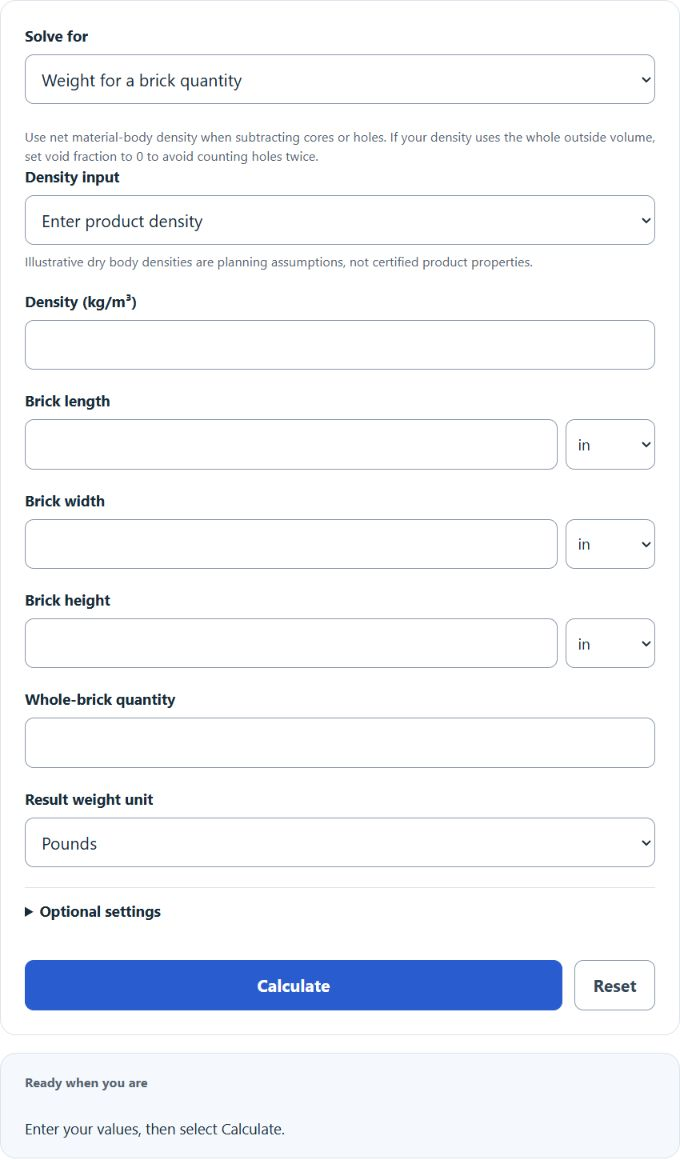
Calculate single and total brick weight from size, material density, quantity, and void fraction, or reverse-calculate whole bricks for an entered payload limit.
- All Construction Calculators
- All Weight Calculators
- Bricks Per Square Foot Calculator
- Brick Calculator
- Brick Circle Calculator
Brick Weight Formula
The brick weight calculation is based on volume multiplied by density. The calculator converts dimensions to meters and works in kilograms internally. It estimates total weight for a whole-brick quantity, or whole bricks within an available payload. The core/hole correction applies only to intentional geometric voids and must match the density basis.
- W = brick weight
- L = brick length
- Wd = brick width
- T = brick thickness
- ρ = density consistent with the selected volume basis; v is intentional core/hole volume as a percentage
For a solid brick with no geometric void correction, the same mass-volume relationship can be rearranged algebraically (reference formulas):
Choose Weight for a brick quantity or Whole bricks within a payload. All displayed required inputs must be entered; the payload calculation rounds down. Product density is the default input, and the material presets are explicitly illustrative dry body-density assumptions. If density is already measured as mass divided by the whole outside volume, use 0% additional void correction.
Common Brick Sizes and Approximate Weights
Actual brick weight varies by material, holes, moisture, and manufacturer. These values are useful for checking whether your result is in a reasonable range.
| Brick Type | Typical Size | Approximate Weight |
|---|---|---|
| Standard modular brick | 7.625 in × 3.625 in × 2.25 in | 4 to 5 lb |
| Engineering brick | About 8 in × 4 in × 2.25 in | 5 to 6.5 lb |
| Concrete brick | About 8 in × 4 in × 2.25 in | 5 to 7 lb |
| Fire brick | 9 in × 4.5 in × 2.5 in | 7 to 9 lb |
Typical Brick Density Values
| Material | Typical Density | Equivalent Approximation |
|---|---|---|
| Clay brick | 110 to 130 lb/ft³ | 0.064 to 0.075 lb/in³ |
| Concrete brick | 120 to 150 lb/ft³ | 0.069 to 0.087 lb/in³ |
| Fire brick | 130 to 150 lb/ft³ | 0.075 to 0.087 lb/in³ |
Brick Weight Examples
Example 1: Find the weight of a brick
Suppose a brick is 8 in long, 4 in wide, and 2.25 in thick. Its density is 120 lb/ft³.
First convert density to lb/in³:
Then multiply volume by density:
The brick weighs about 5.00 lb.
Example 2: Find density from brick weight
Suppose a brick measures 7.625 in × 3.625 in × 2.25 in and weighs 4.5 lb.
The density is about 0.07236 lb/in³, which is approximately 125 lb/ft³.
Brick Weight Calculator FAQ
Why does brick density matter?
Density tells you how much material weight is packed into a given volume. Two bricks with the same dimensions can have different weights if one is made from denser clay, concrete, or refractory material. Hollow or cored bricks also weigh less than solid bricks of the same outside size.
Should mortar be included in brick weight?
This calculator finds the weight of the brick itself, not the weight of a finished wall. If you are estimating the load of masonry, include mortar separately. Mortar can add a meaningful amount of weight, especially across a large wall area.
Why is my calculated brick weight different from the supplier’s listed weight?
Supplier weights often account for the actual manufactured shape, cores, recesses, material mix, and moisture content. Use the product’s measured density on a consistent volume basis. Subtract intentional holes or frogs only when using net material-body density; do not subtract microscopic porosity again. Verify actual product weight before shipping.