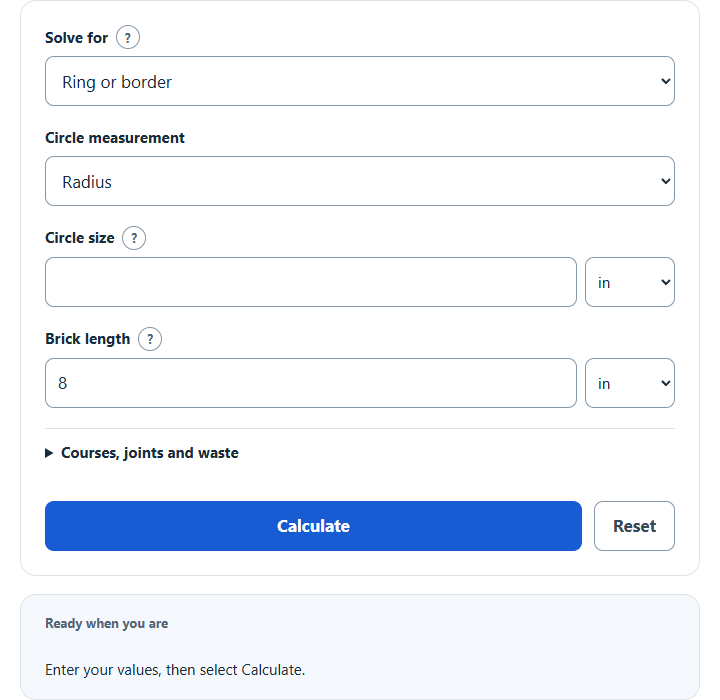
Calculate how many bricks or blocks you need for a circle, fire pit ring or round patio from its radius or diameter, using typical brick sizes plus waste.
- All Construction Calculators
- Brick Calculator
- Arc Height (sagitta) Calculator
- Central Angle Calculator
- Bricks Per Square Foot Calculator
- Brick Weight Calculator
Calculator Functions
| Function | What it does | What it requires |
|---|---|---|
| Ring or border | Estimates the bricks or blocks laid end to end around a circle, such as a fire pit ring, tree ring or curved edging | Requires the inner radius or diameter of the circle and the brick length |
| Full circular patio | Estimates the bricks or pavers needed to cover a whole circle | Requires the radius or diameter to the outside edge, the brick length and the brick width |
Brick length starts at 8 in and width at 4 in, the size of a typical standard brick, with 7.625, 12 and 16 in as other length choices for landscape and fire pit blocks. Sizes go in as inches, feet, centimeters or meters. Optional settings add a joint width (none if left blank), a waste allowance (10% if left blank) and, for Ring or border, the number of stacked courses (one if left blank).
Brick Circle Formulas
| N | Bricks in one course around the circle, before rounding up |
| s | Brick length, measured along the ring |
| j | Joint width between bricks (0 if there is none) |
| r | Radius from the center of the circle to the middle of each brick’s inner face, in the same unit as s |
| atan | Inverse tangent, in radians |
Straight bricks set around a circle form a regular polygon whose sides touch the circle at their midpoints. For a regular polygon with n sides of length s, the distance from the center to the middle of a side is s ÷ (2 × tan(π ÷ n)) [1]. Setting that distance equal to r and solving for n gives the formula above.
Ring or border
(1 + waste ÷ 100)⌉
The brackets mean rounding up to a whole brick. A ring with a 20 in inner radius built from 4 in bricks with no joint needs π ÷ atan(4 ÷ 40) = 31.52, so 32 bricks per course, and 36 with the 10% waste allowance. A 36 in diameter fire pit ring of 8 in bricks with 3/8 in joints needs π ÷ atan(8.375 ÷ 36) = 13.74, so 14 bricks per course. Three courses are 42 bricks, and 45 with 5% waste.
The brick plus its joint must be shorter than the inner diameter of the circle. Because the count per course is rounded up, the last brick has to be cut or the joints adjusted to close the ring.
Full circular patio
((s + j) × (w + j))
Here r is the radius to the outside edge of the patio and w is the brick width. The area of the circle is divided by the area one brick covers with its joints, then rounded up and increased by the waste allowance. A patio with a 60 in radius laid in 8 in by 4 in bricks with no joint needs π × 60² ÷ 32 = 353.4, so 354 bricks, and 390 with 10% waste.
Limits of This Estimate
- The ring count treats each brick as a straight side touching the circle at the middle of its inner face. Wedge-shaped or tapered blocks sold for fire pits fit a set diameter chosen by the manufacturer, so the maker’s count for that kit is the one to follow.
- The patio count divides areas. It does not lay out a pattern or count the cut bricks along the curved edge, which is why a waste allowance matters more for a circle than for a square.
- The 10% waste allowance is a rule of thumb that can be changed. These estimates are based on the best available data and estimations.
Sources
- U. H. Kurzweg, University of Florida, Areas of Regular n-Sided Polygons (2023): distance from the center of a regular polygon to the middle of a side, from the side length and the number of sides