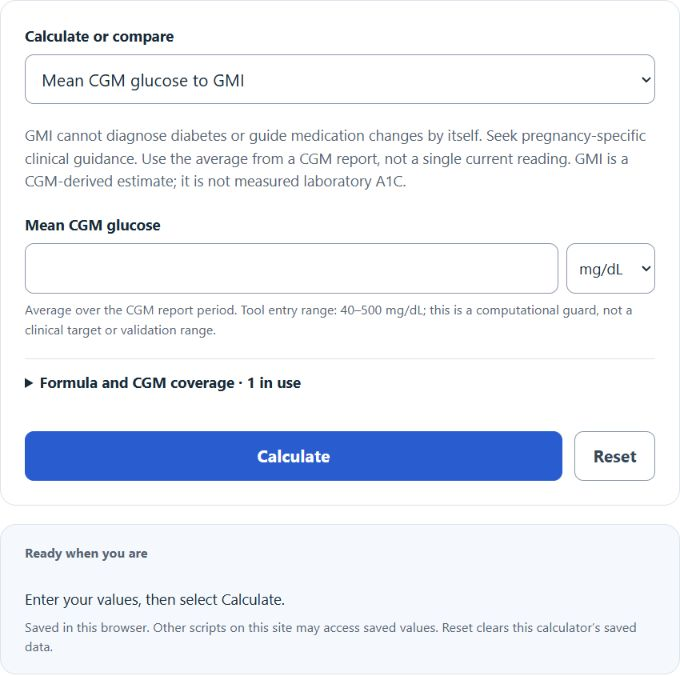
Calculate GMI from average CGM glucose, find the glucose average implied by a GMI, or compare GMI with a separately measured lab A1C. The calculator distinguishes the established 2018 formula from the 2026 research update and never treats GMI as a lab result.
Note: GMI is derived from CGM data and may differ from a laboratory A1C. It cannot diagnose diabetes or prediabetes and should not be used to change insulin or other medication. Use average CGM glucose—not a single current reading.
- All Health and Medical Calculators
- Medical and Health Unit Converters
- HbA1c To mg/dL Calculator
- Hgb To A1C Calculator
- Average Glucose To A1C Calculator
Can you convert GMI to A1C?
Not to an individual laboratory A1C. Glucose management indicator (GMI) is already an A1C-like estimate calculated from average continuous glucose monitor (CGM) glucose. A1C, also called HbA1c, is a separate blood test. The two values can be compared, but one cannot reliably predict the other for a specific person.
Use the calculator above to calculate GMI from average CGM glucose, find the average glucose implied by a particular GMI formula, or compare a GMI with a separately measured lab A1C.
Which calculator mode should I use?
| What you have | Mode | What the result means |
|---|---|---|
| Average glucose from a CGM report | CGM average glucose → GMI | Calculates standard 2018 GMI. You may opt in to view the newer 2026 research formula for comparison. |
| A GMI value from a report that names its formula version | GMI → implied average glucose | Reverses that selected formula. If the report does not identify its version, do not assume one. This mode never calculates lab A1C. |
| Both a GMI and a recent measured lab A1C | Compare GMI with lab A1C | Shows the signed and absolute difference without diagnosing its cause. |
Standard GMI and the optional 2026 research comparison
The original GMI equation was published in 2018 and is the familiar formula used in many reports and clinical discussions. A large 2026 study proposed a nonlinear updated GMI, or uGMI, to reduce proportional bias at lower and higher glucose levels. Because the new equation is recent and device adoption is not universal, this calculator labels both versions instead of silently substituting one for the other.
Original 2018 GMI formula
The original equation was derived from pooled data from 528 insulin-treated adults, mostly people with type 1 diabetes, using Dexcom G4/G5 CGM data. It is established in reporting and clinical discussion, but its population and device limits still matter.
Updated 2026 research formula
The 2026 study analyzed 26,647 paired CGM and lab A1C observations from 18,860 people and reported better alignment at the extremes. Important limits remain: the data came from Abbott and Dexcom systems, the population was predominantly adult and White, Abbott funded the research, and two authors were Abbott employees. The study appeared after the 2026 ADA Standards were published, so it should not be described as ADA-endorsed or universally adopted.
| Mean CGM glucose | Original 2018 GMI | Optional 2026 uGMI research comparison | uGMI minus original GMI |
|---|---|---|---|
| 100 mg/dL (5.5 mmol/L) | 5.70% | 5.10% | −0.60 point |
| 125 mg/dL (6.9 mmol/L) | 6.30% | 6.05% | −0.25 point |
| 154 mg/dL (8.5 mmol/L) | 6.99% | 7.03% | +0.04 point |
| 200 mg/dL (11.1 mmol/L) | 8.09% | 8.38% | +0.29 point |
| 250 mg/dL (13.9 mmol/L) | 9.29% | 9.62% | +0.33 point |
Common GMI values and their implied average glucose
A phrase such as “6.3 GMI to A1C” does not have a second A1C answer. A GMI of 6.3% is already expressed on an A1C-like percentage scale. The chart uses the standard 2018 formula to show its implied average CGM glucose; your actual laboratory A1C remains unknown until it is measured. Use the calculator’s explicit 2026 research option only when you intend to examine that newer formula.
| GMI | IFCC-equivalent GMI | Original 2018 implied mean CGM glucose | Lab A1C |
|---|---|---|---|
| 5.4% | 36 mmol/mol | 87 mg/dL (4.8 mmol/L) | Cannot be predicted |
| 5.5% | 37 mmol/mol | 92 mg/dL (5.1 mmol/L) | Cannot be predicted |
| 5.6% | 38 mmol/mol | 96 mg/dL (5.3 mmol/L) | Cannot be predicted |
| 5.7% | 39 mmol/mol | 100 mg/dL (5.5 mmol/L) | Cannot be predicted |
| 5.8% | 40 mmol/mol | 104 mg/dL (5.8 mmol/L) | Cannot be predicted |
| 5.9% | 41 mmol/mol | 108 mg/dL (6.0 mmol/L) | Cannot be predicted |
| 6.0% | 42 mmol/mol | 112 mg/dL (6.2 mmol/L) | Cannot be predicted |
| 6.1% | 43 mmol/mol | 117 mg/dL (6.5 mmol/L) | Cannot be predicted |
| 6.2% | 44 mmol/mol | 121 mg/dL (6.7 mmol/L) | Cannot be predicted |
| 6.3% | 45 mmol/mol | 125 mg/dL (6.9 mmol/L) | Cannot be predicted |
| 6.4% | 46 mmol/mol | 129 mg/dL (7.2 mmol/L) | Cannot be predicted |
| 6.5% | 48 mmol/mol | 133 mg/dL (7.4 mmol/L) | Cannot be predicted |
| 6.6% | 49 mmol/mol | 138 mg/dL (7.6 mmol/L) | Cannot be predicted |
| 6.7% | 50 mmol/mol | 142 mg/dL (7.9 mmol/L) | Cannot be predicted |
| 6.8% | 51 mmol/mol | 146 mg/dL (8.1 mmol/L) | Cannot be predicted |
| 6.9% | 52 mmol/mol | 150 mg/dL (8.3 mmol/L) | Cannot be predicted |
| 7.0% | 53 mmol/mol | 154 mg/dL (8.6 mmol/L) | Cannot be predicted |
| 7.1% | 54 mmol/mol | 158 mg/dL (8.8 mmol/L) | Cannot be predicted |
| 7.2% | 55 mmol/mol | 163 mg/dL (9.0 mmol/L) | Cannot be predicted |
| 7.3% | 56 mmol/mol | 167 mg/dL (9.3 mmol/L) | Cannot be predicted |
| 7.4% | 57 mmol/mol | 171 mg/dL (9.5 mmol/L) | Cannot be predicted |
| 7.5% | 58 mmol/mol | 175 mg/dL (9.7 mmol/L) | Cannot be predicted |
| 7.6% | 60 mmol/mol | 179 mg/dL (10.0 mmol/L) | Cannot be predicted |
| 7.7% | 61 mmol/mol | 184 mg/dL (10.2 mmol/L) | Cannot be predicted |
| 7.8% | 62 mmol/mol | 188 mg/dL (10.4 mmol/L) | Cannot be predicted |
| 8.3% | 67 mmol/mol | 209 mg/dL (11.6 mmol/L) | Cannot be predicted |
IFCC values use the NGSP master relationship and are rounded to the nearest mmol/mol. Glucose values are formula-implied estimates rounded for readability.
GMI vs A1C vs eAG
| Measure | Source | Typical window | What it can do |
|---|---|---|---|
| GMI | Average glucose recorded by a CGM | Depends on the selected CGM report period | Summarizes CGM average on an A1C-like scale; it is not diagnostic. |
| Laboratory A1C | Glycation of hemoglobin in a blood sample | Roughly the preceding 2–3 months, weighted toward recent weeks | May be used in diagnosis and monitoring when interpreted by a qualified clinician. |
| Estimated average glucose (eAG) | A lab A1C transformed through the ADAG regression | Reflects the A1C measurement window | Expresses lab A1C in glucose units; it is not the same as a measured CGM average. |
How much CGM data should you use?
For standardized CGM reporting, the 2026 ADA Standards identify at least 14 days of data with at least 70% active CGM time as the standardized minimum wear threshold for pattern management. Meeting that threshold does not guarantee that the data are representative or that GMI will agree with lab A1C. The calculator shows a warning when either threshold is not met, but it does not block the calculation.
Use the mean glucose from the same report window as the days and active-time values you enter. A single sensor reading, a manually selected “good day,” or mixed data from different date ranges is not an appropriate input.
Why can GMI and lab A1C differ?
Differences are common. In the original GMI study, 51% of observations differed from laboratory A1C by at least 0.3 percentage point, and 28% differed by at least 0.5 point. A gap does not identify its own cause.
Different time windows
A CGM report may cover 14 days, while A1C reflects a longer period. Recent glucose changes can make the two summaries diverge.
CGM coverage and sensor factors
Missing data, wear time, sensor performance, and whether the sampled days are representative can affect mean CGM glucose.
Red-blood-cell factors
Hemoglobin variants, anemia, blood loss or transfusion, and conditions that alter red-cell lifespan can make A1C less reliable. The direction and size of the effect depend on the mechanism.
Health and treatment context
Kidney disease, liver disease, pregnancy, medications, and other clinical circumstances can affect interpretation. Persistent discordance deserves individualized review, not an automatic correction.
GMI units and glucose units
- Glucose: mg/dL ÷ 18.0182 = mmol/L.
- Measured A1C: NGSP percent and IFCC mmol/mol are two reporting systems for measured glycated hemoglobin. The NGSP master relationship is NGSP (%) = 0.09148 × IFCC (mmol/mol) + 2.152.
- Calculated GMI: applying that relationship to GMI produces an IFCC-equivalent GMI; it does not turn GMI into a measured glycated-hemoglobin result.
- One mmol/L is not one mmol/mol: mmol/L describes glucose concentration. On this page, mmol/mol is either measured A1C on the IFCC scale or a clearly labeled IFCC-equivalent GMI.
Frequently asked questions
Is GMI the same as A1C?
No. GMI is calculated from CGM mean glucose. A1C is measured from a blood sample. Both may be shown as a percentage, but they measure different things and frequently do not match exactly.
Can GMI diagnose diabetes or prediabetes?
No. Diagnostic criteria use laboratory glucose testing and/or laboratory A1C in appropriate clinical settings. A GMI value or a consumer calculator result should not be used to diagnose a condition.
Can I convert a 6.3 GMI into lab A1C?
No. A 6.3% GMI is already an A1C-like CGM estimate. Under the original 2018 equation it implies about 125 mg/dL (6.9 mmol/L) mean CGM glucose; the 2026 updated equation implies about 132 mg/dL (7.3 mmol/L). Neither tells you what a laboratory A1C will measure.
Should I use the original GMI or updated GMI?
Use the formula version named by your device, clinic, or research protocol. If the version is unknown, do not use the inverse mode as though either equation were confirmed; formula choice can materially change the implied mean glucose. For a new calculation from mean CGM glucose, the calculator defaults to the established original 2018 formula and offers the 2026 result only as an explicit research option.
How do I compare a Dexcom or FreeStyle Libre GMI with lab A1C?
Use the comparison mode only when you have both the device-report GMI and a separately measured lab A1C. The result shows the gap without diagnosing its cause. If you have only average glucose, use the first mode. Do not assume that every app or report has adopted the 2026 equation; check its label or documentation.
What should I do if GMI and A1C are far apart?
Check that both values come from comparable dates and that the CGM report has adequate coverage. Then discuss a persistent or unexpected gap with your clinician, especially before making treatment decisions.
Methodology and primary sources
This page uses the original published GMI regression as its standard calculation, presents the 2026 nonlinear equation as a labeled research comparison, converts NGSP and IFCC units using the NGSP master equation, and reports comparison gaps without assigning a cause. Formula review date: August 10, 2026.
- Bergenstal et al. (2018), original GMI equation and observed GMI–A1C discordance
- Bergenstal et al. (2026), updated GMI equation and validation study
- Jaeb Center for Health Research, current GMI calculator and equations
- American Diabetes Association, Standards of Care in Diabetes—2026, glycemic goals and CGM metrics
- American Diabetes Association, Standards of Care in Diabetes—2026, diagnosis and classification
- Battelino et al. (2019), international consensus on time in range and CGM data sufficiency
- Meek et al. (2025), limitations of standard GMI during type 1 diabetes pregnancy
- Nathan et al. (2008), A1C-derived estimated average glucose (ADAG)
- NGSP, IFCC–NGSP master equation
- NIDDK, A1C test uses and factors affecting interpretation
- NGSP, factors that interfere with A1C measurement or interpretation