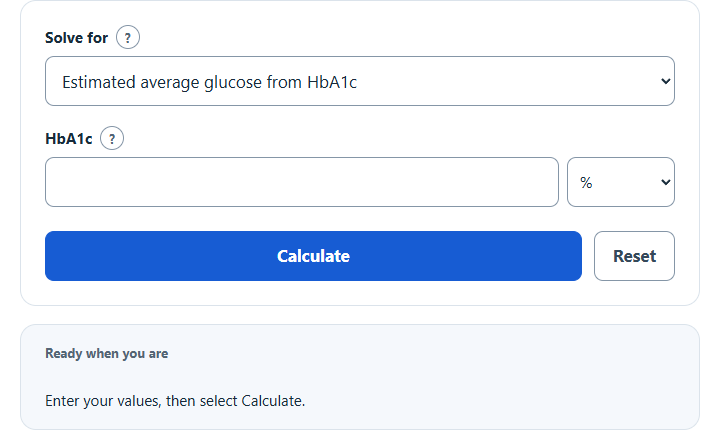
Convert HbA1c to mg/dL estimated average glucose (eAG) with the ADAG formula. Enter HbA1c in % or mmol/mol, or convert mg/dL back to HbA1c.
- All Health and Medical Calculators
- All Medical and Health Unit Converters
- mmol/L to mg/dl Calculator
- Average Glucose To A1C Calculator
- Glucose Infusion Rate Calculator
Calculator Functions
| Function | What it does | What it requires |
|---|---|---|
| Estimated average glucose from HbA1c | Converts an HbA1c lab result to estimated average glucose (eAG) in mg/dL, and also shows it in mmol/L | Requires the HbA1c result in % or in mmol/mol |
| Model HbA1c from average glucose | Estimates the HbA1c that matches a long-term average glucose, in % and in mmol/mol | Requires the average glucose in mg/dL or mmol/L |
HbA1c in % is the NGSP unit reported in the United States, and mmol/mol is the IFCC unit that many other countries report alone or alongside it [3]. An HbA1c entered in mmol/mol is converted to % first. The average glucose for the second function should be a long-term average, not a single fasting or random reading.
HbA1c to mg/dL Formulas
| eAG | Estimated average glucose (mg/dL) |
| A1C | HbA1c (%) |
The equation comes from the A1c-Derived Average Glucose (ADAG) study, published in 2008. It compared the HbA1c of 507 adults from 10 centers with their average glucose over the previous 3 months, measured by continuous glucose monitoring and frequent fingerstick tests, and found this straight-line relationship with an R² of 0.84 [2]. The American Diabetes Association uses the same formula to report HbA1c as eAG [4].
Estimated average glucose from HbA1c
The main formula applies directly. An HbA1c of 7% gives 28.7 × 7 − 46.7 = 154.2 mg/dL. The result in mmol/L is the mg/dL figure divided by 18, here 8.57 mmol/L, which matches the study’s own mmol/L equation, 1.59 × A1C − 2.59 [2]. An HbA1c in mmol/mol is converted with the IFCC to NGSP master equation:
+ 2.152 [3]
An HbA1c of 53 mmol/mol is 0.09148 × 53 + 2.152 = 7.0%, which gives 154.2 mg/dL.
How to Convert HbA1c to mg/dL
Multiply the HbA1c percentage by 28.7 and subtract 46.7. For 8.8%, 28.7 × 8.8 = 252.56, and 252.56 − 46.7 = 205.9 mg/dL. For 5.5% the answer is 111.2 mg/dL, and for 9.6% it is 228.8 mg/dL. HbA1c itself is a percentage of hemoglobin and has no mg/dL value of its own. The mg/dL figure is the average blood glucose that an HbA1c of that level corresponds to.
| HbA1c (%) | HbA1c (mmol/mol) | eAG (mg/dL) | eAG (mmol/L) |
|---|---|---|---|
| 4.0 | 20 | 68.1 | 3.78 |
| 4.5 | 26 | 82.5 | 4.58 |
| 5.0 | 31 | 96.8 | 5.38 |
| 5.5 | 37 | 111.2 | 6.18 |
| 6.0 | 42 | 125.5 | 6.97 |
| 6.5 | 48 | 139.9 | 7.77 |
| 7.0 | 53 | 154.2 | 8.57 |
| 7.5 | 58 | 168.6 | 9.36 |
| 8.0 | 64 | 182.9 | 10.16 |
| 8.5 | 69 | 197.3 | 10.96 |
| 9.0 | 75 | 211.6 | 11.76 |
| 9.5 | 80 | 226.0 | 12.55 |
| 10.0 | 86 | 240.3 | 13.35 |
| 10.5 | 91 | 254.7 | 14.15 |
| 11.0 | 97 | 269.0 | 14.94 |
| 11.5 | 102 | 283.4 | 15.74 |
| 12.0 | 108 | 297.7 | 16.54 |
| 12.5 | 113 | 312.1 | 17.34 |
| 13.0 | 119 | 326.4 | 18.13 |
| 13.5 | 124 | 340.8 | 18.93 |
| 14.0 | 130 | 355.1 | 19.73 |
Model HbA1c from average glucose
This is the main formula solved for HbA1c. An average glucose of 154 mg/dL gives (154 + 46.7) ÷ 28.7 = 6.99%. An average entered in mmol/L is multiplied by 18 first, so 8.6 mmol/L is 154.8 mg/dL and gives 7.02%. The answer is a model value and not a measured HbA1c.
Limits of This Estimate
- This calculator gives a population-based estimate for information only. It is not medical advice and should not be used to diagnose diabetes or to change medication or insulin. Results should be reviewed with a qualified clinician.
- The relationship is an average across a study group, and one person’s average glucose can differ from the estimate. The study included adults aged 18 to 70 with type 1 diabetes, type 2 diabetes or no diabetes. Children and pregnant women were not included, and some ethnic groups were underrepresented [2].
- Conditions that shorten the life of red blood cells, such as hemolytic anemia or recovery from blood loss, lower HbA1c whatever the glucose level. Iron deficiency anemia, kidney failure and some hemoglobin variants can also make an HbA1c result misleading [5].
- eAG is not the same as the average shown on a glucose meter or the glucose management indicator (GMI) from a continuous glucose monitor.
Sources
- NGSP, HbA1c and Estimated Average Glucose (eAG): the ADAG regression equation and its table of values
- Nathan DM et al., Translating the A1C Assay Into Estimated Average Glucose Values, Diabetes Care 2008: the study behind the equation, its mmol/L form, who took part and its stated limits
- NGSP, IFCC Standardization of HbA1c: the master equation between mmol/mol and %, and which unit is reported where
- American Diabetes Association, eAG/A1C Conversion Calculator: the formula as used to report HbA1c as estimated average glucose
- NGSP, Factors that Interfere with HbA1c Test Results (updated October 23, 2026): conditions that make an HbA1c result misleading