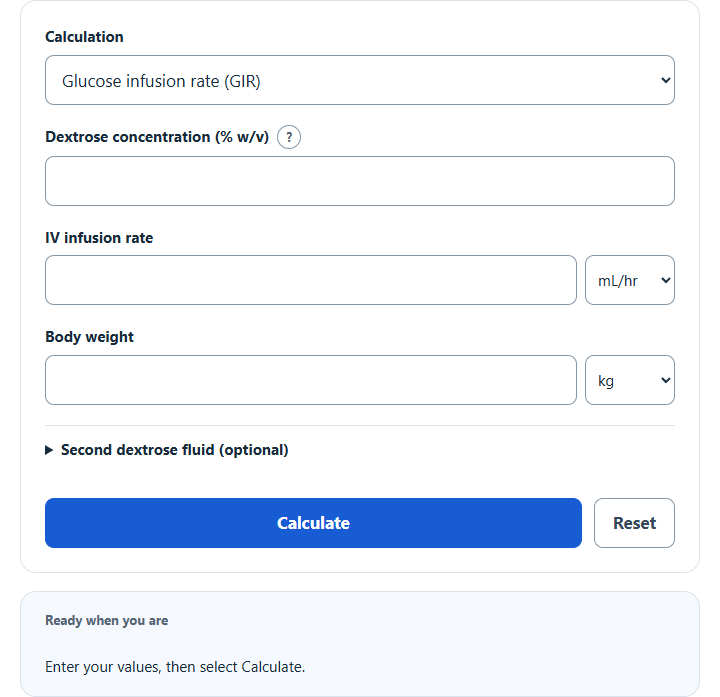
Calculate glucose infusion rate (GIR) in mg/kg/min from dextrose concentration, IV rate and body weight, including a second dextrose fluid if needed.
- All Health and Medical Calculators
- mmol/L to mg/dl Calculator
- Glucose to Insulin Ratio Calculator
- Serum Osmolality Calculator
Glucose Infusion Rate Formula
The following formula is used to calculate the Glucose Infusion Rate (GIR) when a dextrose solution is infused intravenously:
Variables:
- GIR is the glucose infusion rate (mg/kg/min)
- D(%) is the dextrose concentration of the IV fluid (e.g., D5 = 5%, D10 = 10%)
- Rate is the infusion rate (mL/hr)
- Weight is the patient’s weight (kg)
To calculate GIR, multiply the dextrose concentration (%) by the infusion rate in mL/hr, then divide by 6 × weight (kg). (The constant 6 comes from converting % dextrose to mg/mL and hours to minutes.)
Rearranging the GIR formula
For one dextrose-containing fluid, the two reverse modes use a GIR value that you enter. Select IV rate from entered GIR and supply the body weight and dextrose concentration, or select Dextrose % from entered GIR and supply the body weight and known IV rate.
- Rate (mL/hr) = GIR (mg/kg/min) × 6 × weight (kg) ÷ dextrose (% w/v).
- Dextrose (% w/v) = GIR (mg/kg/min) × 6 × weight (kg) ÷ rate (mL/hr).
These are arithmetic rearrangements, not treatment recommendations. They do not choose a target GIR, account for other glucose sources, or determine an appropriate concentration, fluid volume, route or infusion rate for a patient. The concentration result is a mathematical % w/v, not a preparation or mixing instruction.
What is a Glucose Infusion Rate?
The Glucose Infusion Rate (GIR) is the rate at which glucose is delivered to a patient through an IV dextrose-containing solution, normalized to body weight. It is commonly used in neonatal care, critical care, and parenteral nutrition to quantify glucose delivery and to help guide dextrose/IV fluid adjustments. GIR is typically expressed in mg/kg/min. In metabolic research (for example, during a hyperinsulinemic-euglycemic clamp), GIR may also refer to the glucose infusion required to maintain a target blood glucose while insulin is infused.
How to Calculate Glucose Infusion Rate?
The following steps outline how to calculate the Glucose Infusion Rate (GIR).
- First, determine the patient’s weight (kg).
- Next, determine the dextrose concentration of the IV fluid (%, e.g., D10 = 10%).
- Next, determine the IV infusion rate (mL/hr). (If you have mL/min, multiply by 60 to convert to mL/hr.)
- Next, use the formula from above: GIR (mg/kg/min) = (D% × Rate (mL/hr)) / (6 × Weight (kg)).
- Finally, calculate the Glucose Infusion Rate.
- After inserting the variables and calculating the result, check your answer with the calculator above.
Example Problem:
Use the following variables as an example problem to test your knowledge.
Weight (kg) = 70
Dextrose concentration (%) = 10
Infusion rate (mL/hr) = 50
Glucose infusion rate = (10 × 50) / (6 × 70) = 1.1905 mg/kg/min, rounded to four decimal places.