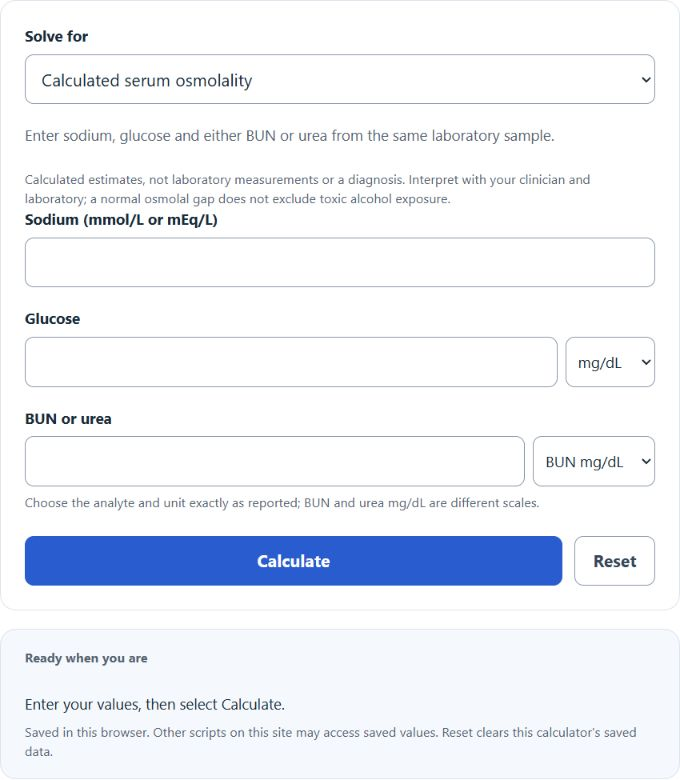
Estimate calculated serum osmolality or effective osmolality, or find the signed gap between a laboratory measurement and the calculated estimate. Enter sodium, glucose and BUN or urea in their explicitly selected laboratory scales; measured osmolality is required only for the gap.
Related Calculators
- Potassium to Creatinine Ratio Calculator
- Gfr To Creatinine Clearance Calculator
- HbA1c To mg/dL Calculator
- Drop Factor Calculator
- All Health and Medical Calculators
Calculated Serum Osmolality, Tonicity and Gap
Measured serum osmolality describes the concentration of dissolved particles per kilogram of solvent. This calculator estimates it from sodium, glucose and urea using the standard sodium-based approximation below; it does not measure a sample or solve for a missing sodium, glucose or BUN value. Effective osmolality (tonicity) uses the sodium and glucose terms only, excluding urea.
Where:
- Osm = calculated serum osmolality estimate, conventionally reported in mOsm/kg
- Na = serum sodium concentration in mEq/L or mmol/L
- Glucose = blood glucose in mg/dL
- BUN = blood urea nitrogen in mg/dL
Some references use an expanded version that includes potassium in the doubled cation term:
The calculator uses the sodium-based formula without a potassium term, glucose multiplier or ethanol correction. Laboratories may use other validated equations, so identify the formula and laboratory method when comparing calculated estimates or interpreting a gap.
Algebraic Rearrangements for Reference
The following rearrangements are algebraic references for this approximate equation, not calculator modes or laboratory measurements. In them, Osm must mean the calculated value defined by the same equation; substituting a measured osmolality does not independently measure sodium, glucose or BUN, because other osmoles can contribute. The widget does not back-solve these analytes:
How to Use the Calculator
- Select Calculated serum osmolality, Effective osmolality (tonicity), or Signed osmolal gap.
- Enter sodium and glucose. Calculated and gap modes also require BUN or urea; gap mode additionally requires measured osmolality in mOsm/kg.
- Choose glucose mg/dL or mmol/L independently from BUN mg/dL, urea mmol/L, or urea mg/dL. Changing a populated unit control converts its numeric value, rather than merely relabeling it.
- Select Calculate. Editing an input leaves the earlier result marked as previous until you calculate again.
- Use results from the same sample. Consult the reporting laboratory or clinician for interpretation; no diagnostic category or treatment recommendation is assigned.
Input Guide
| Variable | Common Units | What It Represents | Why It Matters |
|---|---|---|---|
| Sodium | mEq/L or mmol/L | Main extracellular cation | Usually the largest contributor to serum osmolality |
| Glucose | mg/dL or mmol/L | Circulating blood sugar | Can raise osmolality significantly when elevated |
| BUN or urea | BUN: mg/dL; urea: mmol/L or mg/dL | Nitrogen mass for BUN, or whole-molecule urea concentration | Contributes to the total estimate; excluded from effective osmolality |
| Measured serum osmolality | mOsm/kg | Laboratory measurement per kilogram of solvent | Required for the signed measured-minus-calculated gap; mOsm/L is not an interchangeable input unit |
Unit note: for sodium, mEq/L and mmol/L are numerically the same because sodium is monovalent. Glucose and BUN/urea have independent unit controls. BUN mg/dL and urea mg/dL are different mass scales; choose the exact analyte and unit printed on the laboratory report.
Useful Unit Conversions
If the laboratory reports glucose and urea in mmol/L, use them directly: calculated estimate = 2 × sodium + glucose + urea. Effective estimate = 2 × sodium + glucose, without urea. The divisors 18, 2.8 and 6 are rounded clinical approximations used consistently for calculations and unit changes; they are not exact molecular constants. Urea mg/dL is approximately 2.14 times BUN mg/dL.
Example Calculation
If sodium is 140 mEq/L, glucose is 90 mg/dL, and BUN is 14 mg/dL, the estimated serum osmolality is:
This arithmetic example gives a calculated estimate of 290 mOsm/kg and an effective estimate of 285 mOsm/kg. Equivalent SI inputs are glucose 5 mmol/L and urea 5 mmol/L. If measured osmolality were 300 mOsm/kg, the signed gap would be +10 mOsm/kg; if it were 285, the gap would be −5 mOsm/kg. These examples do not classify a patient result.
How to Interpret Serum Osmolality
A reference interval near 275 to 295 mOsm/kg is used by some laboratories for measured adult serum osmolality. Use the interval and method on the reporting laboratory’s result; this interval is not a universal threshold for every calculation formula, age group or clinical situation. The widget does not assign normal, high or low bands.
- Lower values generally reflect relatively more water compared with dissolved particles.
- Higher values generally reflect relatively less water, more dissolved solute, or both.
- Calculated values estimate the concentration from routine chemistry inputs.
- Measured values come directly from the laboratory and may differ when unmeasured osmoles are present.
Calculated vs. Measured Osmolality
The calculator provides an estimate, not a direct lab measurement. A direct serum osmolality test may be higher or lower than the calculated result because the equation only includes the major routinely reported contributors.
The gap retains its sign: measured minus calculated, including a negative result. Other solutes, formula choice and laboratory interference can affect the gap. A normal gap does not exclude toxic alcohol exposure. Interpretation requires the clinical picture and other laboratory results; this calculator does not identify a toxic substance, diagnose a condition or recommend treatment.
Osmolality vs. Osmolarity
These terms are related but not identical:
- Osmolality describes particles per kilogram of solvent.
- Osmolarity describes particles per liter of solution.
- In body fluids, the values are often numerically close, but osmolality is the standard term used for serum interpretation.
Practical Tips
- Use values from the same blood sample whenever possible.
- Confirm whether the lab reports BUN or urea, since those are not interchangeable labels.
- Match the unit selector to the lab report before calculating.
- Use measured serum osmolality when a direct laboratory value is available and precise interpretation is needed.
- Remember that this calculator estimates concentration; diagnosis depends on the full clinical context.