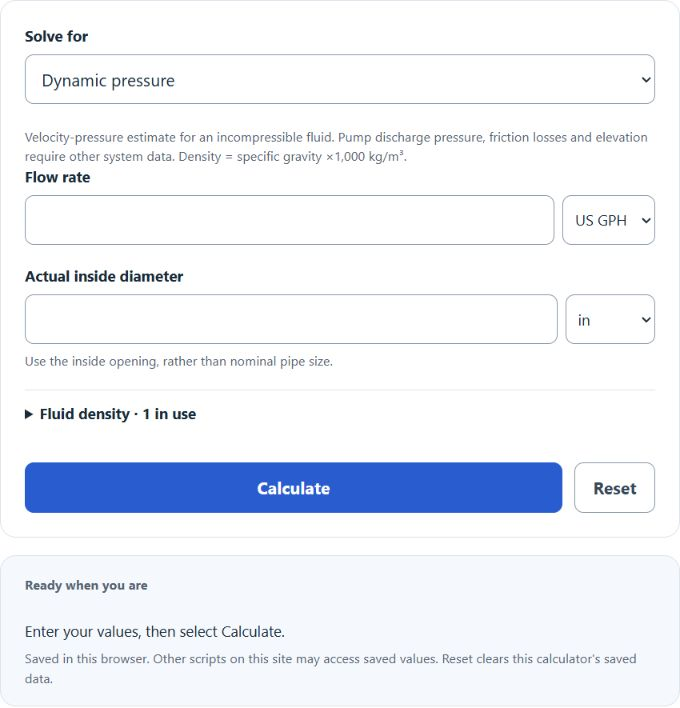
Estimate dynamic pressure from flow rate and inside diameter, or solve for GPH or diameter, with GPM, LPH, PSI, bar, kPa, and fluid-specific-gravity options.
GPH to PSI Formula
Flow alone cannot determine static pressure. This estimates dynamic (velocity) pressure from a circular inside diameter and density using q = ½ρv², with v = flow ÷ area. For US gallons per hour, square-inch area and density = SG × 1,000 kg/m³:
Variables:
- PSI is estimated dynamic pressure in pounds per square inch; SG is fluid density divided by 1,000 kg/m³.
- GPH is the flow rate in gallons per hour
- Area is the cross-sectional area of the pipe in square inches
Convert flow and actual inside area to compatible units, divide flow by area for average velocity, then apply q = ½ρv². Dynamic pressure is a velocity term; it does not establish static pump discharge pressure or friction loss. See NASA’s explanation of static and dynamic pressure.
| Gallons per Hour (GPH) | Pounds per Square Inch (PSI) |
|---|---|
| 10 | 0.000 |
| 25 | 0.003 |
| 50 | 0.012 |
| 75 | 0.028 |
| 100 | 0.050 |
| 150 | 0.112 |
| 200 | 0.200 |
| 250 | 0.312 |
| 300 | 0.450 |
| 400 | 0.799 |
| 500 | 1.249 |
| 600 | 1.799 |
| 750 | 2.811 |
| 1,000 | 4.997 |
| 1,250 | 7.807 |
| 1,500 | 11.242 |
| 2,000 | 19.987 |
| 2,500 | 31.229 |
| 3,000 | 44.970 |
| 4,000 | 79.946 |
| * Rounded to 3 decimals. Formula used: PSI = 1.9263598278e-7 × (GPH²) / A², with A in square inches and specific gravity = 1. Here A = 0.19635 in² (d = 0.5 in). Example: 1,000 US GPH → 4.997 psi. | |
What is GPH to PSI Conversion?
This calculator relates flow, circular inside diameter and dynamic pressure under an incompressible mean-velocity model. Real system pressure also depends on pump curves, static head, pipe length and roughness, fittings and outlet conditions. Use those data for system design.
How to Calculate Pressure from Flow Rate?
The following steps outline how to calculate the pressure from the flow rate.
- First, determine the flow rate (GPH) in gallons per hour.
- Next, determine the cross-sectional area of the pipe (Area) in square inches.
- Use the formula provided to calculate the pressure (PSI).
- Finally, use the calculator above to verify your result.
Example Problem :
Use the following variables as an example problem to test your knowledge.
Flow rate (GPH) = 300 gallons per hour
Pipe cross-sectional area (Area) = 2 square inches