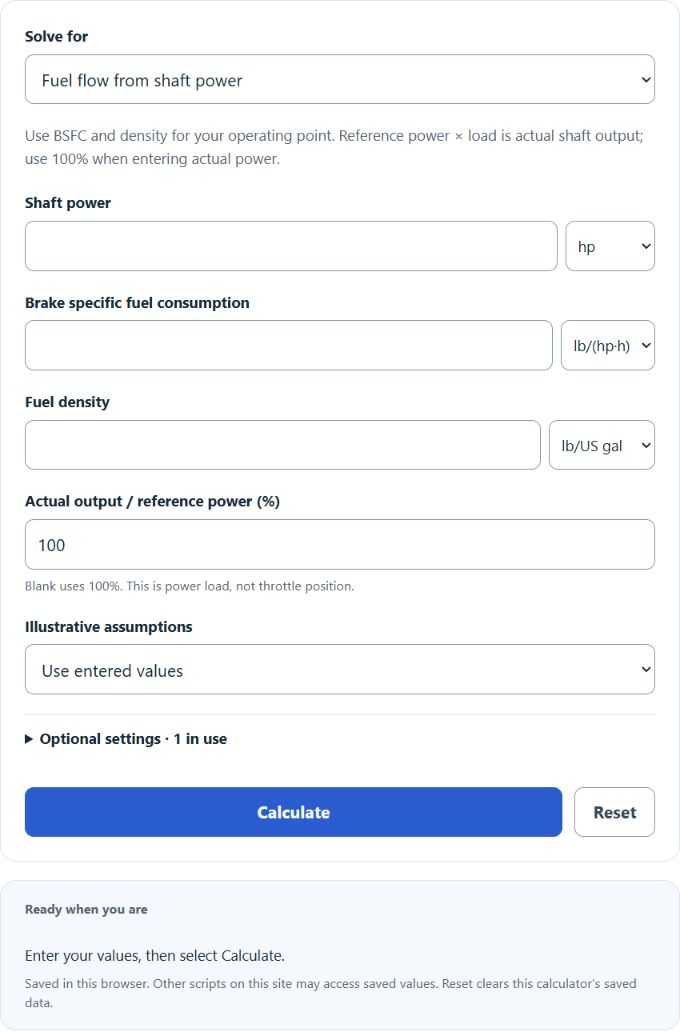
Calculate fuel flow in GPH from engine horsepower using BSFC, fuel density and load factor, plus fuel cost per hour and run time on your tank.
- All Unit Converters
- CC to HP Calculator
- WHP to HP Calculator
- CFM to HP Calculator
- RWKW to HP Calculator
- PSI to HP Calculator
- GPH to HP Calculator
- Hydraulic Flow to HP Calculator
hp To GPH Formula
Variables:
- GPH is the fuel flow rate in US gallons per hour.
- HP is reference mechanical brake/shaft horsepower (hp); HP × LF is actual shaft output. Use LF = 1 when entering actual measured output.
- BSFC is brake specific fuel consumption in lb/(hp·hr).
- LF is actual output divided by reference power, greater than 0 and no more than 1 (enter a percentage in the calculator). It is not throttle position.
- ρfuel is fuel density in lb/US gal.
There is no single universal conversion from horsepower to gallons per hour. However, you can estimate fuel flow from horsepower using BSFC, fuel density, and the operating load factor with the formula above.
| Horsepower (hp) | Fuel Flow (US GPH) |
|---|---|
| 1/16 | 0.0051 |
| ⅛ | 0.0101 |
| 1/6 | 0.0135 |
| ¼ | 0.0203 |
| ⅓ | 0.0270 |
| ⅜ | 0.0304 |
| ½ | 0.0405 |
| ⅝ | 0.0506 |
| ⅔ | 0.0540 |
| ¾ | 0.0608 |
| ⅞ | 0.0709 |
| 1 | 0.0810 |
| 1¼ | 0.1013 |
| 1⅓ | 0.1080 |
| 1½ | 0.1216 |
| 1¾ | 0.1418 |
| 2 | 0.1621 |
| 2½ | 0.2026 |
| 3 | 0.2431 |
| 4 | 0.3241 |
| *Estimates assume illustrative gasoline assumptions retained from this page (BSFC = 0.50 lb/(hp·hr), fuel density = 6.17 lb/US gal) at 100% load (LF = 1.0). This implies 1 hp ≈ 0.081 US GPH. | |
How to Calculate hp To GPH?
The following steps outline how to estimate fuel flow (GPH) from horsepower (or horsepower from fuel flow) using BSFC, fuel density, and load factor.
- First, determine the horsepower (hp) or the fuel flow rate (GPH).
- Next, enter operating-point BSFC and fuel density, then set actual output as a percentage of reference power. Optional preset values are illustrative assumptions; use manufacturer data or measurements for your engine.
- Then use the formula: GPH = (HP × BSFC × LF) ÷ ρfuel (or rearrange to solve for HP).
- After inserting the variables and calculating the result, check your answer with the calculator above.
Example Problem :
Use the following variables as an example problem to test your knowledge.
horsepower (hp) = 456 (assume gasoline BSFC = 0.50 lb/(hp·hr), fuel density = 6.17 lb/US gal, and load factor = 100%). Estimated fuel flow: GPH = (456 × 0.50 × 1.0) ÷ 6.17 ≈ 36.95 US GPH.
Other Modes and Optional Results
Reverse power uses flow × density ÷ BSFC; the entered load relates actual output to reference rating. Measured BSFC uses actual shaft power and measured flow at the same operating point. Pump flow uses shaft input, pressure rise and entered overall efficiency, separately from fuel burn; 100% is the ideal lossless default. Optional fuel amount and USD price produce cost/endurance under constant-flow assumptions; blank fields omit those results. Thermal efficiency is shown only when a lower heating value is supplied. Illustrative presets are examples, not engine specifications, and no cruise-throttle, fuel-reserve or voyage recommendation is inferred.
FAQs
What does GPH stand for in the context of this calculator?
GPH stands for gallons per hour. The primary fuel-flow result uses US gal/h; inputs may use US gal/h, L/h or Imperial gal/h, and converted results are retained in details. The separate pump mode reports hydraulic fluid flow, not fuel burn.
Why is it important to know the GPH for a given horsepower?
An estimated GPH helps with planning fuel needs and operating costs. Keep in mind horsepower alone does not determine GPH—fuel flow depends on engine efficiency (BSFC), fuel type, and load.
Can the HP to GPH formula be used for any type of engine?
The relationship here is an engineering estimate based on BSFC and fuel density, and it can be used broadly if you choose appropriate BSFC/density values for your engine and fuel. Manufacturer data or measurements are best for precise results.
Is there a way to improve the fuel efficiency reflected by the GPH value?
Yes. Improving efficiency typically means lowering BSFC for the same power output (or reducing required power): good maintenance, correct tuning, avoiding unnecessary load, and operating in an efficient RPM/load range can all reduce fuel use.