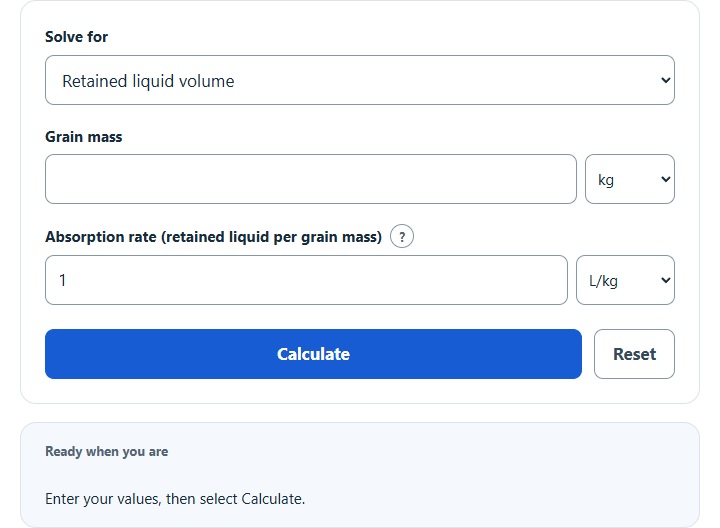
Calculate grain water absorption from grain weight and absorption rate, or total water absorbed by grain type in liters and gallons.
Related Calculators
- Dough Hydration Calculator
- Raw to Cooked Weight Conversion Calculator
- Refractometer Temperature Correction Calculator
- Sugar To Alcohol Calculator
- All Food and Cooking Calculators
Calculator Functions
| Function | What it does | What it requires |
|---|---|---|
| Retained liquid volume | Finds the liquid that stays in the spent grain after the mash is drained | Requires the grain mass and an absorption rate |
| Grain mass | Finds the grain mass that would hold back a known volume of liquid | Requires the retained liquid volume and an absorption rate |
| Measured retention rate | Finds the absorption rate of a brewing setup from a measured batch | Requires the retained liquid volume and the grain mass |
| By grain type / grain bill | Totals the retained liquid for up to five grains and gives the mass-weighted rate | Requires a type, a mass and a retention rate for each grain |
Grain mass is entered in kg or lb, volume in L or US gal, and rate in L/kg or US gal/lb. The rate is prefilled at 1.0 L/kg, which is about 0.12 US gal/lb. Results come in litres with US gallons alongside.
Grain Absorption Formulas
| GA | Liquid retained by the grain (L) |
| W | Dry grain mass (kg) |
| A | Absorption rate, the liquid retained per unit of grain (L/kg) |
A common homebrewing figure for the rate is half a US quart per pound of grain [1], which is 0.125 US gal/lb or about 1.04 L/kg. The prefilled 1.0 L/kg is that figure rounded down slightly.
Retained liquid volume
The formula above applies directly. A 5 kg grain bill at 1.0 L/kg holds back 5 × 1.0 = 5 L, or 1.32 US gal, so the mash needs that much extra water to reach the same volume in the kettle.
Grain mass
This is the main formula solved for mass. A loss of 5 L at 1.0 L/kg points to 5 ÷ 1.0 = 5 kg of grain. The rate must be above zero.
Measured retention rate
Measure the water that went into the mash and the wort that drained out. The difference is the retained liquid. If 5 kg of grain kept 4.5 L, the rate is 4.5 ÷ 5 = 0.9 L/kg, or 0.108 US gal/lb. One US gal/lb is 8.3454 L/kg.
By grain type / grain bill
Each grain’s mass is multiplied by its own rate and the results are added. The mass-weighted rate is the total liquid divided by the total mass. Every grain type starts at 1.0 L/kg, and choosing a type sets that row back to 1.0 L/kg whatever the grain, so a different rate has to be typed in afterwards. With 4 kg at 1.0 L/kg and 1 kg at 0.8 L/kg, the total is 4 + 0.8 = 4.8 L and the weighted rate is 4.8 ÷ 5 = 0.96 L/kg.
Limits of This Estimate
- Half a quart per pound is a general rule for a drained mash [1], not a property of a particular malt. Crush, mash thickness, how long the grain drains and whether a bag is squeezed all change it. These estimates are based on the best available data and estimations.
- The result covers liquid held in the grain only. Dead space under a false bottom, hoses, evaporation and trub losses are separate.
- A rate measured on the same equipment and process is more reliable than any typical figure. Use dry grain mass, and liquid measured after the same draining routine each time.
- All gallons are US gallons.
Sources
- John J. Palmer, How to Brew, Chapter 17, Getting the Wort Out: water retained by the grain, 0.5 quart per pound