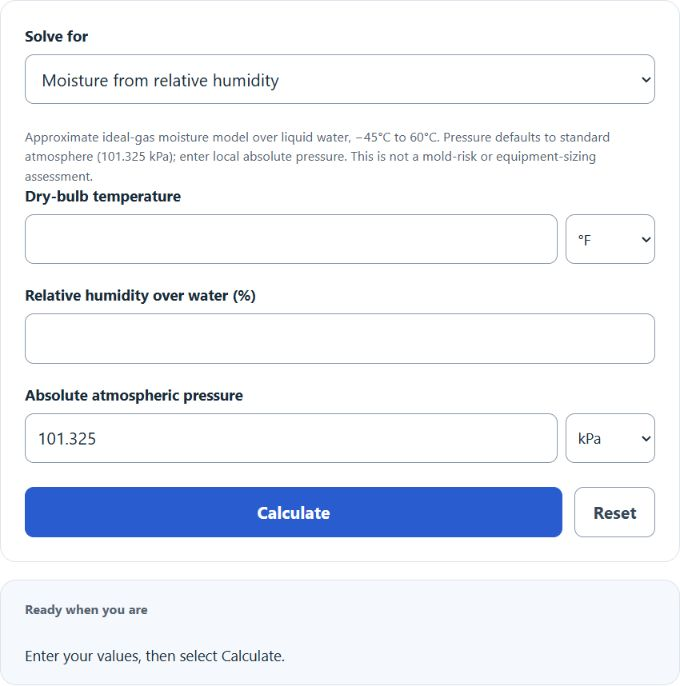
Calculate grains of moisture per pound of dry air from temperature, relative humidity, and pressure. Select Calculate for GPP, g/kg and an approximate water-based dew point.
Grains of Moisture Formula
The following formula calculates grains of moisture per pound of dry air from partial pressure, derived from the ideal gas law applied to a mixture of dry air and water vapor (Dalton's Law of Partial Pressures):
Variables:
- G = grains of moisture per pound of dry air (gr/lb)
- Pw = partial pressure of water vapor (same pressure unit as P)
- P = total barometric pressure (inHg)
- 0.621945 = water-vapor/dry-air molecular-mass ratio used by this model
- 7000 = grains per pound (exact conversion)
The humidity ratio W (lb water/lb dry air) is the core quantity; multiplying by 7,000 converts it to grains. ASHRAE Fundamentals (Chapter 1) defines this relationship as the primary psychrometric property for moisture content.
What is a Grain of Moisture?
A grain is a unit of mass equal to 1/7,000 of a pound (0.0648 grams). The unit predates SI and was historically the weight of a single grain of barley. In psychrometrics, grains per pound of dry air (gr/lb or GPP) is the preferred imperial unit for moisture content because it avoids small decimal humidity ratios. The equivalent SI unit is grams per kilogram of dry air (g/kg), where 1 g/kg = 7.0 gr/lb.
Unlike relative humidity, which changes with temperature while moisture content stays constant, grains per pound is an absolute measure. Air at 75°F/50% RH and air that has been cooled to 60°F (now near 80% RH) can contain the same number of grains per pound if no moisture was added or removed. This makes GPP the operationally correct variable for tracking actual moisture loads in HVAC systems.
Reference Values at Sea Level (29.92 inHg)
The table below shows grains of moisture per pound of dry air at standard atmospheric pressure, calculated from the Magnus saturation pressure equation. These values apply at sea level; see the altitude section for corrections.
| Temp (°F) | 30% RH | 40% RH | 50% RH | 60% RH | 70% RH | 80% RH |
|---|---|---|---|---|---|---|
| 60°F | 22.8 | 30.5 | 38.2 | 45.9 | 53.7 | 61.5 |
| 65°F | 27.3 | 36.4 | 45.6 | 54.9 | 64.2 | 73.5 |
| 70°F | 32.4 | 43.4 | 54.3 | 65.4 | 76.4 | 87.6 |
| 75°F | 38.4 | 51.4 | 64.5 | 77.6 | 90.8 | 104.1 |
| 80°F | 45.4 | 60.8 | 76.2 | 91.8 | 107.5 | 123.3 |
| 85°F | 53.5 | 71.6 | 89.9 | 108.3 | 126.9 | 145.7 |
| 90°F | 62.8 | 84.2 | 105.7 | 127.5 | 149.5 | 171.7 |
Highlighted rows are example conditions, not a comfort or moisture-safety standard. Values use 101.325 kPa absolute pressure and the calculator’s approximate water-based Magnus model.
At 75°F and 50% RH, the calculator gives about 64.5 gr/lb. GPP alone does not define comfort or mold risk. EPA moisture guidance recommends indoor RH below 60%, ideally 30–50% when possible; this is not a universal GPP threshold.
Effect of Altitude on Grains of Moisture
Because barometric pressure appears in the denominator of the grains formula (P - Pw), lower atmospheric pressure at higher elevations increases the calculated GPP for the same temperature and relative humidity. This is a common source of error when contractors apply sea-level psychrometric charts in high-altitude locations.
| Elevation | Barometric Pressure | GPP at 75°F / 50% RH | Difference vs. Sea Level |
|---|---|---|---|
| Sea Level (0 ft) | 29.92 inHg | 64.5 gr/lb | baseline |
| 1,000 ft | 28.86 inHg | 66.9 gr/lb | +2.4 gr/lb |
| 2,500 ft | 27.32 inHg | 70.7 gr/lb | +6.2 gr/lb |
| 5,000 ft (Denver, CO) | 24.89 inHg | 77.7 gr/lb | +13.3 gr/lb |
| 7,000 ft | 23.09 inHg | 83.9 gr/lb | +19.4 gr/lb |
Barometric pressures from the International Standard Atmosphere (ISA) model. GPP computed at constant 75°F dry bulb / 50% RH.
Lower absolute pressure increases GPP for the same temperature and RH. Both solve modes use the entered pressure. These moisture-ratio differences alone do not determine dehumidifier capacity or justify a percentage equipment-sizing adjustment.
Grains of Moisture in HVAC Latent Load Calculations
HVAC engineers use grains per pound directly in latent heat calculations. The standard field formula for latent cooling capacity is:
Where Q is latent capacity in BTU/hr, CFM is airflow, and delta-G is the change in grains per pound across the coil. The approximate 0.68 factor assumes standard air density near 0.075 lb/ft³, latent heat near 1,060 BTU/lb and 60 minutes/hour divided by 7,000 grains/lb; adjust for actual air properties. A coil removing 20 grains/lb from 1,200 CFM of air is handling 0.68 x 1,200 x 20 = 16,320 BTU/hr of latent load.
Short run cycles can limit moisture removal. Evaluate latent performance with airflow, entering and leaving conditions, equipment data and surface conditions; a single GPP threshold does not establish mold risk.
Grains of Moisture Formula
How to Calculate Grains of Moisture
- Determine the partial pressure of water vapor (Pw) in inHg. If you know temperature and RH, use Pw = (RH/100) x Ps, where Ps is the saturation pressure from the Magnus formula.
- Determine total barometric pressure (P) in inHg. Standard atmosphere is 101.325 kPa (about 29.92 inHg); use measured local absolute pressure when available.
- Substitute into G = 0.621945 x (Pw / (P - Pw)) x 7000.
- Verify your result against the reference table above for the relevant temperature and RH combination.
Example: At 75°F / 50% RH and 101.325 kPa, ps ≈ 2.956790 kPa. With e = 0.5 × ps, G = 7000 × 0.621945 × e / (101.325 − e) ≈ 64.463 gr/lb. This is an approximate model result, not a universal indoor design value.