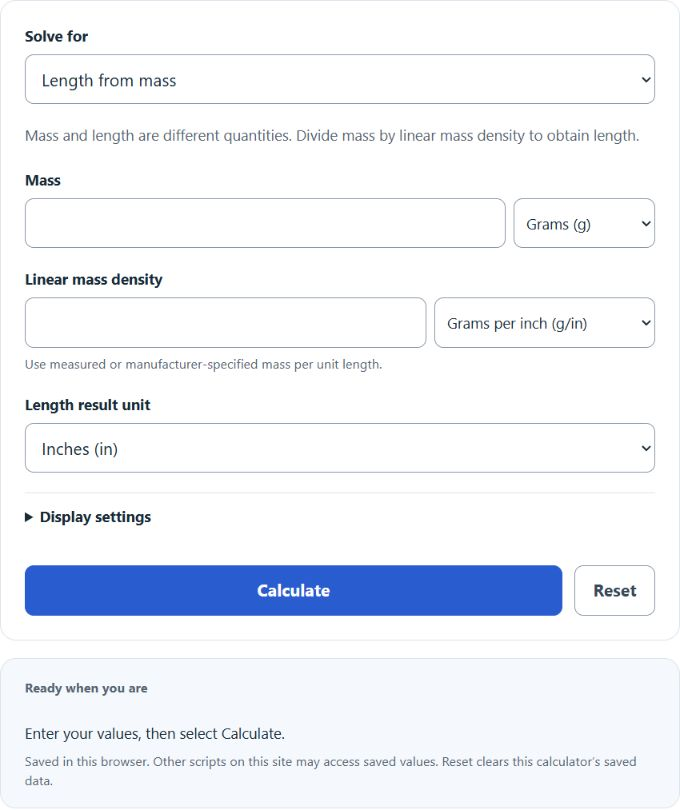
Convert grams to length in inches using linear mass density, solve grams from length, or calculate cubic inches from mass and material density.
- All Unit Converters
- Grams to Gallons Calculator
- Grams to Volume Calculator
- Mass to Volume Calculator
- Specific Gravity to Density Calculator
- Weight to Density Calculator
Grams To Inches Formula
For length, use L = M / λ, where M is mass in grams and λ is linear mass density in grams per inch; the result L is in inches. For reverse calculation, M = L × λ. For volume, the following formula uses material density in grams per cubic inch and returns cubic inches, not linear inches.
Variables:
- V is the volume in cubic inches (in³)
- M is the mass in grams (g)
- D is the density of the material in grams per cubic inch (g/in³)
To calculate the volume in cubic inches, divide the mass in grams by the density of the material in grams per cubic inch. Please note that this formula is only applicable if the density of the material is known and is constant.
| Grams (g) | Kilograms (kg) | Pounds (lb) |
|---|---|---|
| 1 | 0.001 | 0.002 |
| 5 | 0.005 | 0.011 |
| 10 | 0.010 | 0.022 |
| 20 | 0.020 | 0.044 |
| 25 | 0.025 | 0.055 |
| 28.35 | 0.028 | 0.063 |
| 30 | 0.030 | 0.066 |
| 50 | 0.050 | 0.110 |
| 75 | 0.075 | 0.165 |
| 100 | 0.100 | 0.220 |
| 125 | 0.125 | 0.276 |
| 150 | 0.150 | 0.331 |
| 200 | 0.200 | 0.441 |
| 250 | 0.250 | 0.551 |
| 300 | 0.300 | 0.661 |
| 454 | 0.454 | 1.001 |
| 500 | 0.500 | 1.102 |
| 750 | 0.750 | 1.653 |
| 1000 | 1.000 | 2.205 |
| 2000 | 2.000 | 4.409 |
| * Rounded to 3 decimals. Conversions: 1 kg = 1000 g; 1 lb ≈ 453.592 g (1 g ≈ 0.00220462 lb). | ||
What is Grams To Inches?
Grams measure mass and inches measure length, so there is no direct conversion. For a uniform cord, wire or strip, a known linear mass density (mass per length) lets you calculate length: 100 g at 5 g/in is 20 in. Material density (mass per volume) instead gives a volume, such as cubic inches; it does not determine length without cross-sectional information.
How to Calculate Grams To Inches?
The following steps apply to the Volume from mass mode using V = M / D. For Length from mass, divide mass by linear mass density; for Mass from length, multiply length by linear mass density.
- First, determine the mass in grams (M).
- Next, determine the density of the material in grams per cubic inch (D).
- Next, gather the formula from above = V = M / D.
- Finally, calculate the volume in cubic inches (V).
- After inserting the variables and calculating the result, check your answer with the calculator above.
Example Problem :
Use the following variables as an example problem to test your knowledge.
mass in grams (M) = 150
density of the material in grams per cubic inch (D) = 0.5; the volume is 150 / 0.5 = 300 in³. Select Volume from mass and enter the density in g/in³.