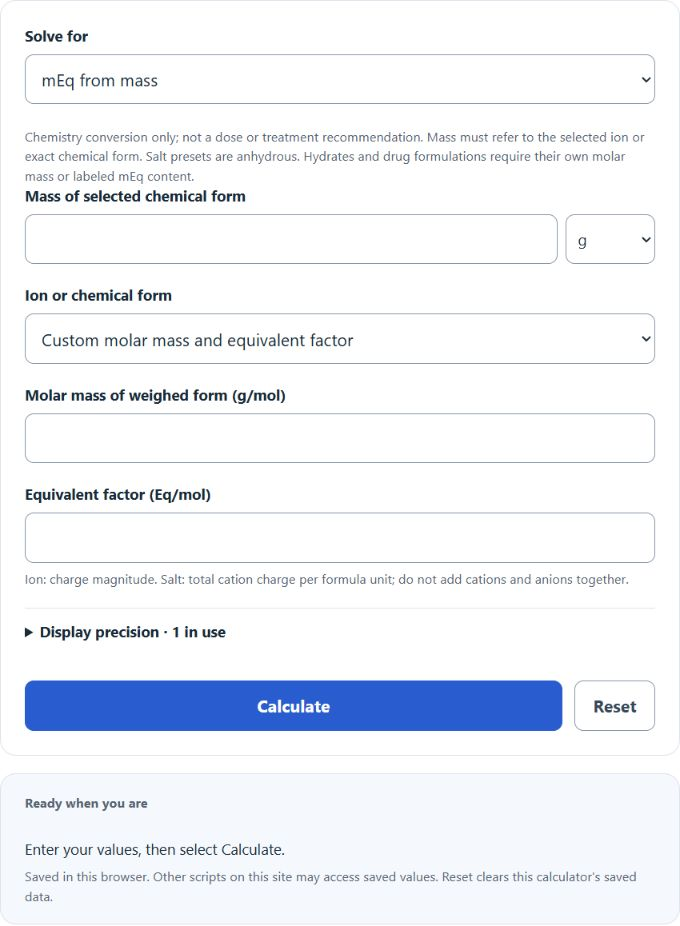
Calculate milliequivalents from grams, valence, and molecular weight, or convert between mg, mEq, and mg/L with unit support for labs.
Related Calculators
- kJ/mol To kJ/kg Calculator
- g/mol To ppm Calculator
- mg/m3 to ppm Converter
- ng/mL Calculator
- All Unit Converters
Grams To mEq Formula
The following formula is used to calculate the conversion from grams to milliequivalents (meq).
Variables:
- meq is the amount in milliequivalents
- g is the amount in grams
- V is the charge factor: |z| for an ion, or the total positive charge per salt formula unit (equal to the magnitude of its total negative charge)
- MW is the molar mass (g/mol) of the exact ion or salt form entered, including water of hydration
Divide grams by the matching molar mass to obtain moles, then multiply by the charge factor and 1000 to obtain mEq. For an ion, use its charge magnitude. For a salt, count the total charge on one side only: Na2SO4 supplies two Na+ ions, so its factor is 2. Do not add cation and anion equivalents together. Use the exact anhydrous or hydrated form that matches the mass.
| Grams (g) | Milliequivalents (mEq) |
|---|---|
| 0.01 | 0.171 |
| 0.025 | 0.428 |
| 0.05 | 0.856 |
| 0.1 | 1.711 |
| 0.2 | 3.422 |
| 0.25 | 4.278 |
| 0.5 | 8.556 |
| 0.75 | 12.834 |
| 1 | 17.112 |
| 1.5 | 25.667 |
| 2 | 34.223 |
| 2.5 | 42.779 |
| 3 | 51.335 |
| 4 | 68.446 |
| 5 | 85.558 |
| 7.5 | 128.337 |
| 10 | 171.116 |
| 12.5 | 213.895 |
| 15 | 256.674 |
| 20 | 342.231 |
| * Rounded to 3 decimals. Assumes Sodium Chloride (NaCl), valence = 1, molecular weight = 58.44 g/mol. Formula: mEq = g x (1000 x valence / MW). Equivalences: 1 g = 17.112 mEq, 58.44 mg = 1 mEq. | |
What is Grams To mEq?
A milliequivalent (mEq) expresses an amount of ions weighted by charge magnitude. One mmol of a monovalent ion is 1 mEq; one mmol of a divalent ion is 2 mEq. A salt conversion also depends on its formula and exact molar mass. Equal mEq values describe equal amounts of charge, not equal biological effects.
Electrolyte labels and laboratory reports may use mass units, mmol, mEq, or concentrations. Match the substance, chemical form, and units before converting. A unit conversion does not determine a medication dose or interpret a laboratory result; use the exact product labeling and the treating clinician’s instructions.
Electrolyte mEq Quick-Reference Table
The table below lists ions and specified pure salt forms with molar mass, charge factor, milligrams per mEq, and mEq per gram. These are mathematical conversions for the forms named, not universal medication strengths. Hydrated formulations can differ.
| Substance | MW (g/mol) | Charge factor | mg per 1 mEq | mEq per 1 g |
|---|---|---|---|---|
| Sodium (Na+) | 22.99 | 1 | 23.0 | 43.5 |
| Potassium (K+) | 39.10 | 1 | 39.1 | 25.6 |
| Calcium (Ca2+) | 40.08 | 2 | 20.0 | 49.9 |
| Magnesium (Mg2+) | 24.31 | 2 | 12.2 | 82.3 |
| Chloride (Cl-) | 35.45 | 1 | 35.5 | 28.2 |
| Bicarbonate (HCO3-) | 61.02 | 1 | 61.0 | 16.4 |
| Hydrogen phosphate (HPO42-) | 95.98 | 2 | 48.0 | 20.8 |
| Sodium Chloride (NaCl) | 58.44 | 1 | 58.4 | 17.1 |
| Potassium Chloride (KCl) | 74.55 | 1 | 74.6 | 13.4 |
| Calcium Chloride (CaCl2, anhydrous) | 110.98 | 2 | 55.5 | 18.0 |
| Calcium Gluconate (anhydrous) | 430.37 | 2 | 215.2 | 4.65 |
| Magnesium Sulfate (MgSO4, anhydrous) | 120.37 | 2 | 60.2 | 16.6 |
| Sodium Bicarbonate (NaHCO3) | 84.01 | 1 | 84.0 | 11.9 |
| Sodium Sulfate (Na2SO4, anhydrous) | 142.04 | 2 | 71.0 | 14.1 |
| Magnesium Chloride (MgCl2, anhydrous) | 95.21 | 2 | 47.6 | 21.0 |
| For an ion, the factor is |z|. For a salt, use total cation charge per formula unit, equal to total anion charge magnitude; do not sum both sides. Formula: mEq per gram = (charge factor x 1000) / molar mass. Match the exact salt and hydrate form. | ||||
Interpreting Serum Electrolyte Units
Use the units and reference interval supplied by the testing laboratory. Total and ionized calcium are different measurements, and converting units does not convert one test into the other. Abnormal results require clinical context; this calculator does not set treatment or critical-value thresholds.
| Electrolyte | Reference interval | Low result | High result |
|---|---|---|---|
| Sodium (Na+) | Use the lab report’s interval and units | Use the laboratory’s alert limit | Use the laboratory’s alert limit |
| Potassium (K+) | Use the lab report’s interval and units | Use the laboratory’s alert limit | Use the laboratory’s alert limit |
| Chloride (Cl-) | Use the lab report’s interval and units | Use the laboratory’s alert limit | Use the laboratory’s alert limit |
| Bicarbonate (HCO3-) | Use the lab report’s interval and units | Use the laboratory’s alert limit | Use the laboratory’s alert limit |
| Calcium (total or ionized) | Match the exact calcium test and units | Use the laboratory’s alert limit | Use the laboratory’s alert limit |
| Magnesium (Mg2+) | Use the lab report’s interval and units | Use the laboratory’s alert limit | Use the laboratory’s alert limit |
| Use the testing laboratory’s reference interval and alert limits. Follow its or the clinician’s instructions for flagged results. A mass-to-mEq conversion alone does not determine treatment. Ionized and total calcium. | |||
IV Fluid Electrolyte Composition
Intravenous fluids are formulated with electrolyte concentrations measured in mEq/L. Selecting the correct fluid depends on matching the patient’s electrolyte deficit to the solution’s composition. The following table shows the electrolyte content of the most commonly administered IV fluids in U.S. hospitals.
| IV Fluid | Na+ | K+ | Ca2+ | Cl- | Buffer | mOsm/L |
|---|---|---|---|---|---|---|
| 0.9% NaCl (Normal Saline) | 154 | 0 | 0 | 154 | 0 | 308 |
| Lactated Ringer’s | 130 | 4 | 3 | 109 | 28 lactate | 273 |
| 0.45% NaCl (Half Normal Saline) | 77 | 0 | 0 | 77 | 0 | 154 |
| D5W + 0.45% NaCl | 77 | 0 | 0 | 77 | 0 | 432 |
| PlasmaLyte A | 140 | 5 | 0 | 98 | 50 (acetate + gluconate) | 294 |
| 3% NaCl (Hypertonic Saline) | 513 | 0 | 0 | 513 | 0 | 1026 |
| PlasmaLyte A contains 27 mEq/L acetate and 23 mEq/L gluconate as buffers. Lactated Ringer’s lactate is metabolized by the liver into bicarbonate. | ||||||
Specified Salt Form Conversions
Salt mass includes the counterion and, for a hydrate, water of crystallization. The conversions below apply only to the named forms. Medication labels can state strength on a different basis; use the labeled ion content and exact product instructions rather than treating these conversions as doses.
| Specified salt form | Active Ion | mg of Salt per 1 mEq | mEq per 1 g of Salt | Medication check |
|---|---|---|---|---|
| Potassium Chloride (KCl) | K+ | 74.6 | 13.4 | Use exact product label |
| Potassium Bicarbonate (KHCO3) | K+ | 100.1 | 10.0 | Use exact product label |
| Potassium Citrate Monohydrate | K+ | 108.1 | 9.25 | Confirm label strength basis |
| Sodium Chloride (NaCl) | Na+ | 58.4 | 17.1 | Use exact product label |
| Sodium Bicarbonate (NaHCO3) | Na+ | 84.0 | 11.9 | Use exact product label |
| Calcium Gluconate (anhydrous) | Ca2+ | 215.2 | 4.65 | Use labeled calcium content |
| Calcium Chloride (CaCl2, anhydrous) | Ca2+ | 55.5 | 18.0 | Injection may use dihydrate |
| Magnesium Sulfate (MgSO4, anhydrous) | Mg2+ | 60.2 | 16.6 | Injection may use heptahydrate |
| Anhydrous values must not substitute for hydrated products. The cited calcium chloride label uses dihydrate: 100 mg/mL supplies a rounded 1.4 mEq calcium/mL. The cited magnesium sulfate label uses heptahydrate: 500 mg/mL supplies 4.06 mEq magnesium/mL. Follow the exact product’s labeling and prescribing instructions; this table gives no doses. | ||||
mEq vs mmol: U.S. and International Units
For a specified ion, mEq = mmol x |z|. Thus 1 mmol Na+ is 1 mEq, while 1 mmol Ca2+ or Mg2+ is 2 mEq. Phosphate species differ: H2PO4- has charge magnitude 1, HPO42- has magnitude 2, and PO43- has magnitude 3. For salt mass conversions, use total charge on one side per formula unit. Check the actual label or laboratory report rather than assuming a regional unit convention.
Soil Science and Agricultural Applications
Beyond clinical medicine, the grams-to-mEq conversion is foundational in soil chemistry and agricultural science. Cation exchange capacity (CEC), a measure of a soil’s ability to hold positively charged nutrients, is reported in mEq per 100 grams of soil (or the equivalent unit cmol(+)/kg). When a soil test reports CEC of 25 mEq/100g, it means 100 grams of that soil can hold 25 milliequivalents of total cations: a mix of Ca2+, Mg2+, K+, Na+, and H+. Fertilizer application rates for potassium and calcium are calculated by converting the target mEq/100g increase back to grams of the actual fertilizer salt per hectare. A soil with 60% base saturation and a CEC of 20 mEq/100g holds 12 mEq/100g of base cations; raising calcium saturation by 10% requires adding 2 mEq/100g of Ca2+, which equals 0.040 g of elemental calcium per 100g of soil (using MW 40.08 and valence 2).
Water Chemistry and Environmental Testing
Water hardness, alkalinity, and ion balance in aquatic systems are all expressed in mEq/L. Total hardness is the sum of calcium and magnesium in mEq/L (often converted to mg/L as CaCO3 for reporting, where 1 mEq/L of hardness equals 50 mg/L as CaCO3). Drinking water standards, aquaculture management, and wastewater treatment all require converting measured grams or milligrams of dissolved minerals to mEq to assess charge balance. An ion balance error greater than 5%, calculated as the difference between total cation mEq/L and total anion mEq/L divided by their sum, indicates an analytical error in the water sample. This quality control check depends entirely on accurate gram-to-mEq conversions for every ion measured.