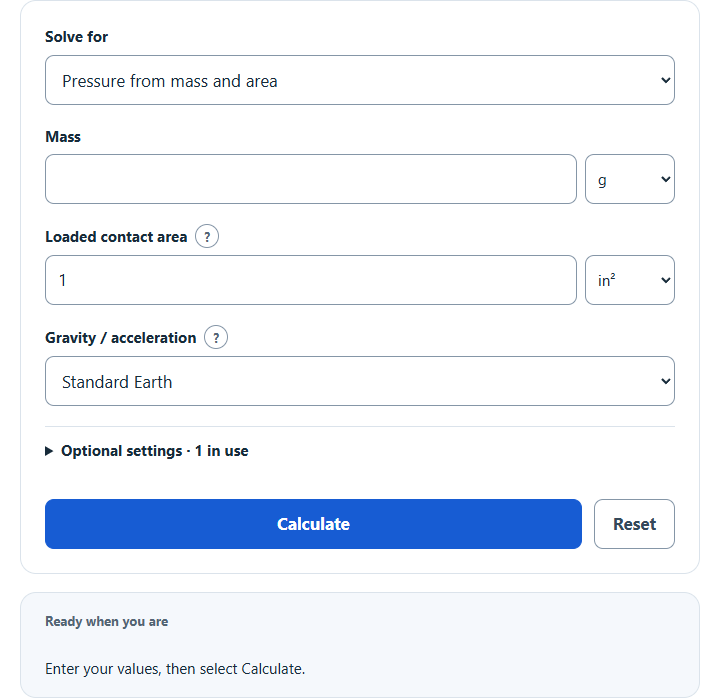
Convert grams to PSI by entering a mass and the area it presses on (1 in² by default), or convert PSI back to grams and between pressure units.
- All Unit Converters
- mm to PSI Calculator
- Newton to PSI Calculator
- PSI to PSF Calculator
- PSI to Force Calculator
- Weight to Pressure Calculator
Calculator Functions
| Function | What it does | What it requires |
|---|---|---|
| Pressure from mass and area | Converts a mass resting on a surface into the average pressure under it | Requires the mass, the loaded contact area and the gravity setting |
| Mass from pressure and area (PSI to grams) | Finds the mass whose weight produces a given pressure on a given area | Requires the pressure, the loaded contact area and the gravity setting |
| Convert pressure units | Converts a pressure between PSI, gf/cm², kgf/cm², Pa, kPa and bar | Requires the pressure and the output unit |
The contact area starts at 1 in², so a mass in grams converts as if it rests on one square inch. Mass can be entered in g, kg, lb or oz and area in in², cm², ft² or m². Gravity is Standard Earth (9.80665 m/s²), Moon (1.62 m/s²), Mars (3.71 m/s²) or a custom acceleration. Every result is also listed in the other pressure units.
Grams to PSI Formulas
| P | Average pressure (Pa) |
| m | Mass (kg) |
| g | Acceleration of gravity (m/s²) |
| A | Loaded contact area (m²) |
Grams measure mass and PSI measures pressure, so grams to PSI has no single answer: the result depends on the area the weight is spread over. The pressure in pascals is divided by 6,894.757 to give PSI [1]. At standard gravity this reduces to PSI = grams ÷ 453.59237 ÷ area in in², because one pound of mass on one square inch is 1 PSI.
Pressure from mass and area
500 g on 1 in² at standard gravity is 500 ÷ 453.59237 = 1.102311 PSI. Spread over 10 in², the same 500 g gives 0.110231 PSI. On the Moon setting, 500 g on 1 in² gives 0.182095 PSI.
| Grams on 1 in² | PSI |
|---|---|
| 0.1 | 0.000220 |
| 0.5 | 0.001102 |
| 1 | 0.002205 |
| 2 | 0.004409 |
| 5 | 0.011023 |
| 10 | 0.022046 |
| 20 | 0.044092 |
| 25 | 0.055116 |
| 30 | 0.066139 |
| 50 | 0.110231 |
| 75 | 0.165347 |
| 100 | 0.220462 |
| 150 | 0.330693 |
| 200 | 0.440925 |
| 250 | 0.551156 |
| 300 | 0.661387 |
| 500 | 1.102311 |
| 750 | 1.653467 |
| 1000 | 2.204623 |
| 2000 | 4.409245 |
The table uses standard gravity and a contact area of 1 in². For another area, divide the PSI value by the area in square inches.
Mass from pressure and area (PSI to grams)
This is the main formula solved for mass. 1 PSI on 1 in² at standard gravity is 453.59237 g, which is one pound, and 5 PSI on 2 in² is 4,535.9237 g. The result is also given in kg, lb and oz.
Convert pressure units
Each unit has a fixed size in pascals: 1 gf/cm² is 98.0665 Pa, 1 kgf/cm² is 98,066.5 Pa, 1 bar is 100,000 Pa and 1 PSI is 6,894.757 Pa [1]. 1,000 gf/cm² is therefore 98,066.5 ÷ 6,894.757 = 14.223343 PSI. No mass, area or gravity setting is involved, and a gauge reading stays a gauge reading.
Limits of This Estimate
- The result is the average pressure of a weight spread evenly over the contact area. Real contact stress depends on how the load is distributed and on the shape of the surfaces.
- Gram-force and kilogram-force units are defined with standard gravity, 9.80665 m/s² [1], whichever gravity setting is selected.
- The Moon and Mars settings are approximations. NASA lists 1.62 m/s² for the Moon [2] and, for Mars, 3.69 m/s² at the equator and 3.73 m/s² as the mean [3]. The Mars setting of 3.71 m/s² lies between those two figures.
- The unit conversion does not change a gauge pressure into an absolute pressure or add atmospheric pressure.
Sources
- National Institute of Standards and Technology, Guide for the Use of the International System of Units (SP 811), Appendix B.9: pressure, mass and area conversion factors and standard gravity
- NASA Goddard Space Flight Center, Moon Fact Sheet: surface gravity of the Moon
- NASA Goddard Space Flight Center, Mars Fact Sheet: surface gravity of Mars